

I’ve spent enough time around dive boats to know that the right dive light changes the whole experience. Murky water at 60 feet, a quiet night dive over a wreck, a buddy who needs a signal across a coral head, the flashlight in my hand needs to keep up without complaint. I’ve put together this list for divers who want reliable illumination for real underwater adventures.
An Overview Of The Picks
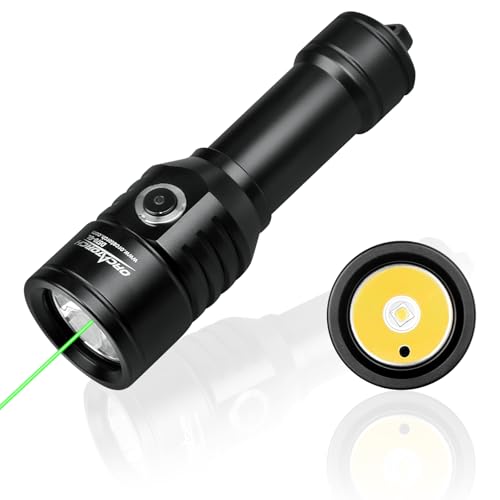
ORCATORCH D570-GL 2.0 2-in-1 Scuba Dive Light

ORCATORCH ZD710 MK2 Zoomable Scuba Dive Light

Blue Reef 2000 Lumens Scuba Dive Light

Blue Reef 1200 Lumens Compact Scuba Dive Light

ORCATORCH D530 1500 Lumens Scuba Dive Light
More Details On Our Top Picks
The D570-GL 2.0 solves a problem most recreational lights ignore: talking to your buddy underwater. It pairs a 1500-lumen white beam with a separate Class IIIA green laser pointer rated under 5mW, which is the eye-safe category divers rely on for visible signal lines that punch through low-vis water. For dive instructors running group tours, the green dot becomes a silent way to point out a cleaning station or signal “surface here” without waving arms.
The white side delivers an 8-degree concentrated beam, narrow enough to read a gauge at arm’s length or inspect a wreck detail across a swim. Compared to the broader flood designs further down this list, the D570-GL trades width for distance and precision. It feels less like a video light and more like a tool for divers who need to direct attention, not just brighten a scene.
The Good Stuff
- Green signal beam rated for underwater visibility up to roughly 1000m in clear conditions, giving dive teams a long-range signaling option that white light can’t match.
- Dual-beam layout means one torch covers both navigation and signaling, eliminating the need to pack a separate pointer.
- Tight 8-degree white beam cuts through murky water and reaches into wreck holes where wider floods wash out detail.
- 1500-lumen output handles recreational depth ranges and short technical penetrations without strain.
- Compact body fits standard dive light mounts and Goodman clips without extra adapters.
Honest Caveats
- Green beam is Class IIIA, useful for signaling but not a substitute for a full primary light in low-vis conditions.
- The narrow white beam can feel limiting when filming wide reef scenes where a flood beam would serve better.
- Owners commonly report the dual controls take a few dives to learn by feel in cold water with gloves.
Who It Suits Best
Dive instructors, team leaders, and any diver who regularly needs to signal a buddy or class across distance will find the D570-GL 2.0 genuinely useful.
Consider Something Else When
Solo recreational divers wanting a single bright flood for photography should look at the ORCATORCH ZD710 MK2 instead.
The ZD710 MK2 is built around one idea: one light, every beam shape. A stepless zoom collar adjusts the angle anywhere between 4 degrees and 72 degrees, which means a single twist shifts the beam from a tight throw used in cave passages to a wide flood that lights up a coral wall for photos. That kind of range used to require carrying two lights, and frankly most divers don’t want the bulk.
The MK2 version improves on earlier models with a smoother beam edge and a better-balanced hotspot, which matters when you’re aiming at marine life without overblowing the subject. At 212,500 candela, the throw distance competes with dedicated spotlights in this list. Underwater photographers appreciate the flood mode for even coverage, while night divers lean on the narrow setting for navigation.
Features That Help
- 4 to 72 degree zoom range lets one light handle spot navigation, wreck exploration, and wide-angle video without swapping gear.
- Smoother beam profile with a balanced hotspot reduces glare on reflective surfaces like fish scales and metal fixtures.
- High candela rating supports long throw distance, useful for signalling at depth or checking ahead in low-vis dives.
- Single rotary control is glove-friendly once the muscle memory sets in.
Points To Keep In Mind
- The zoom mechanism introduces more moving parts than fixed-beam lights, a common trade-off for adjustability.
- Heavier than compact backup lights like the Blue Reef 1200-lumen model below.
- At maximum flood, the beam loses the punch that tighter spotlights offer for cave work.
Feature Snapshot
Made For
Underwater photographers and divers who split their time between cave penetrations and wide reef filming will appreciate the dual personality of the ZD710 MK2.
Reach For A Different Pick When
Divers who never shoot video and just want maximum lumen output on a single setting should consider the Blue Reef 2000 Lumens Scuba Dive Light instead.
The Blue Reef 2000-lumen light is a high-output workhorse. Constant 2000-lumen output, not a momentary turbo that drops after 60 seconds, means the brightness stays steady through a full dive. The claimed throw reaches 390 meters in lab conditions, though real-world performance on a dark reef wall still feels impressively far.
Runtime splits into two useful ranges: roughly two hours at full 2000 lumens, and up to five hours on lower settings. USB-C charging removes the need for proprietary cables, which is one of those quiet upgrades that matters after the third dive trip. Rated waterproof to 100 meters, it covers recreational and most technical depths without concern.
Standout Benefits
- Sustained 2000-lumen output means consistent brightness throughout the dive rather than a stepped-down turbo curve.
- USB-C recharging works with the same cable most travelers already carry.
- Up to 5-hour runtime on lower settings supports longer night dives or multi-dive days.
- 100m waterproof rating covers recreational diving and most tech-level depths.
Trade Offs
- Higher output drains the battery faster at full power than mid-range lights like the ORCATORCH D530.
- Tighter beam profile is great for distance but narrower than what photographers typically want for wide shots.
- Battery cells commonly benefit from partial discharges during storage, a typical lithium-ion care note.
Key Specs
Right Fit For
Deep recreational divers and night-diving enthusiasts who want maximum sustained brightness and reach will find this Blue Reef model well matched to their needs.
A Better Fit Elsewhere
Travel-focused divers who prioritize smaller size and lighter weight should look at the Blue Reef 1200 Lumens Compact Scuba Dive Light.
Not every dive needs a tank-sized primary. The Blue Reef 1200 delivers constant 1200-lumen output in a body small enough to forget in a BCD pocket, making it a strong daily driver or backup option. I think of this as the “second light” that lives on a hose clip, always there when the primary floods or the GoPro battery dies mid-trip.
Runtime is where compact lights tend to win, and this one stretches to about 5 hours on low, longer than several brighter competitors in this list. USB-C charging, 100m waterproof rating, and a travel-ready form factor make it appealing for divers packing light or flying with limited baggage weight.
What Pays Off
- Compact form factor slips into BCD pockets, clips, and travel bags without bulk.
- Up to 5-hour runtime on lower settings handles long night dives and multi-dive days.
- USB-C charging matches modern cables and power banks divers already carry.
- 1200-lumen constant output handles most recreational illumination tasks comfortably.
Small Caveats
- Lower max output means less throw distance than the Blue Reef 2000-lumen model.
- Smaller body can be harder to grip with thick dry gloves in very cold water.
Best Suited To
Traveling divers and anyone wanting a reliable backup light that doubles as a capable primary for shallow recreational dives.
Skip It When
Divers who regularly explore deep wrecks or caves and need the throw distance of a high-output primary should pick the ORCATORCH D530 instead.
The ORCATORCH D530 is the narrow-beam specialist on this list. A 7-degree focused beam delivers claimed visibility out to roughly 291 meters in clear conditions, with a 6500K cold white tint that helps divers spot marine life and read details through the gloom. Cold white light renders colors closer to daylight than warm tints, which can help identify coral species and find critters hiding in shadows.
For wreck divers peering into wheelhouses and cave divers checking ahead through silty passages, that narrow throw is the whole point. Compare that to the ZD710 MK2’s zoom flexibility, and the D530 leans harder into fixed-spot territory. It’s a purpose-built tool rather than an all-rounder, and that focus is exactly what some divers want.
The Case For It
- 7-degree narrow beam reaches up to roughly 291m for navigation and exploration in low-vis water.
- 6500K cold white tint renders colors close to natural daylight, useful for species identification.
- Compact build fits standard dive light mounts and Goodman clips.
- 1500-lumen output balances reach with usable flood spill for situational awareness.
- Simple single-button interface is glove-friendly and easy to teach to new divers.
Less Ideal Details
- Fixed narrow beam does not suit wide-angle underwater photography.
- Single-mode design lacks the lower-power runtime extension that step-down lights provide.
Feature Rundown
Whose Shelf It Belongs On
Wreck divers, cave explorers, and divers who prioritize long throw over flood width will find the D530’s narrow beam exactly fits their style.
Swap It Out When
Photographers and divers who want one light that adjusts from spot to flood should reach for the ORCATORCH ZD710 MK2 Zoomable Scuba Dive Light.
What Matters Most Before Choosing Scuba Diving Flashlights
Beam Type and Throw Distance
A dive light’s beam shape decides what the light is actually useful for. Spot beams (narrow angles under 10 degrees) throw light far for navigation, wreck exploration, and signaling, while flood beams spread illumination wide for photography and reef-watching. Some lights, like the ORCATORCH ZD710 MK2, offer adjustable beams that handle both. Throw distance, measured in meters or candela, tells you how far the usable beam reaches in clear water; longer throw helps in low-vis conditions and deep dives.
Depth Rating and Build Quality
Every dive light has a maximum depth rating, and exceeding it risks flood damage. Recreational divers typically need 30 to 40 meters, while tech divers push past 100 meters. Look for lights rated beyond your deepest planned dive for a safety margin. Aluminum bodies with type-anodized finishes resist corrosion, and double O-ring seals at the battery cap and switch add redundancy against leaks.
Runtime and Charging Style
Runtime at full output determines how long the light stays useful during a dive, and runtime at lower settings matters for long night dives or multi-dive days. USB-C charging has become standard on modern lights, which simplifies travel because the same cable handles phones and cameras. Lithium-ion batteries benefit from partial state-of-charge storage and avoiding full depletion, so plan to top off between trips.
Mounting and Handling
Dive lights need to attach somewhere secure, whether on a Goodman clip, hose mount, or wrist strap. Compact lights disappear into pockets and clips but can be harder to grip with thick gloves. Heavier lights with longer bodies feel more substantial but add bulk. Match the size and mounting style to your typical dive profile.
Key Considerations Across These Picks
Pitfalls Shoppers Hit
The most common mistake is choosing a light based purely on lumen count. Real underwater usefulness depends on beam shape, color temperature, and how long the light holds that output. A 2000-lumen flood can feel weaker than a 1500-lumen spot in murky water because flood beams scatter. Another trap is ignoring depth rating: a light rated to 30 meters is unsafe for deep dives even if the lumen number looks attractive. Match the light to your actual depth, visibility, and dive style, not the biggest number on the box.
The Upgrade Payoff
Higher-tier dive lights earn their cost through better beam quality, sustained output without aggressive step-downs, and construction that survives years of saltwater abuse. A premium zoomable light replaces two fixed-beam lights, simplifying your kit. Premium models also tend to use tougher anodized aluminum and more reliable O-ring seals, reducing the chance of a flooded light ending a dive day early. For divers logging multiple trips per year, the upgrade pays back in durability and fewer replacements.
Frequently Asked Questions
What lumen output do I need for scuba diving?
For most recreational dives in clear tropical water, 800 to 1500 lumens handles primary illumination. Night dives, cave exploration, and low-vis conditions benefit from 1500+ lumens with a focused beam.
How deep can scuba diving flashlights go?
Depth ratings vary by model. Recreational lights typically handle 30 to 60 meters, while technical-rated lights like several in this list reach 100 meters or beyond. Always check the rating before diving deeper than the listed limit.
Should I choose a spot beam or flood beam?
Spot beams reach farther for navigation and exploration, while flood beams cover wider areas for photography and reef watching. Zoomable lights offer both in one body. Pick based on your primary dive activity.
How long does a scuba dive light battery last?
Runtime depends on output level. Most lights run 1.5 to 3 hours at full brightness and stretch to 4 to 6 hours on lower settings. USB-C rechargeable models let you top off between dives easily.
Can I use a regular flashlight for scuba diving?
Regular flashlights are not designed for underwater pressure and will likely flood or fail at depth. Dive-specific lights feature sealed O-rings, depth-rated bodies, and corrosion-resistant materials suited for saltwater immersion.