

Programmable light switches help control your home lighting on a schedule, reduce wasted energy, and give you manual control anytime.
They can run on simple daily timers or connect to Wi‑Fi for app-based control.
Some are built for easy replacement, while others offer more advanced features like sunrise and sunset settings.
This guide covers seven standout options that fit different homes and routines.
| Southwire Woods In-Wall 7-Day Digital Timer |  | Best Overall | Timer Type: In-wall digital | Schedule Control: 7 on/off sequences | Wiring: Line/neutral/load | VIEW LATEST PRICE | Read Our Analysis |
| Honeywell PLS750C1000 Timer Switch with Sunrise Sunset Single or 3 Way |  | Best for Sunrise/Sunset | Timer Type: Sunrise/sunset | Schedule Control: 7-day scheduling | Wiring: 3-way compatible | VIEW LATEST PRICE | Read Our Analysis |
| BN-LINK WiFi Smart In-Wall Light Switch | Best Smart Switch | Timer Type: Wi-Fi smart | Schedule Control: Daily on/off | Wiring: Neutral required | VIEW LATEST PRICE | Read Our Analysis | |
| Honeywell ECONOSwitch Programmable Timer Switch (RPLS540A) |  | Best for Simplicity | Timer Type: Programmable | Schedule Control: 7 programs/week | Wiring: Single-pole or 3-way | VIEW LATEST PRICE | Read Our Analysis |
| Leviton Decora Smart Dimmer Switch Wi-Fi 2nd Gen |  | Best Smart Dimmer | Timer Type: Smart dimmer | Schedule Control: Schedules/scenes | Wiring: Neutral required | VIEW LATEST PRICE | Read Our Analysis |
| Intermatic EJ600A Electronic Timer Almond |  | Best for Heavy Use | Timer Type: Electronic | Schedule Control: 7 events | Wiring: Neutral required | VIEW LATEST PRICE | Read Our Analysis |
| UltraPro Daysmart 7-Day Digital In-Wall Timer | 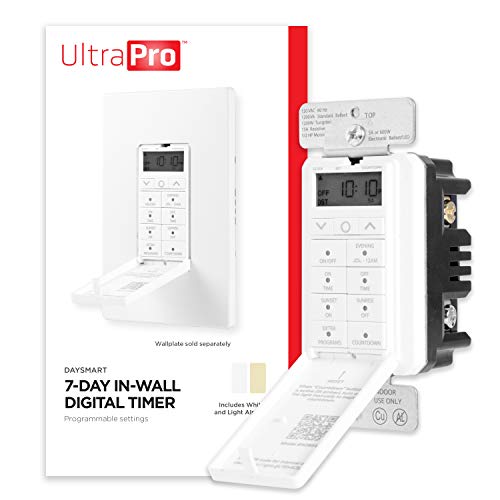 | Best Daylight Sync | Timer Type: 7-day digital | Schedule Control: 7-day cycle | Wiring: Single-pole or 3-way | VIEW LATEST PRICE | Read Our Analysis |
More Details on Our Top Picks
Southwire Woods In-Wall 7-Day Digital Timer
If you want a programmable light switch that makes everyday scheduling easy, the Southwire Woods In-Wall 7-Day Digital Timer is a smart pick. You can set up to seven on/off sequences for daily or weekly control, so your lights or fan run when you need them. It works with motors, electronic ballasts, and compact fluorescent lights, and you can still use manual override without erasing your settings. The pre-installed rechargeable battery protects programming for up to 30 days during outages. Install it in a standard single-pole box, connect line, neutral, and load wires, and enjoy reliable Southwire quality.
- Timer Type:In-wall digital
- Schedule Control:7 on/off sequences
- Wiring:Line/neutral/load
- Voltage:Not listed
- Control Method:Manual override
- Compatible Lights:LED/CFL/motors
- Additional Feature:Manual override
- Additional Feature:30-day battery backup
- Additional Feature:Up to 7 sequences
Honeywell PLS750C1000 Timer Switch with Sunrise Sunset Single or 3 Way
The Honeywell PLS750C1000 is a smart pick for you if you want a 3-way wall timer switch that follows sunrise and sunset automatically, since it combines 7-day EconoSwitch scheduling with standard 120-volt operation for compatible lighting fixtures. You can use its push-button touch controls to set ON-NONE-ON modes and manage lights without fuss. It handles 29 amps and up to 3,480 watts, so it fits many setups. Its wall-mount design, screw terminals, and simple white finish make installation practical. With strong 4.6-star ratings, it’s a reliable upgrade for daily convenience.
- Timer Type:Sunrise/sunset
- Schedule Control:7-day scheduling
- Wiring:3-way compatible
- Voltage:120V AC
- Control Method:Push-button
- Compatible Lights:Standard fixtures
- Additional Feature:Sunrise/sunset scheduling
- Additional Feature:EconoSwitch 7-day mode
- Additional Feature:3-way wall switch
BN-LINK WiFi Smart In-Wall Light Switch
Need a smart in-wall switch that works with your existing Wi-Fi setup and doesn’t require a hub? The BN-LINK WiFi Smart In-Wall Light Switch, model CP-C10, gives you app-based control through Smart Life and voice commands with Alexa or Google Assistant. You can set daily timers, switch between automatic and manual modes, and troubleshoot with AP mode if needed. It’s a single-pole, 2.4 GHz switch that requires a neutral wire. With 15 amps, 125 volts, ETL and FCC certification, and a compact white design, it fits neatly in your wall.
- Timer Type:Wi-Fi smart
- Schedule Control:Daily on/off
- Wiring:Neutral required
- Voltage:125V
- Control Method:App/voice
- Compatible Lights:Standard lights
- Additional Feature:Alexa voice control
- Additional Feature:Smart Life app
- Additional Feature:No hub required
Honeywell ECONOSwitch Programmable Timer Switch (RPLS540A)
Honeywell Home’s ECONOSwitch Programmable Timer Switch (RPLS540A) is a solid pick for households that want simple, reliable scheduling for incandescent, halogen, or fluorescent lights without smart-home complexity. You can set up to seven programs each week, choose sunrise or sunset-based timing, and switch between manual, automatic, or random modes. It works on 120 VAC systems, fits single-pole or 3-way replacements, and supports 40 to 500 watts. The backlit display, night light mode, and three-button control make setup easy, while automatic daylight savings adjustment saves you extra hassle.
- Timer Type:Programmable
- Schedule Control:7 programs/week
- Wiring:Single-pole or 3-way
- Voltage:120V AC
- Control Method:Button interface
- Compatible Lights:Incandescent/fluorescent
- Additional Feature:Random mode
- Additional Feature:Large backlit display
- Additional Feature:Night light mode
Leviton Decora Smart Dimmer Switch Wi-Fi 2nd Gen
If you want a dimmer switch that fits modern smart homes without adding a hub, the Leviton Decora Smart Dimmer Switch, Wi‑Fi 2nd Gen is a strong pick. You can connect it to a 2.4 GHz Wi‑Fi network and control it with the My Leviton app, voice assistants, or remote access. It works with Alexa, Google Assistant, Apple Home/Siri, and more, and it gains Matter support after a firmware update. You also get custom fade rates, preset levels, schedules, scene control, and full-range dimming. A neutral wire is required, and it supports single-pole or 3-way setups.
- Timer Type:Smart dimmer
- Schedule Control:Schedules/scenes
- Wiring:Neutral required
- Voltage:120V
- Control Method:App/voice
- Compatible Lights:LED/CFL/incandescent
- Additional Feature:Matter compatible
- Additional Feature:Custom fade rates
- Additional Feature:Wireless 3-way support
Intermatic EJ600A Electronic Timer Almond
The Intermatic EJ600A Electronic Timer in almond suits you if you want a dependable programmable light switch with automatic dawn/dusk control. You can set 7-day schedules with 7 ON/OFF events and 49 options for entryway, hallway, deck, or landscape lighting. Its astronomic clock adjusts to dawn and dusk, and it handles Daylight Saving Time automatically. Random mode helps make your home look occupied. You can use it with single-pole or 3-way setups, incandescent or fluorescent loads, and neutral wiring. A rechargeable battery backup keeps your settings. It’s rated for 12 amps and includes a 1-year limited warranty.
- Timer Type:Electronic
- Schedule Control:7 events
- Wiring:Neutral required
- Voltage:Not listed
- Control Method:Button control
- Compatible Lights:Incandescent/fluorescent
- Additional Feature:Astronomic clock
- Additional Feature:Automatic DST adjustment
- Additional Feature:Random mode
UltraPro Daysmart 7-Day Digital In-Wall Timer
Need a wall timer that keeps your lights aligned with the seasons? The UltraPro Daysmart 7-Day Digital In-Wall Timer uses Daysmart technology to adjust sunrise and sunset schedules by region, so you don’t have to reset it constantly. You can program a full 7-day cycle, use presets, or set countdowns for flexible control. The large LCD display makes settings easy to read, while the concealed door keeps buttons hidden and doubles as an ON/OFF switch. It replaces single-pole or three-way switches and works with LED, CFL, incandescent, and halogen fixtures indoors or on your porch.
- Timer Type:7-day digital
- Schedule Control:7-day cycle
- Wiring:Single-pole or 3-way
- Voltage:Not listed
- Control Method:Override switch
- Compatible Lights:LED/CFL/incandescent/halogen
- Additional Feature:Daysmart technology
- Additional Feature:Countdown timer
- Additional Feature:Door conceals buttons
Factors to Consider When Choosing a Programmable Light Switch
When you choose a programmable light switch, look at scheduling flexibility first so it fits your daily routine. You’ll also want to check wiring compatibility, load capacity, smart control options, and whether you need a wall-mounted or other installation type. These details help you pick a switch that works safely and gives you the control you want.
Scheduling Flexibility
Scheduling flexibility matters because it determines how well a programmable light switch fits your routine. You should check how many on/off events it can store, since some models handle only simple daily timers while others manage up to seven sequences each week. Look for scheduling by individual day, every day, weekdays and weekends, or a full seven-day cycle so you can match changing routines precisely. If your daylight changes a lot, choose sunrise, sunset, or astronomic scheduling to shift timing automatically through the year. Make sure manual override leaves your programs intact, so you can adjust lights without resetting anything. For extra control, consider random mode, countdown timers, or preset scene scheduling when you want more than basic timing.
Wiring Compatibility
Wiring compatibility is one of the first things you should check, because the best programmable light switch still has to match your home’s wiring. You’ll want to see whether the model needs a neutral wire, since some switches require line, neutral, and load connections while others fit simpler setups. Next, confirm your circuit type: some switches only handle single-pole wiring, and others support 3-way or multi-way control from more than one location. You should also match the switch to your load type, whether you’re controlling LED, CFL, incandescent, halogen, fluorescent, motor, or fan circuits. Finally, check that it fits your electrical box and terminal style, and verify the voltage and current ratings against your existing circuit before you buy.
Load Capacity
Start by checking the switch’s load capacity, because it has to handle everything you connect to it without overheating or failing early. You should compare the switch’s maximum wattage and current rating with the total load on that circuit. Some timers only handle about 500 watts, while higher-capacity models reach 3,480 watts and 29 amps. Add up every fixture you’ll control and stay under the limit to avoid nuisance trips or premature failure. You also need to confirm the load type. Some switches support incandescent, halogen, fluorescent, and motor loads, but others don’t accept LED or CFL lighting. If you want dimming, check the dimmer rating separately, since it’s often lower. For fans, pumps, or other motors, make sure the switch explicitly allows motor loads.
Smart Control Options
When you’re choosing a programmable light switch, focus on the control method you’ll actually use, whether that’s an app, touch controls, voice commands, or a simple push-button setup. If you want to change lights from anywhere, pick a Wi‑Fi model that doesn’t need a hub, and make sure it works on your home’s network, since 2.4 GHz-only switches won’t connect to 5 GHz. For hands-free convenience, confirm compatibility with Alexa, Google Assistant, or another voice assistant you already use. If automation matters more than remote access, look for built-in timers with daily, weekly, sunrise, sunset, countdown, or random modes. Also, check whether the switch needs a neutral wire and supports single-pole or 3-way control, because those details affect the features you can actually use.
Installation Type
Installation type matters because the switch has to match your existing wall wiring and control setup. You should check whether the model supports a single-pole setup, a 3-way circuit, or both, so it works with your current switch location. If your wiring includes a neutral wire, choose a switch that requires one; if not, look for a two-wire replacement designed for simpler installs. You’ll also want to confirm that the device fits your electrical box and mounting style, whether you have a standard single-gang box or a multi-gang setup. Finally, verify the connection method so the line, load, and neutral terminals match your home’s circuit. When you’re replacing a standard switch, multi-switch arrangement, or 3-way control point, compatibility keeps installation straightforward.
Display Visibility
Display visibility can make a big difference in how easy your programmable light switch is to use day to day. You’ll want a large, backlit LCD or illuminated screen so you can read the time and settings in dim hallways or at night. High-contrast displays help you spot on/off times, day indicators, and status icons fast, without squinting. A clear screen size and simple layout matter too, since crowded menus can slow you down when you’re checking schedules. If you’re placing the switch in an entryway, basement, or bedroom, look for night-light or low-light modes. For the easiest experience, choose bold digits, bright backlighting, and an uncluttered interface instead of a small, plain display that’s hard to scan quickly.
Power Backup
Beyond an easy-to-read screen, you’ll also want a switch that keeps working after the power goes out. Choose a model with battery backup so your clock and schedules stay saved during outages. Some switches can hold programming for up to 30 days without power, which means you won’t have to reset everything after a short interruption. Rechargeable or built-in backup batteries are especially useful because they keep the device’s memory active when line power drops. That matters most if you rely on daily on/off routines, since backup power helps you avoid missed events. Also check whether the backup battery is serviceable or non-serviceable. A replaceable battery can simplify long-term care, while a sealed one may need less attention but limit maintenance options.
Override Functions
An override function lets you turn the light or load on or off temporarily without wiping out the programmed schedule, so you can make quick changes and still keep automatic control afterward. You should look for switches that make manual changes simple, since you’ll want instant control without digging through menus. Good models keep the override separate from the timer program, so you can handle a one-time change and let the schedule resume on its own. This matters even more with multi-event timers that manage up to seven on/off settings, because you won’t need to reprogram every event. Before you buy, check that the override works in both automatic and manual modes and doesn’t force you to reset the date, time, or daily schedule.
Frequently Asked Questions
Can Programmable Light Switches Work With LED Bulbs?
Yes, if you choose the right one, you can use programmable light switches with LED bulbs. For dimmable LEDs, pick a dimmer compatible model to avoid flicker, buzzing, or weak performance.
Do Smart Switches Require a Neutral Wire?
Yes, many smart switches need a neutral wire, but some do not. Check the switch’s installation requirements first because certain models need a neutral to stay powered and work correctly.
Are These Switches Difficult to Install Yourself?
No, you can usually install them yourself if you know how to handle basic wiring. Turn off the power, replace the old switch, and connect the wires. If you are unsure, hire an electrician.
Can I Control Them When I’M Away From Home?
Yes, you can control them from anywhere if they connect to Wi Fi or a smart hub. Use your phone app to turn the lights on or off, create schedules, and check their status while you are away.
Do Programmable Switches Help Lower Electricity Bills?
Yes. Programmable switches can cut electricity bills by switching lights off at set times, reducing unnecessary usage, and keeping lighting aligned with your daily routine. Savings are greater when lights are no longer left on by mistake.