

A solid patrol flashlight does more than throw a bright spot down an alley. It has to take a drop on the asphalt, stay usable in the rain, and click through modes without thinking about it. After a long shift, the gear that earns its keep is the gear that disappears into the routine. I put together six options that span hazardous-location duty lights, dual-beam workhorses, and tactical models aimed at hunting and outdoor patrol. Some are built for hazardous-environment industrial work, others for everyday carry on a duty belt. The list mixes intrinsically safe picks with rechargeable high-output options, plus a couple of specialty color-beam models.
The Choices Worth Comparing

Streamlight 90540 Survivor Right-Angle Flashlight (Orange)

Streamlight 68750 Dualie 3AA HAZ-LO Flashlight (Yellow)
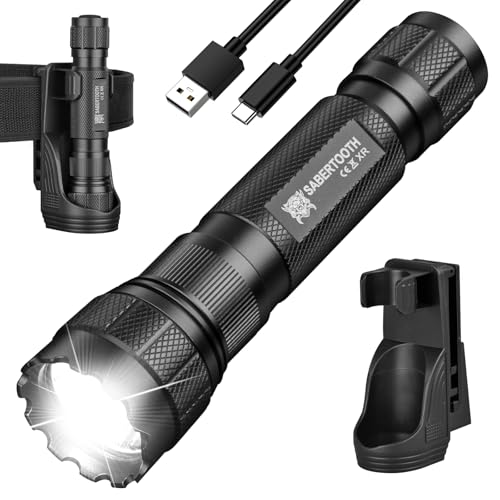
Rechargeable LED Police Tactical Flashlight for Duty Belt

SABERTOOTH Police Tactical Flashlight with Duty Belt Holster

SABERTOOTH Green Hunting Tactical Flashlight with Holster 1800LM

SABERTOOTH Red Hunting Tactical Flashlight with Holster 1800LM
The Survivor is one of those rare lights that takes workplace safety seriously enough to earn a hazardous-location rating. Class I, Division 1 intrinsically safe means it can be carried into spaces where flammable vapors or dust could be present, which is the kind of thing a fire inspector or refinery worker needs in writing before a light crosses the threshold. The right-angle head drops naturally off a belt clip and forward, so the beam follows the gaze when the user is crawling or working at arm’s length.
Build quality leans industrial: nylon housing, two-meter impact testing on the record, and an IPX4 rating (meaning it can handle splashed water from any direction without failing) for wet conditions. Compared to the Dualie that follows, the Survivor is less about dual-beam cleverness and more about durability under code.
What Pays Off
- Class I, Division 1 intrinsically safe construction lets it enter regulated hazardous zones that ordinary flashlights cannot.
- Push-button switch works with gloved hands, which is the difference between fumbling and functioning in cold-weather or hazmat work.
- Right-angle head paired with a clip means it sits on a turnout coat or belt and points where the wearer looks.
- Two output modes give a 175-lumen high beam and a longer-running 60-lumen low for paperwork and close inspections.
Things To Consider
- Brightness looks modest next to high-lumen tactical lights, so it is not the pick for reaching deep into a field at distance.
- Industrial safety ratings add cost, so casual users may be paying for certifications they don’t need.
Built With In Mind
Firefighters, refinery techs, and industrial safety officers who genuinely need an intrinsically safe rating for their worksite.
Skip It When
The SABERTOOTH Police Tactical Flashlight with Duty Belt Holster is the better match for street patrol officers chasing maximum reach on a standard beat.
The Dualie solves a specific frustration: the moment you prop a flashlight against a wall to work with both hands, the beam lands at the wrong angle and shadows hide the work. Two independent LEDs solve that by letting the user pick a forward spot, a downward flood that lights the floor in front of the feet, or both at the same time. It runs on three AA batteries, which is a quiet superpower on a long shift because the cells are easy to swap in any gas station.
Where the Survivor leans on a right-angle clip, the Dualie leans on the body itself. The HAZ-LO designation means the same hazardous-environment pedigree, so this light is comfortable in plants and on utility trucks. It is friendlier to carry than the Survivor for general patrol because of the dual-beam layout.
Strong Points
- Dual-beam design (spot plus flood) eliminates the head-shadow problem that plagues single-LED lights propped on a flat surface.
- AA battery compatibility avoids specialty cells and chargers, which is a real advantage on multi-day deployments.
- HAZ-LO rating matches hazardous-environment requirements for inspectors and industrial crews.
- Body shape stays comfortable clipped to a turnout coat or belt through a long shift.
Worth Noting
- The forward spot tops out around 140 lumens, which is fine for confined spaces but feels shy on open patrol.
- AA cells give convenience but lower sustained output than a rechargeable platform like the SABERTOOTH tactical lights reviewed below.
Right Fit For
Utility workers, inspectors, and any operator who wants hands-free floor lighting alongside a forward beam in tight spaces.
A Better Fit Elsewhere
Reach for the Streamlight 90540 Survivor Right-Angle Flashlight (Orange) when intrinsically safe certification matters more than dual-beam convenience.
SABERTOOTH’s entry-level tactical light is the kind of body that earns its place through daily repetition. It is built to ride a duty belt, click through bright and soft modes with a double-tap, and recharge between shifts rather than feed a battery budget. Compared with the SABERTOOTH holster-equipped sibling below, this version leans toward minimalism: the light itself, nothing extra.
For street patrol, the high-output mode reaches well down a street or across a lot, and the lower mode keeps paperwork readable without bleaching the page. You may find the burst mode more useful in momentary encounters than the steady high, which is a common preference for officers in the field.
Reasons It Performs
- High maximum output rated for long-distance reach, with a soft mode for close tasks.
- Rechargeable cell cuts the recurring cost of disposable batteries on a regular patrol rotation.
- Belt-friendly body shape slides onto most duty holsters and uniform layouts.
- Double-tap burst entry keeps the steady mode from accidentally blinding a partner during a handoff.
Trade Offs
- Without a bundled holster, first-time owners need to source one separately for belt carry.
- Rechargeable platform requires a charging routine, which complicates back-to-back long shifts without a top-off.
Feature Snapshot
Best Suited To
Patrol deputies and uniformed officers who want a rechargeable high-output flashlight without bundled extras.
Consider Something Else When
The SABERTOOTH Police Tactical Flashlight with Duty Belt Holster is a better fit for officers who want the holster and charging cable in the box.
Where the previous SABERTOOTH model is the bare flashlight, this version shows up as a small kit: the light, a holster, and a charging cable, ready to clip on a belt out of the box. The 1800-lumen output and long beam reach match the standard tactical model, so performance lands in the same place. What changes is the day-one experience.
The holster is the kind of detail that looks minor until you actually wear it for a full shift. It holds the light at the right draw angle and keeps the body from flopping while running. For officers buying their first duty flashlight, this is often the safer starting point.
A Few Highlights
- Holster included, which removes a common first-week purchase.
- Rechargeable cell cuts long-term battery cost over years of patrol use.
- Beam reach holds up across parking lots and open perimeters.
- Body profile fits common duty-belt layouts without snagging on vests or web gear.
Points To Note
- Holster design is fixed; users wanting custom offset or MOLLE mounting may still swap it out.
- Output reaches the same 1800-lumen ceiling as the cheaper sibling, so the value depends on whether the holster matters to you.
Who Should Grab It
Officers and security pros buying a first or replacement duty flashlight who want everything in one box.
Where A Sibling Pick Shines
The SABERTOOTH Green Hunting Tactical Flashlight with Holster 1800LM is the better fit when the job calls for a green beam that preserves night vision.
The green-beam variant of the SABERTOOTH tactical line is aimed squarely at hunters and outdoors users who know the trade-off a white beam creates. A green wavelength reads as less startling to most wildlife and keeps the user’s own dark-adapted vision steadier than white light does. Compared with the white-light sibling above, this is the same body and holster, swapped emitter.
Beam reach stays close to the white-light version, so the long-throw advantage carries over. Green light also tends to render blood trails and animal eyes more visibly at moderate range, which is why predator and hog hunters reach for it at dusk.
Noteworthy Benefits
- Green wavelength preserves night vision for the user and reads as less alarming to most game.
- High output and long beam reach hold up across fields and wood lines.
- Rechargeable battery and rotating holster make waist or pack carry comfortable on long stalks.
- Hidden USB-C charging port keeps the body sealed against dust and splash during use.
A Few Limitations
- Green light renders color detail poorly, so it is not the right tool for reading labels or evidence indoors.
- Specialty emitter commands a higher cost than the white-light version, so casual users may not justify it.
Quick Facts
Whose Shelf It Belongs On
Hunters, property managers, and rural officers who specifically want a stealthier beam that keeps game and night vision calm.
Swap It Out When
The SABERTOOTH Red Hunting Tactical Flashlight with Holster 1800LM is a stronger pick when the priority is preserving night vision at close range rather than reaching far.
Red light sits at the most conservative end of the visibility spectrum, which is exactly why it has stuck around in military and astronomy circles for decades. The SABERTOOTH red-beam model uses the same tactical body, holster, and 1800-lumen platform as its green sibling, with the emitter swapped to red. The effect is the same kind of stealth on a different wavelength.
For patrol officers working low-light vehicle checks or hunters reading maps in the dark, red light keeps pupils dilated and avoids giving away position. Compared with the green model, red travels less far through atmosphere and reads as gentler at close range, so it complements rather than replaces the green beam.
The Practical Payoff
- Red wavelength preserves dark-adapted vision for the user and stays subtle to onlookers.
- Same high-output body as the rest of the SABERTOOTH tactical line for consistent feel and controls.
- Rotating holster makes the light accessible at multiple carry positions.
- Hidden USB-C port keeps the body weather-sealed during heavy outdoor use.
Honest Caveats
- Red renders fine color detail poorly, which is rough for evidence work or reading colored indicators.
- Throws less far than the green or white versions, so it is a close-to-mid-range tool rather than a search beam.
Spec Overview
Who Will Love This
Patrol officers, hunters, and astronomers who want maximum night-vision preservation at close to mid range.
Look Elsewhere When
The Streamlight 68750 Dualie 3AA HAZ-LO Flashlight (Yellow) is the smarter choice for hazardous-location work where certification matters more than beam color.
Picking The Right Patrol Flashlight For The Job
The right patrol flashlight depends less on raw lumens and more on the environment where it will live. Hazardous-location work demands an intrinsically safe rating, which is a certification that says the light cannot ignite flammable vapors or dust. For everyday patrol and traffic stops, rechargeable tactical bodies with 1000 to 2000 lumens and beam reaches over 200 meters are the practical sweet spot. Hands-free work in tight spaces benefits from dual-beam designs that pair a forward spot with a downward flood, since they remove the head-shadow problem that a single LED propped against a wall always creates. Color-beam models earn their keep when the priority is preserving night vision, reading maps in the dark, or working close to wildlife without startling it.
Beam Type And Output
Lumens measure total light output, while candela measures how tightly that light focuses into a beam. A high-lumen, low-candela light floods a room evenly; a lower-lumen, high-candela light punches farther downrange. Patrol work usually wants both, so look for figures that pair a strong lumen count with respectable candela for distance checks.
Power Source And Runtime
Rechargeable platforms save money over years of shift work but demand a charging routine. Disposable-cell lights like the AA-powered Dualie trade sustained brightness for the comfort of finding cells anywhere. Choose rechargeable if the light lives on the same duty belt every shift, and disposables for grab-bag backup duty.
Carry And Mounting
Belt holsters that ship in the box remove a first-week purchase and keep the light at a consistent draw angle. Rotating holsters adapt to multiple carry positions, which matters for officers who swap between waist and pack setups during outdoor shifts.
Safety Ratings And Build
IP ratings measure water and dust resistance. An IPX4 rating (the second number) handles splashed water from any direction, which is enough for most outdoor patrol. Impact resistance ratings, usually expressed in meters, indicate the drop height the housing was tested to survive on hard surfaces.
Key Considerations Across These Picks
Where Shoppers Go Wrong
A common mistake is chasing the highest lumen count and overlooking beam shape and candela. A 3000-lumen floodlight feels impressive in a backyard but throws a soft, washed-out spot that loses definition at distance. Another trap is buying a tactical body without confirming the carry system fits a duty belt; a flashlight that does not draw cleanly is a flashlight that stays in a bag. Finally, skipping battery strategy leads to dead lights mid-shift, so plan for recharge access or carry spare cells from day one.
When Paying More Pays Off
The premium tier in this category buys safety certifications, dual-beam versatility, and color-specific emitters. Intrinsically safe lights like the Survivor carry a real cost premium that only pays off in regulated environments. Color-beam models are worth the extra money for hunters and stealth-patrol officers who would otherwise lose night vision with white light. For everyone else, a standard rechargeable tactical body delivers most of the practical benefit at a friendlier cost.
Frequently Asked Questions
What lumen count is realistic for patrol work?
For most patrol scenarios, anywhere from 800 to 2000 lumens covers both close-quarters tasks and distance checks. More than that mostly helps with search applications and open-terrain work.
Are intrinsically safe flashlights worth the extra cost?
For officers working in refineries, fuel terminals, or grain handling, yes: the certification is the point. For street patrol with no flammable atmospheres, a standard rechargeable tactical light is usually sufficient.
How far should a patrol flashlight throw?
A useful minimum is around 150 meters of beam reach for traffic stops and building perimeters. Hunters and rural officers benefit from 250 to 300 meters or more for tracking across open ground.
Why do some patrol lights use colored beams?
Green and red beams preserve dark-adapted vision in the user and read as less startling to wildlife or targets. They are specialty tools that complement rather than replace a white-light main beam.
Can the same light work for patrol and hunting?
A rechargeable white-light tactical body covers both as a generalist. Hunters who want stealth and night-vision preservation usually add a color-beam model as a second light rather than swapping out their primary patrol tool.