

A dark driveway or an unlit warehouse corner is an open invitation. Whether you’re lighting up a backyard, a side entrance, or a commercial lot, the right fixture turns a shadowy patch into a usable, safer space after sundown. I put together this roundup for folks who want serious illumination without the old-school energy bill that comes with metal halide or high-pressure sodium fixtures. Photocell sensors, LED efficiency, and rugged IP65 housings now do most of the heavy lifting, so the picks below lean into that mix.
An Overview Of The Picks

Tesoorda 80W LED Wall Pack with Photocell (2 Pack)
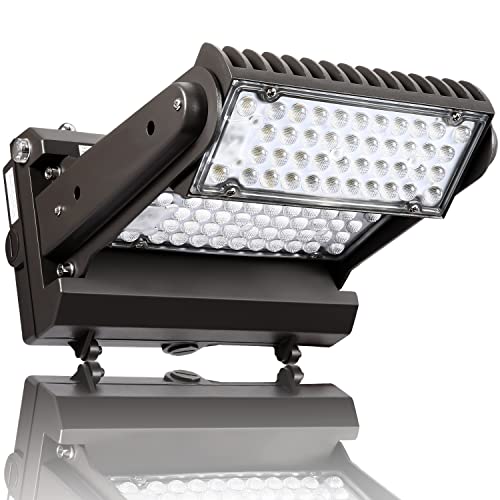
unununo Rotatable 120W LED Wall Pack with Photocell
Tesoorda 120W LED Wall Pack with Photocell (2 Pack)
Tesoorda 100W LED Wall Pack with Photocell (2 Pack)

NUOGUAN Adjustable LED Parking Lot Light

YELLORE 400W LED Parking Lot Lights (10 Pack)
Meet The Standout Selections
For property owners lighting a garage side wall or a modest warehouse bay, the Tesoorda 80W is a sensible starting point. It puts out 10,500 lumens at 5000K daylight, a brightness that handles most residential-to-light-commercial walls without overwhelming a small yard. The built-in photocell sensor (a light-sensing switch that turns the fixture on at dusk and off at dawn) keeps things automatic, so nobody has to remember a timer.
The wide AC100-277V input range means it fits common North American wiring without a transformer, which simplifies installation for anyone hiring an electrician. I like that this model ships as a two-pack, so a homeowner can cover two walls on one purchase and keep the lighting consistent across both sides of a building.
What Works In Its Favor
- Built-in dusk-to-dawn photocell removes the need for a separate timer or smart switch.
- 10,500 lumens at 80W delivers a serious efficiency gain over older 400W halogen wall packs, easing the monthly utility bill.
- Two-pack format keeps the brightness uniform across paired walls or opposite garage doors.
- 5000K daylight color renders faces and license plates accurately, which matters for security cameras.
Trade Offs
- 10,500 lumens may feel short on very tall facades above roughly 20 feet, where the unununo 120W rotatable model performs better.
- Fixed beam angle means less control over aiming once it’s mounted on the wall.
Made For
Homeowners and small-shop owners lighting one or two garage or side-entrance walls where simple, automatic dusk-to-dawn operation is the priority.
Consider Something Else When
You need a much brighter, aimable beam for a tall loading dock, in which case the unununo Rotatable 120W LED Wall Pack offers a wider, adjustable spread.
The unununo 120W stands out for one specific reason: the LED panel rotates 270 degrees, so the installer can aim the throw across a parking lane, down a driveway, or straight out from a wall after the bracket is already bolted up. At 16,800 lumens, it replaces older 600-800W HPS or HID (high-intensity discharge) fixtures, and the ETL listing gives commercial sites a recognizable safety mark to point to during inspection.
For property managers who can’t always predict where the light needs to land, this is the most forgiving fixture in the lineup. The photocell still runs automatically, but a manual override is included for times when overnight event lighting is needed and the dusk cycle isn’t desirable.
What Helps Most
- 270-degree panel rotation lets you redirect the beam after mounting, which is genuinely useful on uneven facades.
- Replaces 600-800W legacy fixtures, so the wattage drop shows up fast on commercial meters.
- ETL listing supports code-compliance paperwork on commercial properties.
- Manual override alongside the photocell gives flexible control for occasional all-night events.
Points To Keep In Mind
- Rotating joints can drift slightly over years of vibration on busy exterior walls, so an annual re-tightening is wise.
- Higher lumen output is wasted on short side walls where the Tesoorda 80W would do the same job at lower wattage.
Best Suited To
Commercial property managers outfitting loading docks, parking entrances, or tall facades where post-install aiming flexibility matters more than tight budgets.
Skip It When
You’re lighting a small garage and don’t need 16,800 lumens, because the Tesoorda 80W LED Wall Pack covers that job with less wattage.
For taller commercial walls, the Tesoorda 120W pushes 15,600 lumens per fixture, enough to throw usable light 20-plus feet down a side yard or warehouse bay. Compared to the smaller Tesoorda 80W earlier in this list, it’s a real step up in reach without losing the brand’s signature dusk-to-dawn simplicity.
Owners commonly report the IP65 (a dust-tight and water-jet-resistant) rating holding up well in coastal or snow-belt climates, where cheaper fixtures fog up within a season. The two-pack format makes it easy to stage both sides of a building in one purchase order.
Useful Touches
- 15,600 lumens at 120W reaches tall facades and deep lot edges without piling on more fixtures.
- IP65 housing holds up to rain, sleet, and routine pressure washing.
- Replaces 700-850W legacy HID bulbs for sharp drops in kWh consumption.
Worth Noting
- At 120W, the fixture runs warm, so shaded soffit mounting in tight eaves can shorten LED lifespan over time.
- Fixed beam angle, so aiming decisions have to be made before the bracket is bolted up.
Right Fit For
Property owners with tall warehouse bays or two-story facades who need serious throw distance and a fixed beam is acceptable.
Reach For A Different Pick When
You want post-install aiming, in which case the unununo Rotatable 120W LED Wall Pack delivers similar wattage with adjustable direction.
The Tesoorda 100W is the quiet middle child of the lineup, sitting between the 80W and the 120W versions, and for many homes and shops it’s actually the right answer. At 13,000 lumens, it handles a two-car garage wall or a backyard outbuilding comfortably, without the over-bright punch that 15,600 lumens delivers on a small yard.
The AC100-277V input range means it’ll wire up to most U.S. residential and light-commercial panels without extra transformers. For shoppers torn between Tesoorda’s 80W and 120W, this 100W often hits the sweet spot.
The Practical Payoff
- 13,000 lumens comfortably covers mid-size garage and rear-entrance walls.
- Replaces 400-500W halogen or HID bulbs for meaningful energy savings.
- Two-pack format gives matching brightness on opposite walls.
Honest Caveats
- 13,000 lumens will fall short on very large open yards where a parking-lot-grade fixture performs better.
- Fixed beam angle limits where the throw can land once installed.
Who It Suits Best
Homeowners with two-car garages or single-story facades who want brighter light than the 80W without committing to commercial-grade output.
Look Elsewhere When
You’re lighting a wide parking lot or a long driveway, because the YELLORE 400W LED Parking Lot Lights (10 Pack) deliver a much higher lumen count per fixture.
This NUOGUAN shoebox-style fixture (a flat, pole-mounted housing shaped for parking lots) does something the wall packs don’t: it offers switchable wattage at 400W, 320W, or 240W, so the installer dials the brightness down for smaller lots and up for wide roadways. It mounts with either an arm or slip fitter, which are two standard pole-bracket styles, so it adapts to new pole construction or retrofitting older shoebox fixtures.
For farms, churches, and small commercial drives with one or two pole locations, the adjustable wattage can save real money on the electric bill without forcing a smaller fixture. The IP65 rating handles year-round weather exposure, and the 5000K daylight color renders cleanly under camera surveillance.
Why It Works Well
- Switchable 400W/320W/240W lets the owner match output to lot size.
- Arm and slip-fitter mounting covers both new pole and retrofit jobs.
- IP65 housing handles coastal rain and snow-belt conditions.
Possible Compromises
- Pole-mounted installation requires trenching or existing pole infrastructure, which adds project cost.
- Single-fixture format means multi-pole lots need multiple orders.
Whose Shelf It Belongs On
Property owners with one or two pole locations serving a small commercial lot, driveway, or community space who value tunable output over a bulk pack.
Swap It Out When
You need to light an entire lot of multiple poles at once, in which case the YELLORE 400W LED Parking Lot Lights (10 Pack) covers the site in a single bulk order.
This is the heavy hitter. The YELLORE 400W ships as a ten-pack, putting out 60,000 lumens per fixture at 5000K daylight, with UL and DLC listings (UL is a U.S. safety certification; DLC qualifies the fixture for utility rebates). The 277-480V input means it’s built for commercial three-phase power, not a typical residential panel.
For a full-site redevelopment where an old metal halide system is being replaced pole by pole, the bulk format keeps the spec consistent across the entire lot. The IP65 housing and slip-fitter mount simplify installation on standard pole tops.
Features That Help
- 60,000 lumens per fixture replaces 1500W legacy HID floods for large-scale energy savings.
- UL and DLC listings support commercial code compliance and utility rebate paperwork.
- 277-480V input suits commercial three-phase power systems.
- Slip-fitter mount fits standard pole-top brackets.
Things To Weigh Up
- 277-480V input won’t connect to standard residential 120/240V wiring without a step-down transformer.
- Ten-pack format is overkill for a single driveway and inflates upfront cost.
- Large fixtures can catch wind on tall poles, so mounting hardware should be checked periodically.
Who Should Grab It
Commercial property managers and developers redoing full parking-lot or roadway systems on three-phase power, where the bulk format and certifications matter most.
A Better Fit Elsewhere
A homeowner lighting one driveway, where the NUOGUAN Adjustable LED Parking Lot Light delivers pole-mounted performance in a single, residential-friendly fixture.
What Matters Most Before Choosing Outdoor Security Lightings
Wattage, Lumens, and the Replacement Game
Most of the LED picks in this category replace legacy HPS or HID fixtures that ran at 400W to 1500W. An 80W to 120W LED wall pack covers most garage and small-warehouse walls, while 240W to 400W pole-mounted fixtures handle wider lots. The lumen number, how much visible light a fixture emits, tells you the actual brightness, so a 13,000-lumen 100W fixture is meaningfully brighter than a 10,500-lumen 80W, even though both sit in the same family.
Photocell, Manual Override, and Smart Controls
A photocell turns the light on at dusk and off at dawn automatically, which is the single biggest energy-saving feature on this list. Manual override matters for event lighting, when you want the fixture to stay on past dawn. Skip anything that requires a separate timer or smart switch unless you specifically want app control.
IP Rating and Build for Your Climate
IP65 means the fixture handles rain, sleet, and routine pressure washing. For coastal salt air or extreme snow-belt freeze-thaw cycles, a die-cast aluminum housing with a powder-coat finish tends to outlast plastic-bodied alternatives.
Mounting Style and Beam Direction
Wall packs assume flat vertical mounting. Pole-mounted shoebox fixtures need an arm or slip fitter that matches the existing pole top. If the mounting surface is uneven or the throw direction is uncertain, a rotatable panel like the unununo 120W saves a lot of headaches.
Key Considerations Across These Picks
Mistakes Worth Dodging
The biggest slip-up is buying wattage that’s too high for the wall. A 15,000-lumen fixture on a small backyard bounce-lights off neighbors’ windows and triggers complaints. Match the lumen count to the surface area, and lean toward the higher end only when the throw distance exceeds 15 feet.
The second trap is ignoring voltage. The YELLORE 10-pack runs on 277-480V, and a homeowner who tries to wire it into a 120V residential panel is going to have a bad day. Always confirm the input voltage before clicking through to the listing.
Where The Extra Money Goes
Higher-tier models buy three things: certifications like UL or ETL (which matter for commercial inspection), adjustable mounting hardware for aimable throw, and bulk-pack pricing that drops the per-fixture cost on multi-pole sites. For a single garage wall, the certifications rarely matter; for a commercial site, they’re often required on paper before the install can proceed.
Frequently Asked Questions
What Color Temperature Works Best For Security Lighting?
5000K daylight is the most common choice for outdoor security because it renders faces and license plates accurately under camera surveillance. Warmer 3000K tones look softer but reduce clarity on standard security footage.
Do Photocells Wear Out Over Time?
Photocell sensors can drift after several years of UV exposure, occasionally leaving the fixture on during the day. Most can be replaced as a small module without swapping the entire fixture, which is worth checking before buying.
Can LED Wall Packs Handle Rain And Snow?
Fixtures rated IP65 handle routine rain, sleet, and pressure washing without issue. Direct submersion or persistent ice damming can still cause problems, so gasketed junction boxes and a slight downward mounting angle help water shed.
Is A Two-Pack Better Than Buying Two Singles?
For matching fixtures on opposite walls, a two-pack keeps the brightness and color temperature identical across both sides. Buying singles separately risks slight bin variation between production runs, which shows up as visible color differences on paired walls.
Do These Fixtures Need A Professional Electrician?
Wall packs at standard residential voltage can be a confident DIY project for anyone comfortable with wiring a junction box. Commercial 277-480V fixtures like the YELLORE 10-pack usually require a licensed electrician to meet local code.