

Outdoor light timers quietly fix one of the most annoying chores around the house: remembering to flip the switch. I talk to a lot of people who want their porch lights, garden path lights, or holiday displays to just behave on their own, no fumbling in the dark, no leaving lights burning all night.
The right timer depends on how your yard is wired, how much weather your outlet sees, and whether you want a built-in remote or a full weekly schedule. I put together six solid outdoor light timers that cover those different needs, with honest trade-offs for each one.
A Side-By-Side Look
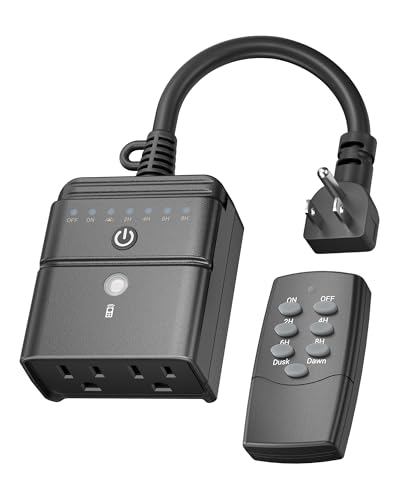
BN-LINK Outdoor Timer with 100FT Remote

DEWENWILS Outdoor Power Stake Timer with Remote

DEWENWILS Outdoor Timer with Remote, 2 Outlets

BN-LINK Outdoor Light Timer with RF Remote

BN-LINK Outdoor 7-Day Programmable Timer Outlet

OSKOS 24-Hour Outdoor Light Timer with Photocell
A Deeper Look At The Lineup
This BN-LINK unit covers the bases most homeowners actually want. It runs on three control modes: a built-in photocell for dusk-to-dawn sensing, a countdown that fires the lights at dusk and shuts them off after 2, 4, 6, or 8 hours, and an RF remote that reaches up to 100 feet through walls and yard.
That mix matters because most yards aren’t one-size-fits-all. A path light that needs to glow all night wants the dusk-to-dawn setting. Holiday string lights that should stop burning at midnight want a 6-hour countdown. The remote lets me toggle either without stepping into the cold or the rain.
The Upside
- Three modes in one box keeps things simple for first-time timer shoppers
- RF remote reaches about 100 ft, handy for a multi-zone yard
- Countdown range from 2 to 8 hours fits most holiday display schedules
- Photocell mode means no seasonal clock adjustments for daily porch lights
- Setup stays minimal, no app or Wi-Fi pairing required
Things To Consider
- No weekly scheduling, so it won’t shift lights on different days automatically
- Single outlet only, which can feel limiting if the yard already runs two zones
- Mounting orientation matters for weather resistance, so vertical mounting is the safer play
Who It Suits Best
Homeowners with mixed lighting needs (porch, garden path, holiday décor) who want one device that handles all three without weekly programming.
Consider Something Else When
Someone running complex weekly routines, like shifting lights earlier on weekdays, gets more flexibility from the BN-LINK 7-Day Programmable Timer Outlet.
The DEWENWILS stake-style timer solves a specific problem: my outdoor outlet sits close to the house, but the lights I want to control live deep in a garden bed. The ground stake plants the timer right next to the lights, no extension cord spaghetti.
It ships with two remotes, which sounds like a small detail until the household has more than one person who likes to mess with the lights. Two remotes means the bedside clicker works as well as the one by the back door.
Useful Strengths
- Stake design brings power to the middle of a flower bed, not just the wall
- Multiple timer modes, including dusk-to-dawn and 2/4/6/8-hour countdowns
- Two remotes included, useful for shared households
- Always-ON override helps when I just want the lights on for a party
Worth Noting
- Stake installation means soft or rocky soil may need a little prep
- No app control, so any mode changes happen at the unit or by remote
- Higher exposure to lawn mowers and foot traffic near garden beds
Made For
Garden owners who want power in the middle of a bed rather than at the house wall, especially with multiple string-light zones.
Look Elsewhere When
Someone with a single outlet by the back door and no soil-based lighting layout will get more use from the DEWENWILS Outdoor Timer with Remote, 2 Outlets, which mounts cleanly on a wall.
This DEWENWILS unit is the wall-mount sibling to the stake version. It plugs into an existing outdoor outlet and gives me two grounded sockets on the bottom, both controlled by the same timer.
Two outlets is the real headline here. Porch light plus a wreath spotlight, garden path lights plus a fountain, holiday lights on one side and patio string lights on the other: all from one timer, one schedule. The included remote saves the trip to the outlet box when weather is rough.
Everyday Wins
- Two grounded outlets handle a typical front-yard setup on one timer
- RF remote keeps control inside the house, no app needed
- Photocell plus countdown options cover both dusk-to-dawn and fixed shutoff times
- Wall-mount orientation protects the plug connection better than a dangling unit
Room For Improvement
- Outlets operate together, not independently, so both must follow the same schedule
- No 7-day programming, so weekend-only lighting patterns require manual changes
- Weather resistance depends heavily on proper vertical mounting as the manual specifies
The Right Fit For
Holiday decorators and entertainers running two coordinated light zones from a single outdoor outlet.
Swap It Out When
Someone who needs independent outlet control, like one outlet on dusk-to-dawn and the other on a different countdown, will find the BN-LINK Outdoor Light Timer with RF Remote a closer match.
Two timers in the box. That’s the headline for the BN-LINK B01MAWA81Q, and it changes how I think about outfitting a property. One handles the front porch, the other lives by the back patio, and neither needs to be unplugged and re-plugged to swap duties.
The mode set covers what most homeowners actually need: automatic dusk-to-dawn via the photocell, plus countdown windows at 2, 4, 6, or 8 hours. The RF remote pairs with both units from inside the house, which makes mid-storm toggling a non-event.
Notable Upsides
- Two-pack coverage for front and back yards without buying twice
- Two grounded outlets per unit handle bigger lighting loads
- Photocell + countdown combo adapts to seasonal day length changes
Honest Caveats
- Outlets on each unit still operate together, not independently
- No 7-day scheduling, so weekday vs. weekend patterns need manual switching
- Storage during off-season matters: keep them dry to preserve the gaskets
Best Suited To
Multi-zone properties where two timers at once beats juggling a single unit between front and back.
A Better Fit Elsewhere
Shoppers who only need one timer and prefer deep weekly control should look at the BN-LINK Outdoor 7-Day Programmable Timer Outlet instead.
This is the timer for someone who wants the lights to do different things on different days. Up to eight on/off programs, each configurable down to one-minute increments, and the two outlets operate together under that schedule.
I appreciate the “Random” vacation mode, which varies the on and off times within a window so the house looks lived-in while the family is away. Daylight Savings gets a dedicated button too, no menu diving twice a year.
Well-Handled Touches
- Eight on/off programs cover complex weekly patterns, weekday vs. weekend easily
- One-minute resolution allows precise control for short-duration needs
- Random mode supports a lived-in look during travel
- Two grounded outlets handle most standard yard setups
Points To Note
- Programming interface is button-based, less intuitive than app-driven timers
- Both outlets share one schedule, no independent control
- Initial setup takes longer than photocell-only models
Who Should Grab It
Planners who want weekday, weekend, and seasonal lighting patterns running on autopilot without weekly manual adjustments.
Reach For A Different Pick When
Someone wanting plug-and-play simplicity with no programming may find the BN-LINK Outdoor Timer with 100FT Remote easier to live with day to day.
OSKOS keeps this one deliberately simple. A photocell handles dusk-to-dawn, or a 2/4/6/8-hour countdown kicks in after dusk and shuts things off overnight. One grounded outlet, vertical mounting, weather-resistant housing.
For an exposed outlet that takes direct rain and snow, simplicity helps. Fewer buttons means fewer failure points over years of weather cycles, and the 10A rating gives enough headroom for typical LED string lights.
Where It Helps
- Vertical-mount water resistance suits exposed outlet locations
- Photocell plus countdown covers both always-on and time-limited patterns
- 10A capacity handles standard holiday string lights comfortably
- Minimal interface means quicker setup and fewer accidental setting changes
Where It May Fall Short
- Single outlet limits it to one zone at a time
- No weekly scheduling, so different weekday vs. weekend patterns aren’t possible
- Proper mounting orientation must be followed for the weather resistance to hold up
Perfect Match For
Homeowners with a single exposed outlet running basic porch or garden lights who value weather resistance over feature depth.
Where A Sibling Pick Shines
Multi-zone users or anyone wanting remote control from inside should look at the BN-LINK Outdoor Light Timer with RF Remote, which trades simplicity for dual-outlet flexibility.
What Matters Most Before Choosing Outdoor Light Timers
The first decision is whether you want a timer that simply follows dusk and dawn or one with a full weekly schedule. Photocell-based timers, like the OSKOS and the BN-LINK 100FT Remote unit, react to actual light levels and never need seasonal clock tweaks. Programmable timers, like the BN-LINK 7-Day, give finer control but ask for upfront setup time.
Outdoor-rated matters more than people realize. A timer with weather-resistant housing needs proper vertical mounting to keep water from pooling around the seals. Skipping that step is the most common reason timers fail early.
Outlet count and load rating both matter. A single-outlet timer is fine for one porch light. Two grounded outlets, like those on the DEWENWILS 2-Outlet or the BN-LINK 7-Day, give more flexibility without adding another device. Match the timer amperage to the light load.
Remote or no remote comes down to outlet placement. A wall outlet by the back door is easy to reach. An outlet deep in a garden bed or on a high porch ceiling feels different on a cold night, and an RF remote saves the trip. Stake-mounted units push the outlet into the yard itself.
Common Slip Ups And Smart Upgrades
Pitfalls Shoppers Hit
The most common mistake is treating a photocell timer like a clock timer. Photocell models react to ambient light, so mounting them under a deep eave or a tree canopy can confuse the sensor and leave lights on too long. Mount them where they actually see the sky.
Another trap is buying a timer with one outlet when the yard already needs two zones. Plugging a power strip into a single-outlet timer looks like a fix, but it usually voids any safety margin and creates more failure points.
Where The Extra Money Goes
Higher-tier timers earn their cost by adding weekly scheduling, multiple independent programs, and broader weatherproofing. For someone who just needs the porch light on at dark and off at dawn, a basic photocell model handles the job. The upgrade becomes worthwhile when weekday and weekend patterns diverge, or when the outlet lives in a fully exposed location that demands stronger sealing.
Frequently Asked Questions
Do outdoor light timers work in winter?
Photocell-based timers actually work better in winter because shorter days trigger the sensor earlier. Cold temperatures rarely affect the electronics in residential outdoor timers rated for outdoor use.
Can one timer run multiple string lights?
Yes, two-outlet timers like the DEWENWILS 2-Outlet model handle two grounded plugs on one schedule. Just stay within the timer’s amperage rating for the combined load.
Will rain damage an outdoor light timer?
Weather-resistant timers handle rain when mounted vertically as the manual specifies. Horizontal mounting or leaving the unit dangling exposes the seals and shortens lifespan.
Are remote-controlled timers reliable?
RF remotes typically reach 80 to 100 feet through walls and respond reliably for years. The main ownership habit is replacing the remote battery when response slows down.
What is a photocell on a light timer?
A photocell is a small light sensor that detects when ambient brightness drops at dusk and rises at dawn, automatically switching the connected lights on and off without any clock programming.