

A dimmable LED driver is one of those parts you don’t think about until the lights start flickering or buzzing. Picking the right one for your strip setup keeps color smooth, protects the strip from voltage spikes, and lets your wall dimmer actually dim. I pulled together seven EMITEVER drivers that handle common home and shop projects, from a tiny under-cabinet run to a larger two-channel tunable white install. The list leans toward practical, honest picks with trade-offs called out so you can match a driver to your strip, dimmer, and box space.
A Closer Look At The Lineup

EMITEVER 60W 24V 5-in-1 Dimmable LED Driver
EMITEVER 25W 24V Triac Dimmable LED Driver

EMITEVER 100W 24V Magnetic Dimmable LED Driver

EMITEVER 192W 48V 5-in-1 2-Channel Dimmable LED Driver

EMITEVER 60W 24V Slim Triac Dimmable LED Driver
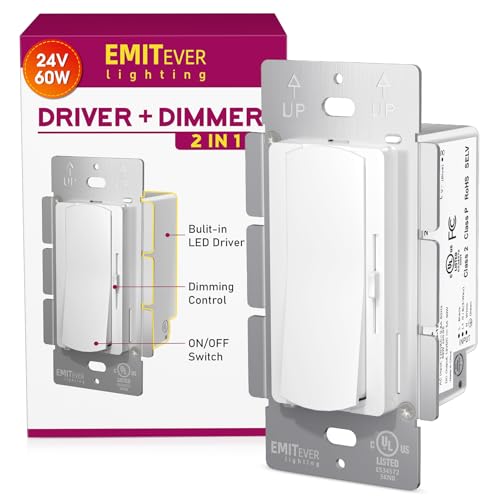
EMITEVER Dimmer Switch & 24V 60W Dimmable LED Driver 2-in-1
EMITEVER 60W 24V Dimmable LED Driver Electronic Transformer
More Details On Our Top Picks
This driver earns the top slot because it speaks nearly every dimmer language in one box. ELV (Electronic Low Voltage), MLV (Magnetic Low Voltage), TRIAC, 0-10V, 1-10V, 10V PWM (Pulse Width Modulation), and a potentiometer input all live behind the same housing. For a homeowner with mixed dimmers across rooms, that flexibility removes a lot of guesswork.
The 110-277V AC input range also covers both US residential and most commercial feeds. Owners commonly use it with name-brand dimmers like Lutron and Leviton. Pair it with a 24V LED strip up to 60W and the unit stays cool in a typical remodel box. The honest read is that the controls menu takes a few minutes to learn the first time, but once dialed in, dimming feels smooth across the full range.
Positive Points
- Seven dimming protocols in a single unit, eliminating the need to match a driver to a specific dimmer brand.
- Wide 110-277V AC input means one unit works in older homes and newer commercial spaces.
- Class 2 output keeps the wiring safer for enclosed cabinets and tight residential spaces.
- Full-range 0-100% dimming without visible flicker at typical brightness steps.
- Pairs cleanly with Lutron and Leviton systems that many households already have on the wall.
Things To Consider
- The wider protocol list adds setup complexity the first time you wire it, especially the potentiometer and 0-10V options.
- Physical size runs larger than the slim 60W unit below, so shallow boxes may feel crowded.
Key Specs
Built With In Mind
Homeowners with mixed dimmer brands across a renovation, and installers who want one driver on the truck for multiple jobs.
Look Elsewhere When
The 25W EMITEVER Triac Dimmable LED Driver suits a tiny single-cabinet accent run where this much capability goes unused.
Small jobs deserve a small driver, and this 25W unit fits that lane well. It runs off standard 120V AC and converts to 24V DC for short LED strip runs, modules, puck lights, and under-cabinet bars. The full plastic housing is friendlier around wood cabinetry than a bare circuit board.
Dimming relies on TRIAC (a leading-edge AC dimming technology used by most standard wall dimmers), with compatibility listed for Lutron, Leviton, Legrand, and Cooper AH controls. Smooth 0-100% output without flicker is the goal, and for short runs that aim is met cleanly. The trade-off shows up if you try to push it past its wattage ceiling, since 25W covers only a few meters of mid-density strip.
Strengths Worth Knowing
- Compact size drops easily into shallow cabinets and small remodel boxes.
- Plastic housing reduces the risk of shorts against nearby wood or metal framing.
- Clean TRIAC compatibility with the four most common dimmer brands in US homes.
- Smooth dimming across the full range on appropriately sized loads.
Trade Offs
- 25W ceiling leaves little headroom for longer runs or higher-density strips.
- Only TRIAC dimming, so homes with 0-10V or DALI (Digital Addressable Lighting Interface) systems will need a different pick.
- Single 120V input range, so it does not adapt to 240V or commercial feeds.
Who It Suits Best
Shoppers lighting a short accent strip under a kitchen cabinet or in a display niche, with a standard 120V TRIAC dimmer on the wall.
Where Another Pick Suits Better
The 60W EMITEVER 5-in-1 Dimmable LED Driver is the better match when a project demands more wattage or mixed dimmer protocols.
A magnetic core driver brings a different feel to LED dimming. Instead of high-frequency switching, it uses a traditional wound transformer to step 120V AC down to 24V DC. Owners commonly describe that difference as a quieter, steadier dim with less shimmer at the bottom of the range, especially with leading-edge MLV (Magnetic Low Voltage) dimmers.
At 100W, this unit handles a much longer strip than the smaller drivers on the list. It also runs cooler than many electronic counterparts under sustained load, which helps in enclosed ceilings. The trade-off is size and weight, since magnetic cores are physically heavier than electronic transformers, and it only supports forward-phase MLV TRIAC dimming, not 0-10V or ELV (Electronic Low Voltage) controls.
Notable Upsides
- 100W output supports longer residential strip runs from a single driver.
- Magnetic core design tends to produce less electronic buzz at low dim levels.
- Works with MLV dimmers from Lutron, Leviton, and similar leading-edge control brands.
- Runs cooler than many electronic drivers under continuous load, helpful in enclosed ceilings.
Points To Keep In Mind
- Heavier than electronic drivers, so mounting needs a solid backing surface.
- Limited to leading-edge MLV TRIAC dimming, ruling out 0-10V and ELV control systems.
- Single 120V AC input range, not suited to 240V or 277V commercial feeds.
Key Specs
Made For
Homeowners running long strip circuits in living rooms or cove lighting, paired with MLV dimmers and craving steady, low-end dimming.
Skip It When
The 192W EMITEVER 5-in-1 2-Channel Dimmable LED Driver is the better pick for tunable white or two-channel color temperature projects.
This is the unit for tunable white or dual-channel strip projects. The 48V output and two-channel design let you mix warm and cool LED strips on one driver for adjustable color temperature. At 192W, it has enough headroom to run sizable installations from a single box.
Like its smaller sibling, the 5-in-1 dimming covers ELV, MLV, TRIAC, 0-10V, 1-10V, 10V PWM, and potentiometer inputs. The 110-277V AC range means it fits both homes and commercial builds. The honest catch is that two-channel wiring takes more planning than single-channel setups, and you need a strip system designed for separate warm and cool control.
Why It Works Well
- Two-channel output opens the door to tunable white and adaptive color temperature lighting.
- 192W capacity runs sizable installations without needing multiple drivers.
- Same broad dimming protocol list as the smaller 5-in-1, covering most control systems on the market.
- 48V output reduces voltage drop (the gradual loss of brightness along long wire runs) on longer strip runs compared with 24V systems.
Worth Bearing In Mind
- Higher price and larger housing than single-channel drivers in the lineup.
- Requires a strip system wired for separate warm and cool channels to use the two outputs.
- Wiring complexity rises, so planning the layout before buying saves rework later.
Right Fit For
Installers and homeowners building tunable white or human-centric lighting systems that adjust warmth through the day.
Reach For A Different Pick When
The 60W EMITEVER 5-in-1 Dimmable LED Driver is a simpler fit for single-channel strip projects that do not need the two-channel capability.
Shallow junction boxes are the bane of LED retrofits, and this slim Triac driver is built for exactly that situation. The housing is noticeably thinner than the standard 60W unit, so it slips into spaces where depth is tight, like shallow ceiling cans or remodel boxes behind drywall.
Functionally, it covers the same 24V DC output and 60W capacity that homeowners use for most strip projects. Dimming supports forward-phase, reverse-phase, TRIAC, MLV, and ELV controls, which gives it more flexibility than the basic 25W sibling. The PWM output design is meant to preserve color rendering index (CRI, a measure of how accurately a light reveals true colors) as you dim, keeping whites from shifting toward green at low levels.
Everyday Perks
- Slim profile fits where standard drivers physically cannot.
- Broader TRIAC and ELV dimmer support than the smaller 25W unit.
- 100-277V AC input covers residential and light commercial wiring.
- PWM output design aims to keep color stable as brightness changes.
Honest Caveats
- At 60W it still cannot power very long strip circuits on its own.
- No 0-10V or DALI control input, so commercial lighting control systems need a different unit.
- Slim housing can run warmer under sustained full load compared with the larger magnetic driver.
Feature Snapshot
Whose Shelf It Belongs On
Installers working in older homes with shallow boxes, or anyone doing a clean retrofit where depth matters more than wattage.
A Better Fit Elsewhere
The 100W EMITEVER Magnetic Dimmable LED Driver suits longer strip runs that outgrow this 60W capacity.
This product solves a problem many people don’t realize they have: where to put the driver. By combining a wall-mount dimmer switch and a 24V 60W dimmable driver into a single unit, EMITEVER eliminates the need for a separate transformer tucked into a ceiling or cabinet. The whole assembly lives in the wall box where a regular dimmer would go.
Single-pole and 3-way circuit settings let the switch control one fixture from one or two locations, depending on the room layout. The compact body and glossy white finish blend with standard decorator wall plates. The trade-off is that it only outputs 60W, so it works for smaller strip zones rather than whole-home coverage.
What Earns Its Place
- Combines dimmer and driver, removing the need to mount a separate transformer.
- Single-pole and 3-way support covers most residential room layouts.
- Standard decorator wall plate form factor fits existing electrical cover plates.
- Compact dimensions open up tight retrofit boxes without extra hardware.
Some Limits To Know
- 60W ceiling restricts use to smaller strip zones rather than whole-room runs.
- All wiring must pass through the wall box, which can be tight on retrofits with old cloth wiring.
- Not designed for 0-10V or DALI commercial lighting systems.
Best Suited To
DIYers and electricians retrofitting an existing wall switch to control a small strip or accent run, with no room for a separate driver.
Swap It Out When
The 60W EMITEVER 5-in-1 Dimmable LED Driver is a better choice for projects that need mixed dimmer protocols or larger wattage capacity.
The closing pick is the everyday workhorse. This electronic driver takes 120V AC and delivers 24V DC at up to 60W, with TRIAC, ELV, and MLV dimmer compatibility. For a typical 120V home with a standard wall dimmer, it covers the basics without extra setup steps.
It pairs with LED strips, modules, light bars, puck lights, and under-cabinet fixtures, making it a flexible default for most rooms. Owners should keep in mind one practical note: at very low loads (under roughly 5% of capacity), flicker can appear, so sizing the driver close to the actual load matters more than picking the biggest one available.
Notable Gains
- Simple 120V AC input matches standard US residential wiring without configuration.
- Works with the most common TRIAC, ELV, and MLV wall dimmers.
- Class 2 rated output keeps the wiring safe for typical home installations.
- Lightweight electronic design mounts easily in standard boxes and cabinets.
Practical Considerations
- Flicker risk at loads under roughly 5% of capacity, so oversized drivers can behave worse than right-sized ones.
- 60W ceiling caps it to medium-length strip runs.
- Electronic design can produce faint buzz with certain dimmers at low brightness.
Feature Card
Perfect Match For
Homeowners doing a straightforward strip install in a 120V home with a regular wall dimmer, no commercial control system in play.
Consider Something Else When
The 192W EMITEVER 5-in-1 2-Channel Dimmable LED Driver is the better match for tunable white or larger commercial-scale projects.
What To Weigh Before Choosing Led Strip And Power Supplies
Wattage And Voltage Match
Start by adding up the actual load your strip will pull. A 24V strip at 4.8W per meter runs differently than one at 14.4W per meter, and the difference shows up at the driver. Pick a driver rated at roughly 80% of your calculated load minimum, never 100%, because most drivers run cooler and last longer with that headroom.
Dimmer Compatibility
The dimmer on your wall dictates which driver family works without flicker. TRIAC dimmers are the most common in US homes, but 0-10V and DALI systems appear in newer builds and commercial spaces. Matching protocol before matching wattage saves a return trip to the hardware store.
Form Factor And Installation Space
Slim housings earn their keep in shallow remodel boxes, while magnetic core drivers add weight that needs solid mounting. Measure the available depth before choosing, especially on retrofits in older homes where boxes tend to be cramped.
Voltage Drop On Long Runs
Long strip runs lose brightness at the far end unless the system uses higher voltage (48V) or thicker wire. For runs over five meters, plan for voltage drop mitigation: heavier gauge wire, parallel feeds, or a 48V system like the two-channel unit above.
Key Considerations Across These Picks
Where Shoppers Go Wrong
Most regret I see comes from three choices: an oversized driver paired with a tiny strip (which causes low-load flicker), a single-channel driver on a tunable white strip (no color temperature control), or a TRIAC-only driver behind a 0-10V control wall plate (no dimming at all). Right-sizing the driver to the load and matching the dimmer protocol first prevents all three.
When Paying More Pays Off
The premium units in this lineup earn their higher cost through protocol breadth, two-channel output, or magnetic core quietness. For mixed dimmer homes, tunable white projects, or long quiet dimming runs, the upgrade pays off in smoother daily use and fewer compatibility headaches over the life of the install.
Frequently Asked Questions
Do all LED strips need a driver?
Yes. LED strips run on low-voltage DC power, and household wiring delivers high-voltage AC, so a driver is required to step the voltage down and regulate current. Without one, the strip either does nothing or burns out quickly.
Can I use any dimmer with a dimmable LED driver?
No. The dimmer protocol on the wall must match what the driver accepts. TRIAC dimmers work with TRIAC drivers, 0-10V dimmers need 0-10V drivers, and mismatches usually show up as flicker, buzzing, or no dimming at all.
How many watts of strip can a 60W driver run?
A 60W driver can run roughly 60W worth of strip, but leaving about 20% headroom is the safer rule. In practice, that means loading it with no more than around 48W of strip to keep it cool and extend its life.
What does “Class 2” mean on an LED driver?
Class 2 is a safety classification that limits output voltage and current to levels considered safe for household wiring. Most residential LED strip drivers carry this rating, which simplifies installation and allows them to run inside walls and cabinets under most electrical codes.
Why does my LED strip flicker at low brightness?
Flicker at low brightness usually means the driver is undersized for the load or the dimmer protocol does not match the driver. Right-sizing the driver and confirming dimmer compatibility fixes the issue in most cases.
Wrap Up
The right driver depends on three honest numbers: your strip voltage, your dimmer type, and the actual wattage of the run. Match those first, then let size, protocol breadth, and form factor guide the final pick. If a unit from this list fits your project, the listing on the retailer has the wiring details and current specs to confirm before you buy.