

A dependable duty light is one of those quiet pieces of gear that never gets noticed until it fails. Patrol officers, detectives, and tactical teams all lean on the same handful of traits: brightness that pushes through tinted windows, controls that work with gloves on, and a body that survives drops onto asphalt or concrete. The ten options below cover the main duty roles, from handheld patrol lights to helmet-mounted beams and rail-mounted weapon lights, plus a few specialty color-output models for tracking or hunting scenarios.
How The Shortlist Stacks Up

Streamlight Strion HL Rechargeable Flashlight (Lime)
Streamlight Stinger DS LED HL Flashlight (Black)

Streamlight Vantage Helmet-Mounted Flashlight (Black)

Streamlight TLR-1s Rail-Mounted Gun Light

Streamlight Survivor Right-Angle Flashlight (Black)

Streamlight Dualie 3AA HAZ-LO Flashlight (Yellow)
SABERTOOTH Rechargeable Duty-Belt Flashlight

SABERTOOTH Blue-Light Tactical Flashlight with Holster

SABERTOOTH Green Hunting Flashlight with Holster

SABERTOOTH Red Hunting Flashlight with Holster
A Breakdown Of The Leading Choices
The Streamlight Strion HL sits in that sweet spot most patrol officers actually want: small enough for a duty belt ring, bright enough to sweep a parking structure at night. The C4 LED pushes out 500 lumens on high with a medium, low, and a disorienting strobe layered on top, so the same light handles a quick license-plate check and a longer building search without a swap. The piggyback charger in this bundle keeps a spare battery topped off in the cradle, which quietly solves the “dead light at shift change” problem that haunts rechargeable setups.
For a uniformed officer running 10-hour shifts, the anodized aluminum body and 2-meter impact rating earn their keep the first time the light rolls off a cruiser seat onto asphalt. IPX4 water resistance means rain and snow are non-events. The high-visibility lime-green housing is a small but real perk in shared vehicle cup holders and patrol bag pockets.
Standout Benefits
- Three output levels plus strobe cover quick ID work and longer searches with the same light
- Piggyback charger holds a ready spare battery, sidestepping downtime between shifts
- Machined aircraft aluminum body shrugs off 2-meter drops and holds up to daily belt carry
- IPX4 water resistance keeps the light working through rain, sleet, and brief splashes
- High-visibility lime housing is easy to spot in a crowded patrol bag or shared vehicle
Worth Noting
- Proprietary Streamlight rechargeable battery means carrying spares through the vendor rather than grabbing AAs at a gas station
- 500 lumens is plenty for most patrol work, but it trails the Stinger DS LED HL in raw output for dedicated search roles
Key Specs
Built With In Mind
Uniformed patrol officers who want one rechargeable light that pulls double duty on traffic stops and building checks.
Look Elsewhere When
The Streamlight Stinger DS LED HL suits officers who need more flood output and a wider beam for search or outdoor work.
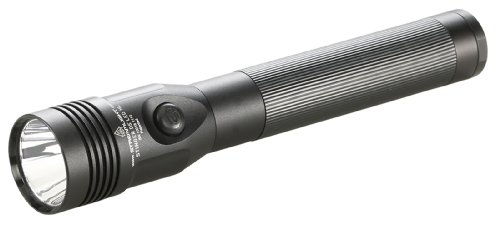
Where the Strion HL is the compact carry, the Streamlight Stinger DS LED HL is the bigger sibling built for officers who want maximum flood on demand. The 800-lumen wide-beam output covers a room the moment it clicks on, which matters during building searches and vehicle checkpoints. The “DS” in the name refers to dual switches, with a tail-cap and a head-mounted button that operate independently, so the light can be controlled by either hand without adjusting grip.
For an officer who spends more time on foot patrol or scene security than in a cruiser, that extra output pays off. The same rechargeable battery platform keeps things simple for agencies already running Stinger-family chargers. Compared to the Strion HL above, the trade-off is size and weight on the belt, which some officers love and others find bulky.
Features That Help
- 800-lumen flood beam lights up entire rooms without sweeping
- Dual-switch design lets officers run the light with either hand and from either button
- Rechargeable battery platform shares chargers with other Stinger-family units
- Durable aluminum body handles daily belt carry and the occasional drop
Trade Offs
- Larger and heavier than the Strion HL, which can feel bulky on slim duty belts
- Higher output shortens runtime on high, so officers running long shifts may stay on medium
Made For
Officers who prioritize flood coverage and dual-switch control for foot patrol, scene work, and search tasks.
Consider Something Else When
The Streamlight Strion HL is a more compact pick for officers who want a lighter belt profile and don’t need the extra flood output.
The Streamlight Vantage takes a different approach: instead of clipping a handheld to a belt, it clamps directly to a helmet brim and points wherever the wearer looks. That hands-free design matters most for SWAT, fire, and rescue roles where both hands are working a tool, a rope, or a patient. The 140-lumen output is modest compared to the Stinger DS LED HL, but it is tuned for close-range visibility rather than long throws.
For an officer or responder who already owns a compatible fire helmet or tactical bump shell, the Vantage mounts without tools and stays low-profile so it does not snag on door frames or vehicle interiors. A rear-facing blue taillight helps teammates track each other in dark hallways, a feature worth more than raw lumens in close-quarters work.
Why It Works Well
- Hands-free operation frees both hands for tools, weapons, or patient care
- Low-profile mount reduces snag risk on doors, gear, and vehicle interiors
- Rear blue taillight helps teammates track each other through dark interiors
- Tool-free attachment makes mounting and removal quick at scene
Points To Keep In Mind
- 140 lumens is intentionally modest and not ideal for long-range searches
- Requires a compatible helmet shell or brim to mount properly
Key Specs
Whose Shelf It Belongs On
Tactical officers, firefighters, and rescue personnel who need a hands-free beam on a compatible helmet.
Reach For A Different Pick When
The Streamlight Survivor right-angle flashlight is the better fit for confined-space and hazardous-area work without helmet mounting.
For patrol rifles and duty pistols running Picatinny rails, the Streamlight TLR-1s is the workhorse rail light most officers already know by name. The 300-lumen output paired with a 12,000-candela peak intensity pushes a 219-meter beam, which clears a property line or alley without dropping the light. The rail-grip clamp snaps on and off without tools, so the same light moves between a duty pistol and a carbine in seconds.
The user-programmable strobe is a real-world asset during close-quarters threats, and the ambidextrous momentary and constant-on switches work for both left and right-handed shooters. The “s” in the model name refers specifically to the strobe function. Compared to the handheld options above, the TLR-1s is purely a weapon-mounted tool, not a standalone handheld, so most agencies run it as a complement to a belt light rather than a replacement.
Real-World Strengths
- 300 lumens with a focused 219-meter beam reaches down alleys and across open ground
- Tool-free rail clamp makes installation and swaps quick at the armory
- Programmable strobe and ambidextrous switches suit both left and right-handed shooters
- Rugged anodized aluminum body holds up to recoil and rough handling
Honest Caveats
- Runs on CR123A batteries, so officers should stock spares for long shifts or training days
- Weapon-mount only, not designed for handheld use, so a belt light is still recommended
The Right Fit
Patrol rifle officers and plainclothes detectives who want a proven rail light that mounts without tools.
A Better Fit Elsewhere
The Streamlight Stinger DS LED HL is the better choice for officers who need a handheld primary light rather than a weapon-mounted one.
The Streamlight Survivor is the right-angle light most fire and hazmat crews reach for, and it crosses over naturally into law enforcement work at fuel spills, meth labs, or confined-space calls. The Class I, Division 1 intrinsic safety rating means it is built not to ignite flammable vapors, which is the kind of detail that matters in specific call types. The right-angle body clips onto turnout gear or a belt and aims forward like a headlamp without the strap.
On high, the 175-lumen output pushes a 405-meter beam for about 3.5 hours, and the 60-lumen low stretches runtime out to 13 hours for longer scenes. The push-button switch is sized for gloved hands. For officers who occasionally run fire detail or technical rescue calls, the Survivor fills a niche the standard patrol lights do not cover.
Positive Points
- Class I Div 1 intrinsic safety rating suits fuel spills and hazmat scenes
- Right-angle body clips to gear and aims forward like a headlamp without a strap
- High and low modes trade output for up to 13 hours of runtime on low
- Large push-button switch works easily with gloves on
Small Caveats
- 175 lumens trails the Stinger DS LED HL and the SABERTOOTH models for raw output
- Intrinsic-safety certification makes it heavier than non-rated right-angle lights
Quick Facts
Best Suited To
Officers who respond to hazmat, fuel, or confined-space incidents where intrinsic safety ratings matter.
Swap It Out When
The Streamlight Dualie 3AA HAZ-LO is a lighter, AA-powered alternative for officers who do not need full Div 1 certification.
The Streamlight Dualie 3AA solves a problem most officers only notice when it bites them: a single beam that casts a shadow directly under a license plate or a stairwell railing. The Dualie pairs a forward spot beam with a downward flood, so the officer can see both the distant subject and the ground under their hands at the same time. The spot mode delivers 140 lumens with a 171-meter throw, while the combined mode pushes output higher for scene lighting.
Because it runs on AA batteries, officers can resupply from nearly any store on a long shift, which removes the charging cradle dependency that comes with the Survivor and the Stinger family. The high-visibility yellow housing is easy to spot in a gear bag, and the body is built tough enough for daily belt carry.
The Value In It
- Dual LED design pairs a forward spot beam with a downward flood to reduce shadows
- Runs on AA batteries that are easy to source during long shifts or remote assignments
- High-visibility yellow housing is hard to lose in shared gear
- Spot mode runs for 18 hours on a fresh set of batteries
Room For Improvement
- Spot output at 140 lumens is lower than the Strion HL and the Stinger DS LED HL
- AA power means more battery waste on heavy use compared to rechargeable platforms
Perfect Match For
Traffic officers and patrol deputies who want shadow-free lighting for plate checks and stairwell searches.
Not Your Match When
The Streamlight Stinger DS LED HL suits officers who want higher flood output and a rechargeable platform.
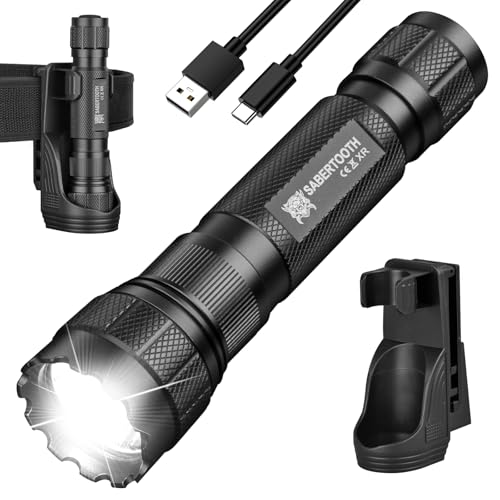
SABERTOOTH targets the budget-conscious officer who still wants a serious duty-belt light. The XR tactical flashlight puts out 1800 lumens on its top mode, with a claimed 1000-foot reach that puts it ahead of every Streamlight option above in raw throw. A double-click burst mode jumps to peak output, which is the kind of detail an officer wants when a suspect ducks behind a vehicle at distance. The body is built for belt carry with a rotating holster that keeps the light accessible without taking up much real estate.
For a smaller agency, a reserve unit, or a personal purchase, the SABERTOOTH sits in a different value conversation than the Streamlight lineup. Officers who have standardized on Streamlight chargers may find the brand switch harder to justify, but for those building a kit from scratch, the high lumens-per-dollar ratio is hard to ignore.
A Few Highlights
- 1800-lumen top output leads the shortlist in raw brightness
- Hidden USB-C port keeps the charging interface sealed until needed
- Rotating holster simplifies belt carry and quick draws
- Duty-belt form factor keeps the light accessible during vehicle exits
Where It May Fall Short
- Brand and charger ecosystem differ from Streamlight, which complicates standardization for some agencies
- High output likely trades runtime, so frequent charging is a realistic expectation
Who It Suits Best
Officers on a personal-purchase budget who want maximum brightness in a belt-friendly package.
Another Choice May Suit
The Streamlight Strion HL is the better match for agencies already running Streamlight chargers and parts inventory.
The blue-spectrum SABERTOOTH sits in a category of its own on this list. Instead of a standard white LED, this model uses a true 450–460 nanometer blue LED that makes blood trails glow in low light, which is the same property forensic investigators and trackers rely on. For evidence searches after a vehicle pursuit or a foot chase, the blue beam picks up biological traces that white light washes out, and the wavelength preserves dark adaptation better than a full white beam.
The XR3.0 platform keeps the same hidden USB-C port and 360-degree rotating holster as the duty-belt model, so charging and belt carry work the same way. Anglers use this color of light to find floats at night as well, which is why it crosses over from law enforcement into outdoor professions. It is a specialty tool, but for the right call type, nothing else on this list does what it does.
A Few Strong Suits
- Blue 450–460nm LED makes blood trails fluoresce for evidence searches
- Wavelength preserves dark adaptation better than full white light
- Same XR3.0 platform as the white-light SABERTOOTH for familiar controls and charging
- Rotating holster keeps the specialty tool accessible on a duty belt
Practical Considerations
- Blue-only output is not a general-purpose patrol light, so a white-light companion is still needed
- Color-specific LEDs can show age-related output shifts faster than standard white LEDs, depending on use
Who Should Grab It
Detectives and K9 handlers who run evidence searches and want a purpose-built blood-trail light.
Where Another Pick Suits Better
The Streamlight Stinger DS LED HL is the better all-around white-light patrol option for officers who need general-purpose brightness.
The green-output SABERTOOTH takes the same XR3.0 body and swaps the LED for a high-purity green chip that does not spook game the way white light does. Hunters lean on green for coyote and wild boar work because most animals do not register the wavelength as a threat, which lets officers on agricultural detail or game-control assignments work without scattering the herd. The 1800-lumen output still throws to roughly 1000 feet, so range is not sacrificed for color.
Like the blue-light model, this is a specialty tool rather than a daily patrol primary. The same hidden USB-C port and rotating holster carry over, so an officer who already runs the white SABERTOOTH can add this light to the kit without learning a new charging routine.
The Practical Payoff
- Green LED output does not startle game or wildlife at distance
- 1800 lumens maintain a roughly 1000-foot throw despite the color change
- Hidden USB-C charging keeps the port sealed until needed
- 360-degree rotating holster integrates with existing SABERTOOTH belt setups
Things To Weigh
- Green-only output is not suited for general patrol or color-rendering tasks
- Specialty LED lights tend to cost more per lumen than standard white-light models
Right Fit For
Officers on rural patrol, agricultural detail, or wildlife-control assignments who need game-friendly output.
Skip It When
The Streamlight Strion HL is the better everyday patrol pick for officers who do not need a specialty color output.
The red-output SABERTOOTH rounds out the color trio with the most dark-adapted option on the list. Red light preserves night vision longer than white or green, which is why astronomers, pilots, and tactical units reach for red when they need to read a map or check equipment without losing their low-light awareness. For officers working surveillances or moving through dark interiors, the red beam keeps pupils dilated and minimizes the “flash blindness” that comes from white-light exposure.
The XR3.0 platform handles charging and carry, with the same hidden USB-C port and rotating holster as the blue and green siblings. Like the other specialty models, this is a companion tool rather than a patrol replacement, and most officers will run it alongside a primary white-light belt light.
What It Does Well
- Red output preserves night vision and avoids triggering reflexive pupil contraction
- 1800 lumens push a 1000-foot throw despite the color filter
- Hidden USB-C port keeps the charging interface sealed during field use
- Shared XR3.0 chassis simplifies spare batteries and chargers across the SABERTOOTH lineup
Factors To Consider
- Red-only output limits color rendering, so it is not suited for evidence or medical assessment
- Specialty color lights command a premium over standard white-light duty models
Who Will Love This
Officers on surveillance, K9 night work, or low-light navigation who need to preserve dark adaptation.
Where A Sibling Pick Shines
The SABERTOOTH Blue-Light Tactical Flashlight is a stronger fit for evidence work where blood-trail fluorescence matters more than night vision.
What Officers Should Weigh Before Choosing A Duty Light
Output, Runtime, And Beam Shape
Lumens describe peak brightness, but candela and beam distance tell you how far that light actually reaches. A traffic officer checking plate numbers cares more about throw distance, while an officer searching a basement cares more about wide flood coverage and runtime on medium or low. For most patrol shifts, anything in the 300–800 lumen range covers the work comfortably, and topping 1000 lumens is helpful mainly for outdoor search or large-structure calls.
Power Source And Charging Logistics
Rechargeable lithium-ion platforms like the Strion HL and Stinger DS LED HL keep batteries topped off between shifts, but they tie an agency to a specific charger and battery inventory. AA-powered lights like the Dualie 3AA HAZ-LO trade runtime and output for the ability to resupply at any store, which matters on multi-day assignments or in remote areas. For officers buying on personal funds, the charging setup often decides the choice as much as the spec sheet does.
Mount Style And Carry Position
Handheld duty-belt lights cover most patrol work, but helmet-mounted, weapon-mounted, and right-angle options each fill a specific niche. Officers running patrol rifles should pair a rail light like the TLR-1s with a handheld belt light, since a weapon light alone is hard to use for building searches. Hazmat and confined-space responders should look at right-angle lights with intrinsic safety ratings, while tactical helmet teams benefit most from a hands-free mount like the Vantage.
Build Quality, Resistance Ratings, And Real-World Abuse
Look for impact resistance ratings of at least 2 meters and water resistance rated IPX4 or higher, since both are realistic expectations for daily patrol abuse. Anodized aluminum bodies resist corrosion and dings better than polymer in most cases, though high-impact nylon on intrinsically safe lights is intentional for use around fuel vapors. The honest read is that any duty light will eventually get dropped onto asphalt, and the body design decides whether that drop ends a shift.
Quick Notes Across The Shortlist
Pitfalls Shoppers Hit
The most common mistake is buying a weapon light and expecting it to double as a patrol primary. Rail-mounted lights are designed for momentary activation with a firing grip, not for long building searches where the officer needs the light at waist height while keeping a hand free. Pair a handheld belt light with a weapon light rather than picking one or the other.
Another trap is chasing the highest lumen count without checking candela and beam shape. A 2000-lumen flood light that spreads wide is great for a campsite and a poor choice for a parking-lot ID at 80 meters. Match the beam profile to the actual call type, not the spec sheet.
Why Top Tier Costs More
Higher-tier models like the Stinger DS LED HL and the Survivor earn their position through dual-switch controls, intrinsic-safety certifications, and aluminum or nylon bodies that survive years of daily carry. Cheaper tactical lights often cut corners on impact ratings, waterproofing, and switch reliability, which are exactly the traits that matter when a light fails at 2 a.m. during a rainstorm.
For officers running agency-issued gear, the upgrade usually pays for itself in charger compatibility and parts availability. For personal purchases, the upgrade mostly buys brighter output and longer runtime, which is worth it for officers who use the light daily but harder to justify for occasional use.
Frequently Asked Questions
How Many Lumens Do Officers Really Need?
For most patrol work, 300 to 800 lumens is the practical range, with higher output reserved for outdoor search or large-structure calls. Anything above 1000 lumens is helpful but rarely necessary for daily uniformed patrol.
Are Rechargeable Lights Better Than AA-Powered Lights?
Rechargeables offer better runtime per charge and lower long-term cost, while AA-powered lights like the Dualie 3AA are easier to resupply on long shifts or remote assignments. The right choice depends on whether you have access to charging cradles at the station.
Do I Need A Weapon Light If I Already Have A Handheld?
Most agencies recommend running both, since a rail-mounted light keeps both hands on the firearm during a threat, while a handheld belt light is more practical for searches and routine ID checks. A weapon light alone is rarely enough for daily patrol work.
What Is An Intrinsically Safe Flashlight?
An intrinsically safe light is built so its electronics cannot ignite flammable vapors, which matters at fuel spills, meth labs, and other hazardous scenes. Ratings like Class I Div 1 indicate the level of protection and are worth checking for officers who respond to those call types.
How Long Should A Duty Flashlight Last On A Charge?
Runtime depends on output level, but most quality duty lights run 2 to 4 hours on high and 8 to 18 hours on low or medium. Officers running 10 to 12 hour shifts should plan to recharge daily or carry a spare battery for rechargeable platforms.
Closing Remarks
For most uniformed patrol work, a rechargeable handheld like the Strion HL or Stinger DS LED HL covers daily needs, with a TLR-1s added for officers carrying a duty firearm. Specialty roles like hazmat, helmet-mounted tactical work, and color-specific tracking call for the Survivor, Vantage, and the SABERTOOTH color models. Pick the light that matches the shift you actually run, and treat the rest as supplements rather than replacements.