

A steamy shower feels great for ten minutes and then punishes your walls for the next ten years. Paint peels, mirror edges fog, and mildew shows up in the caulk lines around the tub. A properly sized fan with a built-in LED fixes two problems at once: it pulls humid air out before it can settle, and it lights the room without a second fixture to wire. I’ve spent years helping homeowners and renters sort through ventilation gear, and the gap between “the cheapest fan at the hardware store” and a unit that actually clears a bathroom in under twenty minutes is wider than most people expect. This roundup focuses on picks that move real air, run quiet enough that nobody complains at 6 a.m., and install without turning a weekend into a construction project.
How The Shortlist Stacks Up

BREEZE EASY Bathroom Exhaust Fan with Light, 50-80-110 CFM (BEL5080110)
BREEZE EASY Bathroom Exhaust Fan with LED Light, 110 CFM, No-Attic (BEL110)

BREEZE EASY Bathroom Exhaust Fan, 50-80-110 CFM, Energy Star (BES5080110)

CONGKAILU Upgraded S97012026 Fan Assembly for Broan-Nutone

Panasonic WhisperFit Ceiling Mount Exhaust Fan with Dimmable LED (FV-0511VFL1)
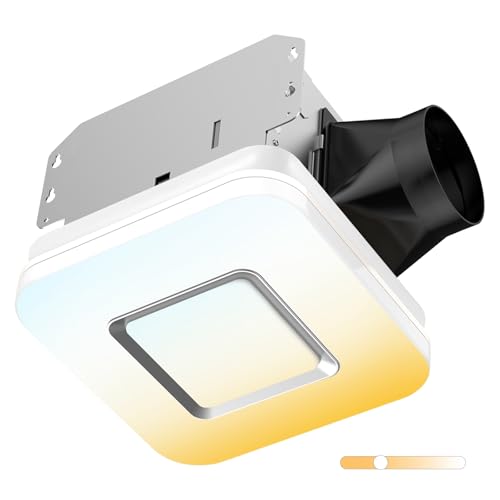
OREiN Bathroom Exhaust Fan with Light, 100 CFM, 1.5 Sones
OREiN 2-in-1 Bathroom Exhaust Fan with Light, 110 CFM
A Breakdown Of The Leading Choices
The BEL5080110 is the kind of fan that quietly does its job in half-bath powder rooms and full master baths alike, because airflow is selectable at 50, 80, or 110 CFM (cubic feet per minute, the standard way exhaust fan strength is measured in the U.S.). That dial-in approach means a small guest bath doesn’t get blasted with wind while the larger primary bath still clears steam in a reasonable window. The integrated LED panel lights the ceiling evenly, which matters more than people realize when the only other light source is a vanity bar overhead.
Install leans toward the room side thanks to the SecureMount tab system, so most homeowners won’t have to climb into the attic with a flashlight and a roll of foil tape. CFM stands for cubic feet per minute, and choosing the right one for your room size is the single biggest decision in ventilation. This pick gives you three options in one box, which removes the guesswork before you even open the instructions.
Advantages To Know
- Three airflow settings cover everything from a closet-sized powder room to a soaking-tub primary bath.
- Built-in LED eliminates the need to wire a separate ceiling fixture, saving a trip to the breaker.
- Room-side mounting keeps the install contained to a ladder and a helper, not a full attic expedition.
- Adjustable CFM also means you can dial down noise in a small space rather than overshooting with a single fixed speed.
- One fan replaces an old unit and an aging light can in the same ceiling cutout, which simplifies weekend projects.
Things To Consider
- At the 110 CFM setting, owners in narrow hallways outside the bath may notice the sound more than with a quieter dedicated unit.
- The LED panel is fixed-tone, so households wanting warm or daylight-switching flexibility will need to look at a different pick on this list.
- Replacement parts for the integrated light module can be harder to source than the fan motor itself.
Who Will Love This
Homeowners tackling a single remodel who want one fan flexible enough for both a guest bath and a larger primary suite without buying two units.
Where Another Pick Suits Better
Light sleepers and noise-sensitive households get a quieter result from the OREiN 100 CFM fan, which runs at 1.5 sones (a sones rating measures perceived loudness; 1.5 is roughly the sound of a soft rustle).
The BEL110 strips away the airflow selector and commits to 110 CFM, which makes it the strongest single-speed pick on this list from the same brand. For rooms over roughly 100 square feet, that ceiling fan with extra muscle clears the mirror before anyone has finished brushing their teeth. The integrated LED runs cool to the touch, so there’s no warm-up delay when you walk in at night.
No-attic installation is the headline feature, and it matters most in older homes where the ceiling joists are tight or the attic is inaccessible. The fan mounts entirely from below, which means a single evening project for most handy homeowners. Anyone who’s ever balanced on a joist with a screwdriver between their teeth will appreciate that simplicity right away.
The Upside
- 110 CFM handles large primary baths and steam-heavy showers without leaving fog on the mirror five minutes later.
- Room-side install removes the most frustrating part of fan replacement for older homes with no attic access.
- Single-speed simplicity means fewer wires to confuse a first-time installer.
- Bright LED throws even light across the ceiling, which helps in windowless interior baths.
Honest Caveats
- No adjustable airflow means it can feel aggressive in a small half-bath powder room.
- Single LED tone may not match a warm-dim vanity setup some homeowners prefer.
Built With In Mind
Owners of older homes with no attic access who need a strong, set-and-forget fan for a full-size bathroom.
Skip It When
Smaller bathrooms or noise-sensitive households will find the Panasonic WhisperFit’s adjustable lower-CFM settings more comfortable to live with day to day.
The BES5080110 is the no-light sibling of the BEL5080110, which sounds like a downgrade until you already have a perfectly good vanity light overhead. Energy Star certification here means the motor meets efficiency thresholds that translate to lower wattage over the years, and the same 50-80-110 CFM selector covers small powder rooms through generous primary baths.
For someone rewiring a vintage bathroom and keeping a period-correct ceiling fixture, dropping the LED saves both cost and visual clutter. The airflow is identical to the lit version, so ventilation performance doesn’t take a back seat just because the light panel is gone. In most cases the install footprint matches, so swapping one for the other is straightforward when plans change.
Positive Takeaways
- Energy Star motor runs cooler and pulls less wattage than uncertified alternatives in the same airflow class.
- Three CFM speeds let you tune output without swapping fans later.
- Clean grille-only look suits bathrooms with existing statement lighting.
- Room-side mounting keeps the project contained to a ladder.
Room For Improvement
- No light means you’ll need to confirm the existing fixture covers the room adequately.
- Single grille color and finish limit styling options for design-focused renovations.
Right Fit For
Renovators preserving an existing light fixture who want efficient ventilation without doubling up on ceiling hardware.
Consider Something Else When
Bathrooms with no overhead lighting at all benefit more from the OREiN 2-in-1 110 CFM unit, which combines strong airflow with a bright built-in LED.
The CONGKAILU S97012026 isn’t a full fan, it’s a metal-blade replacement assembly designed to swap into existing Broan-Nutone housings. That’s a narrow category, but for the right homeowner it’s a lifesaver: keep the original housing, the duct, and the wiring, and just refresh the part that actually moves air. Compatibility covers many 688, 663, 695, and 696-series Nutone units as well as several Broan models with the same metal blade setup.
Anyone who has tried to find a genuine OEM replacement motor for a fifteen-year-old fan knows the frustration of discontinued parts. This assembly sidesteps that search and gives an aging fan a new mechanical heart. The catch is verifying your exact model number before ordering, since the 696N housing is explicitly not on the fit list and a mismatch won’t seat properly.
Noteworthy Benefits
- Restores performance to working Broan-Nutone housings without full replacement cost.
- Metal blade construction tends to hold up better than plastic originals in older installations.
- Wide model coverage makes it a likely match for many homes built in the late 1990s and 2000s.
- Drop-in design preserves existing ductwork and electrical connections.
Points To Note
- Not a fit for Nutone 696N housings, so model verification is mandatory before ordering.
- No light included, so this is strictly a motor-and-blade refresh for an existing setup.
- Homes without a compatible existing housing will need a full unit instead.
Whose Shelf It Belongs On
Homeowners with a still-functional Broan or Nutone housing whose fan motor has finally given out and who want to avoid a full ceiling tear-out.
Reach For A Different Pick When
Anyone starting from scratch or replacing a damaged housing gets more value from a complete unit like the BREEZE EASY BEL110 with integrated LED.
The WhisperFit FV-0511VFL1 sits at the premium end for good reason: it combines a DC/ECM motor (a brushless direct-current motor that’s both quieter and more efficient than older AC designs) with Pick-A-Flow airflow selection across 50, 80, and 110 CFM. The dimmable 10W LED panel paired with a separate low-power night light gives this fan a dual-personality lighting setup that handles morning routines and midnight bathroom trips without the same harsh glare.
SmartFlow technology adjusts the fan’s speed based on the resistance it senses in the duct run, which compensates for longer or more convoluted venting paths. For renovations with tricky duct layouts, that auto-compensation keeps the airflow honest even when the duct takes a few extra turns. It’s the only Energy Star-certified pick on this list with a dimmable light, and that combination is genuinely rare at this airflow tier.
Real Benefits
- Dimmable LED with a dedicated low-level night light covers both bright morning use and soft overnight navigation.
- Three selectable CFM speeds with SmartFlow compensation handle everything from powder rooms to master baths.
- DC motor is noticeably quieter than older AC designs at the same airflow, which matters in homes with adjacent bedrooms.
- Energy Star rating confirms efficient long-term operation.
Worth Bearing In Mind
- Higher upfront cost than the single-purpose fans earlier on this list.
- Dimmable LED requires a compatible dimmer switch, which may not be in place in older bathrooms.
Key Advantages
Key Advantages
Made For
Homeowners deep in a renovation who want premium quiet, dimmable light, and tunable airflow in one ceiling package.
A Better Fit Elsewhere
Budget-focused shoppers who don’t need dimming or SmartFlow get equivalent ventilation from the BREEZE EASY BEL5080110 at a noticeably lower cost.
The OREiN 100 CFM fan runs at 1.5 sones, which puts it firmly in the “barely-there” category for household noise. For bathrooms next to bedrooms, that low rating matters far more than raw airflow numbers because a fan that wakes up a partner at 6 a.m. won’t actually get used. The 1500-lumen LED panel throws strong general light, while the 3CCT (three selectable color temperatures, typically warm, neutral, and daylight) plus a dedicated night light covers the spectrum from candlelit to daylight-bright.
Room-side installation matches the size of a standard 8.11″ × 7.48″ ceiling opening with a 4-inch duct, which means it drops into most retrofit situations without reframing. Energy Star and ETL listings round out the spec sheet for anyone vetting components for code or insurance purposes. The honest read is that this is the friendliest pick on the list for noise-averse households that still want a full-feature light panel.
What Stands Out
- 1.5-sone operation is quiet enough to run overnight without disturbing adjacent rooms.
- Three selectable color temperatures plus a night light cover every lighting mood a household typically needs.
- 1500-lumen LED output handles larger bathrooms without needing a separate ceiling fixture.
- Standard retrofit sizing means it fits the ceiling cutouts most homeowners already have.
Factors To Consider
- 100 CFM is a single fixed speed, so very small powder rooms may feel over-ventilated.
- Ceiling opening measurement matters: verify the existing cutout before ordering to avoid a return trip.
Perfect Match For
Households with thin interior walls, shared bedrooms, or shift workers who need ventilation they can run any hour without noise complaints.
Not Your Match When
Larger master baths with jetted tubs may need the 110 CFM output of the OREiN 2-in-1 fan listed next on this shortlist.
The OREiN 2-in-1 is the strongest airflow pick from this brand, pushing 110 CFM through the same standard 8.11″ × 7.48″ ceiling footprint as its quieter sibling. The 1500-lumen LED panel is on the bright side, which makes it well suited to primary bathrooms that double as the main grooming space. Three selectable color temperatures plus a dedicated night light round out a versatile lighting package.
Room-side installation uses the included quick-mount bracket, and most homeowners report the step-by-step guide is enough to complete the swap without an electrician. The unit covers ceilings that the smaller 100 CFM version would struggle to clear quickly, especially in bathrooms with jetted tubs or extended shower sessions. Among full-feature picks on this list, it offers the best balance of airflow and lighting without stepping into the premium price bracket.
What Stands Out
- 110 CFM moves enough air to clear a large primary bath after a long, steamy shower.
- 1500-lumen LED panel lights grooming-heavy bathrooms without help from a vanity bar.
- Three color temperatures plus night light give the room a flexible lighting personality.
- Quick-mount bracket and room-side install keep the project to a single afternoon for most homeowners.
Small Caveats
- 110 CFM at this size can feel slightly louder than the 100 CFM OREiN sibling in shared-wall situations.
- Verify your existing ceiling opening before ordering to avoid a sizing mismatch on install day.
Best Suited To
Primary and master bathrooms where strong airflow and bright tunable lighting matter more than absolute whisper-quiet operation.
Look Elsewhere When
Households prioritizing near-silent operation should step down to the OREiN 100 CFM fan, which trades a bit of airflow for noticeably less noise.
What To Weigh Before Choosing Bathroom Exhaust Fans With Led Light
Sizing The Fan To The Room
The single biggest mistake homeowners make is installing a fan that’s too small for the space. A rough rule of thumb is one CFM per square foot of bathroom floor area, with extra capacity for high ceilings or jetted tubs. A 7-by-9-foot bath needs at least 63 CFM, and most pros round up to 80 or 110 to clear the mirror faster. Undersized fans run longer to do the same work, which negates any efficiency advantage.
Why Noise Rating Matters More Than People Expect
Sones measure perceived loudness, not raw decibels. Anything at or below 1.5 sones is roughly the sound of leaves rustling, and most people stop noticing it during normal conversation. A 4-sone fan, by contrast, is hard to talk over and tends to get turned off early. Bathrooms next to bedrooms or thin interior walls deserve the lowest sones rating the budget allows.
Duct Length And Layout
A fan only performs as well as the duct it vents through. Long runs, sharp elbows, and flexible plastic ducting all reduce real-world airflow significantly. Look for fans with motor compensation technology when the duct path is complex, and keep total vent runs under roughly 50 feet when possible. Roof or wall caps with backdraft dampers also matter more than the spec sheet suggests.
Integrated Light Vs Separate Fixture
Fans with built-in LEDs save a wiring step and reduce ceiling clutter, but they tie lighting and ventilation to the same switch. Households that want separate control, or that already have a strong vanity light, sometimes prefer a fan-only unit. Color temperature tuning, expressed as CCT, adds genuine flexibility for morning routines versus evening wind-downs.
Key Considerations Across These Picks
Common Shopping Slip Ups
The most frequent mistake is buying a fan based on CFM alone without checking sones, duct compatibility, or housing size. A 110 CFM unit that screams at 4 sones gets used far less than an 80 CFM unit at 1.0. Verify the ceiling cutout dimensions, the duct diameter, and the switch wiring before clicking order. A ten-minute measurement saves a return trip and a weekend of frustration.
Where The Extra Money Goes
Premium models justify their cost through quieter brushless motors, dimmable multi-mode lighting, and motor compensation that holds airflow steady across tricky duct runs. For most households, the upgrade pays off when the bathroom sits next to a bedroom, or when the ceiling cutout is non-standard. For a quick powder-room swap in a rarely-used guest bath, a budget-friendly fixed-CFM fan covers the need just fine.
Frequently Asked Questions
How Many CFM Do I Need For My Bathroom?
A practical baseline is one CFM per square foot of floor area, rounded up. A 50-square-foot bath wants at least 50 CFM, though most homeowners go higher to clear the mirror faster. Adding 50 CFM extra for jetted tubs or extended showers is reasonable.
Are Combination Fan And Light Units Harder To Install?
Not significantly, since the wiring usually combines fan and light on a single switch loop. Separate switch control requires an extra wire run, but most retrofits can handle this in an afternoon. Room-side mounting designs remove the hardest part, which is working above the ceiling.
How Loud Is Too Loud For A Bathroom Fan?
Anything over roughly 2 sones starts competing with normal conversation, and 4 sones or higher tends to get shut off early. For bathrooms adjacent to bedrooms, aim for 1.5 sones or below to keep early-morning runs from waking a partner.
Do I Need A Heavier Fan For A Basement Bathroom?
Basement bathrooms often deal with higher humidity and slower air exchange, so stepping up one CFM tier above the same-size above-grade bath is wise. A 110 CFM unit is often the right call even in a modest basement half-bath.
How Often Should The Fan Run After A Shower?
Fifteen to twenty minutes is a common range, though steam-heavy showers with jetted tubs benefit from longer runs. Many homeowners pair the fan with a simple countdown switch to avoid guessing and to keep the room honest about its humidity.
Bottom Line
A bathroom exhaust fan with LED is one of those quiet upgrades that pays off every single day, mostly by not being noticeable. Match CFM to room size, prioritize low sones for shared walls, and confirm the ceiling cutout before ordering. Any of the seven picks above will clear the mirror and light the room well. The right one depends on whether you value adjustable airflow, quiet operation, or a full lighting package more. Pick the fan that matches the bathroom you actually have, not the one with the longest spec sheet, and the rest of the decision tends to take care of itself.