

Replacing the tired incandescents in a chandelier or sconce should be simple, yet the wrong base size or color temperature leaves a whole room looking off. I pulled together seven LED candelabra bulbs that cover the common sockets, dimming needs, and specialty situations (RVs, outdoor string lights, smart homes) so the next swap goes smoothly.
The Main Contenders

Baufan T6 12V-36V E12 Candelabra Tubular LED Bulb 4W (2700K)
Philips Hue Smart 40W B39 Candle-Shaped LED Bulb (Color, E12)

Austin Coast 25-Pack C7 Warm LED Replacement Bulbs (E12)
YIMILITE B11 Dimmable E26 LED Candelabra Bulbs, 6-Pack

Sengled E12 Dimmable 40W CA10 LED Bulbs, 5000K, 6-Pack
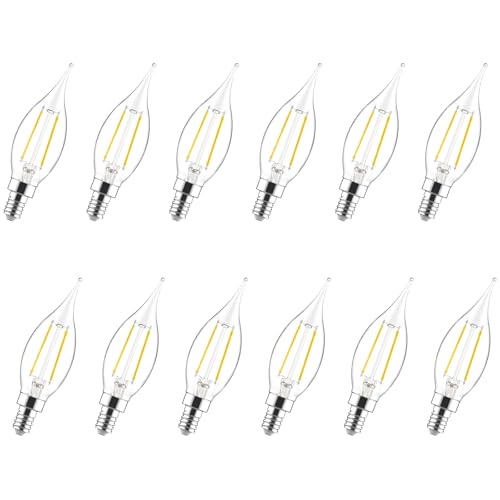
Sengled E12 Dimmable 40W CA10 LED Bulbs 5000K, 12-Pack

Sengled E12 Dimmable 60W CA10 LED Bulbs, 2700K, 6-Pack
A Closer Look At Each Pick
Most candelabra LEDs assume a household 120V line, but RVs, boats, and solar cabins run on 12V or 24V DC. This Baufan T6 tubular bulb fills that exact gap, accepting a low-voltage range and drawing only 4W while giving off the warm 2700K glow I associate with classic incandescent candelabras. The narrow T6 shape slips into tight sconce housings and reading lamps where a standard candle bulb would feel bulky.
It’s a specialized pick rather than a household all-rounder, and the global-store sourcing means warranty terms may not apply locally. For anyone outfitting a camper, a marine cabin, or an off-grid solar shed, though, it’s one of the few candelabra-form LEDs that won’t flicker or refuse to start on a low-voltage circuit.
Real-World Strengths
- Accepts 12V, 24V, and 36V DC, so it matches common RV and marine electrical systems.
- 4W draw produces light comparable to a 40W incandescent, helping preserve battery life.
- Slim T6 tubular profile fits narrow sconce openings where a flared candle bulb won’t seat.
- 2700K soft warm white keeps the cozy tone traditional candelabra fixtures are loved for.
Worth Noting
- International sourcing can mean labeling and packaging differ from domestic products.
- Manufacturer warranty coverage may not apply in all regions.
Who Should Grab It
RVers, boat owners, and off-grid cabin dwellers who need a candelabra-shaped bulb that runs on 12V-36V DC systems.
Consider Something Else When
Shoppers outfitting a standard household chandelier should look at the Sengled CA10 packs below, which target 120V residential wiring instead.
The Philips Hue B39 candle stands apart from every other pick on this list because it isn’t just a bulb, it’s a node in a smart-home system. The 40W-equivalent output, 450-lumen rating, and full white-to-color range pair with app control plus compatibility with Alexa, Google Assistant, and Apple HomeKit. For someone already running Hue in other rooms, adding a candle bulb that responds to the same automations keeps the lighting language consistent across the house.
Compare that to the dumb-YIMILITE B11 or the Sengled CA10 packs, which only switch on and dim; the Hue goes further into scheduling, scenes, and remote control when bridged through a Hue Bridge. It’s the most expensive option per bulb here, but it’s the only one that turns a candelabra fixture into a tunable light source.
Positive Points
- Full color and tunable white in a single E12 bulb, removing the need for separate fixtures.
- Works with major voice ecosystems, so it integrates without rebuilding an existing setup.
- Bluetooth lets the bulb pair with the Hue app even without a Hue Bridge for basic control.
- Compatible with Matter through the Hue Bridge, opening it to wider smart-home platforms.
Honest Caveats
- Unlocked automations and remote access depend on adding a Hue Bridge, an extra purchase.
- Color features pull more standby power than a basic dimmable LED, which may matter on energy audits.
Best Suited To
Smart-home enthusiasts who already use or want to start using app and voice control across their lighting.
Skip It When
Budget-focused shoppers should consider the YIMILITE B11 or Sengled CA10 packs, which deliver warm dimmable light at a much lower cost per bulb.
Outdoor patio string lights and holiday displays eat bulbs fast, especially when one bad lamp takes down the whole run. Austin Coast ships a 25-pack of C7 LEDs in warm white with an E12 base, giving enough spares to refresh an entire patio set plus keep replacements on hand. The plastic construction handles weather exposure better than thin glass incandescent C7s, and the low 0.6W draw makes running long strings more practical on a standard outdoor outlet.
Where the Philips Hue above is a smart showpiece, this is a workhorse. The C7 shape is shorter than a full candle, which is worth noting for anyone wanting the elongated candle silhouette in a chandelier; these are nightlight-scale bulbs, not chandelier candles.
What Helps Most
- 25-bulk pack reduces reordering frequency for large patio or seasonal installations.
- Plastic construction tolerates weather and accidental drops better than fragile glass C7s.
- 0.6W draw replaces typical 7W C7 incandescents, cutting string-light energy use.
- Up to 25,000-hour lifespan means most owners won’t re-lamp within several seasons.
Things To Consider
- C7 nightlight form factor is shorter than a full chandelier candle, so it won’t suit every fixture.
- Not designed for dimming, which may matter if the string-light circuit runs through a dimmer.
Made For
Anyone refreshing outdoor E12 string lights, patio canopies, or seasonal displays who needs plenty of spares at once.
A Better Fit Elsewhere
For indoor chandeliers needing a true candle silhouette and dimming support, the YIMILITE B11 is a more appropriate shape and feature match.
Here’s where terminology catches a lot of people off guard: a “candelabra bulb” doesn’t always mean an E12 base. Many chandeliers and ceiling fans actually use the larger E26 screw base, and the YIMILITE B11 is built precisely for that fixture family. The bulb delivers 2700K soft white with a 360-degree beam angle and dims smoothly from 10 to 100 percent when paired with a compatible dimmer.
Against the Sengled CA10 picks below, the YIMILITE trades the candelabra E12 base for the medium E26, so it’s worth confirming the socket before ordering. For dining-room chandeliers wired to standard dimmers, though, the smooth flicker-free dimming range is a real comfort.
Points In Its Favor
- E26 base matches many ceiling fans and chandelier fixtures labeled for medium-base bulbs.
- 360-degree beam angle fills the fixture with even light, avoiding dark spots on the shade.
- Smooth dimming from 10-100% supports cozy dinners, movie nights, and bright task work.
- No visible flicker reduces eye strain during long evenings at the table.
Where It Is Less Suited
- Dimming depends on the wall switch being a compatible LED dimmer, not every existing dimmer qualifies.
- 80-450 lumen output per bulb may feel modest for very large, high-ceiling fixtures.
The Right Fit
Homeowners with E26-base chandeliers or ceiling fans who want smooth, flicker-free dimming on a familiar medium socket.
Reach For A Different Pick When
Fixtures that take the smaller E12 candelabra socket pair better with the Sengled CA10 packs, which are tuned for that narrower base.
Kitchens and craft rooms don’t always want the warm glow of a 2700K candelabra; sometimes the work calls for the crisp, focused energy of 5000K daylight. Sengled’s CA10 candle bulb delivers exactly that tone in a 6-pack, dimmable, and built around the narrow E12 candelabra base. The CA10 shape is the classic pointed candle silhouette, which matters in fixtures where shorter C7-style bulbs would look out of proportion.
Compared to the warmer Sengled 2700K pack below, this one trades cozy ambiance for clarity. For most kitchens, bathroom vanities, or home-office chandeliers, that trade is exactly the right call.
The Helpful Details
- 5000K daylight tone improves visibility for cooking, makeup, or detail work without yellow cast.
- CA10 candle shape preserves the traditional pointed silhouette in chandeliers and wall sconces.
- Flicker-free dimming keeps the room comfortable across the full brightness range.
- 40W-equivalent output in low-power LED form saves energy versus legacy incandescents.
Trade-Offs
- 5000K can feel cold or sterile in bedrooms and living rooms where warmer light sets the mood.
- 6-pack sizing means smaller projects will end up with spare bulbs stored in a drawer.
Feature Snapshot
Built With In Mind
Kitchen and bathroom homeowners who need bright, neutral light from a traditional chandelier or ceiling-fan fixture.
Swap It Out When
Living-room dwellers after a softer evening glow should reach for the Sengled 2700K 60W-equivalent pack further down the list.
Large chandeliers and multi-room retrofits eat through 6-packs fast, which is where the 12-pack version of the Sengled 5000K CA10 earns its keep. The bulb itself matches its 6-pack sibling on every spec, but doubling the count makes it easier to handle an entire open-concept living area or matching fixtures in a hallway and dining room. The CA10 candle shape and E12 base stay consistent, so a mixed-size batch across rooms still looks uniform.
For someone buying only one fixture, the 6-pack is friendlier to storage. For a whole-home refresh, the 12-pack is the one that gets every room done in a single order.
Where It Excels
- 12-pack covers large chandeliers or multiple fixtures without a second order.
- Identical CA10 spec as the 6-pack keeps the lighting uniform room to room.
- 5000K daylight is well-suited for task-heavy spaces like kitchens and craft rooms.
- Dimmable without flicker, so brightness adjusts comfortably throughout the day.
Practical Considerations
- Buying 12 of the same bulb locks in a single color temperature across all fixtures.
- Storage space for the extras matters in small apartments.
Who It Suits Best
Homeowners tackling a whole-home refresh or outfitting a large chandelier who want matching bulbs in one shipment.
Where Another Pick Suits Better
The YIMILITE B11 fits better for fixtures using the larger E26 base, where this Sengled’s E12 socket would not seat.
Most chandeliers in dining rooms and entryways lean on the warm, soft glow of 2700K to feel inviting, and Sengled’s 60W-equivalent CA10 sits right in that sweet spot. The bump from the 40W to the 60W equivalent gives noticeably more output, which helps in rooms with tall ceilings or fixtures that use multiple bulbs at varying heights. Dimmable and flicker-free, it responds cleanly to standard LED-compatible dimmer switches.
It rounds out the list as the warmest, brightest traditional-look option, sitting in contrast to the daylight-focused Sengled 5000K picks above and the colorful Hue earlier on.
Notable Gains
- 2700K soft white creates the cozy atmosphere most dining rooms and entryways aim for.
- 60W equivalent provides more headroom for tall ceilings and multi-tier chandeliers.
- CA10 candle shape keeps the classic chandelier silhouette intact.
- Flicker-free dimming adapts from full brightness down to a quiet evening glow.
Points To Note
- Higher output per bulb may overpower small accent fixtures in compact rooms.
- Compatibility still depends on using an LED-rated dimmer for the smoothest performance.
Perfect Match For
Homeowners seeking a warm, traditional chandelier glow with enough brightness for tall ceilings and multi-arm fixtures.
Not Your Match When
Shoppers focused on task lighting in kitchens or bathrooms should consider the Sengled 5000K 6-pack above for crisper visibility.
Picking the Right Base, Tone, and Brightness
Choosing LED candelabra bulbs gets easier once three decisions are locked down: base type, color temperature, and whether dimming matters.
Base Type Comes First
The phrase “candelabra bulb” gets used loosely, but the actual socket determines what fits. E12 is the narrow candelabra base seen on most decorative chandeliers and ceiling fans, while E26 is the medium base found on fixtures that take a standard household bulb. Pull an old bulb and check the threads before ordering; a mismatch means the new bulb simply won’t seat. The YIMILITE B11 in this list is the only E26 pick, and it earns its place by covering fixtures that the E12 bulbs can’t.
Color Temperature Sets the Mood
Color temperature, measured in Kelvin, decides whether a room feels cozy or clinical. Lower numbers around 2700K read warm and inviting, which suits living rooms, dining spaces, and bedrooms. Numbers around 5000K read closer to natural daylight, which most people prefer for kitchens, bathrooms, and workspaces. Picking the wrong tone for the room is the most common regret I see in chandelier retrofits, and it’s worth holding a sample bulb in the fixture before committing to a multi-pack.
Dimming Depends on the Switch
Not every dimmer plays nicely with LEDs, and a mismatched switch can cause flicker, buzz, or a limited dimming range. Checking the dimmer for an LED-compatible rating saves a return trip later. The Sengled CA10 picks and YIMILITE B11 all support smooth dimming, while the C7 nightlight pack from Austin Coast does not.
Things Worth Knowing Before You Buy
Common Slip-Ups in This Category
The biggest mistake I see is buying an E12 bulb for an E26 fixture (or the reverse) without checking the socket. Another is choosing 5000K daylight for a dining room because it looked brighter in the store, only to find it reads cold at dinner. Skipping dimmer compatibility is the third common issue, and it shows up as flicker or a buzz when the wall switch is turned down.
Where the Premium Tier Earns It
Smart features, specialty voltages, and higher output all raise the price of a candelabra bulb. The Philips Hue pick is the clearest example: it costs more per bulb than a basic dimmable LED, but it adds app and voice control plus full color. The Baufan low-voltage bulb also costs more for a reason, since most retail LEDs won’t run on 12V-36V DC at all. For a standard 120V chandelier where none of those extras apply, a basic dimmable Sengled CA10 covers the need at a much lower cost per bulb.
Frequently Asked Questions
What’s the difference between E12 and E26 bases?
E12 is the smaller candelabra socket used in most decorative chandeliers, while E26 is the medium screw base found in many ceiling fans and standard household fixtures. The two aren’t interchangeable without an adapter.
Can LED candelabra bulbs be used outdoors?
Some can, but only when rated for outdoor or damp locations. The Austin Coast C7 pack is designed for outdoor string lights, while most indoor-rated chandelier bulbs aren’t sealed against moisture.
Why do some LED bulbs flicker on a dimmer?
Flicker usually points to a dimmer switch that wasn’t designed for low-wattage LED loads. Replacing the switch with an LED-compatible model typically clears the issue.
What does 2700K versus 5000K mean?
It’s the color temperature: 2700K reads warm and yellowish like a traditional incandescent, while 5000K reads closer to natural daylight. Warm tones suit living spaces, cooler tones suit task areas.
How many candelabra bulbs does a typical chandelier need?
Most residential chandeliers hold between 3 and 8 bulbs, though larger fixtures can exceed that. Counting the sockets before ordering prevents an under-buy or a pile of unused spares.
The Takeaway
The right LED candelabra bulb depends less on a single winner and more on the fixture in the ceiling, the room’s purpose, and whether smart features are worth the spend. Match the base, pick a color temperature that suits the mood, and confirm the dimmer compatibility before clicking through.