

A yard that fades to black at sunset wastes half its potential. I’ve spent enough evenings walking past unlit driveways, shadowy trees, and pathways I couldn’t quite read to know how much a thoughtful lighting plan changes the mood of a home. The trouble is, the gear behind that glow is full of jargon: wattage ratings, low-voltage transformers, beam angles, IP ratings.
I built this roundup for homeowners who want the glow without the engineering degree. Below are six solid landscape lighting systems, mixing in-ground well lights, accent spotlights, and the transformers that quietly run them all.
The Shortlist At A Glance

Gardencoin Brass Low Voltage Landscape Well Lights (4 Pack)

DEWENWILS 200W Low Voltage Landscape Transformer

DEWENWILS 120W Low Voltage Landscape Transformer
Gardencoin LED Well Lights 6 Pack with MR16 Bulbs
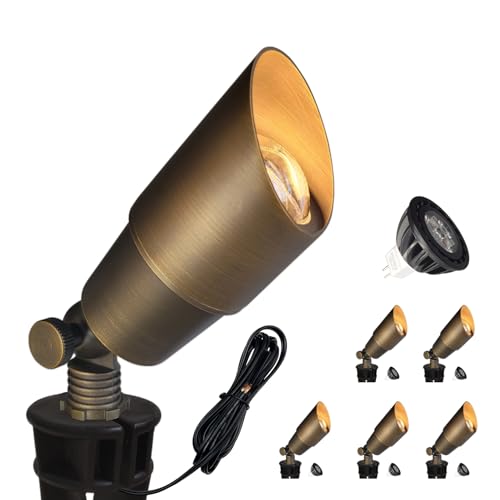
COLOER Solid Brass Landscape Spotlights 6 Pack

DEWENWILS 300W WiFi Smart Transformer, 3 Zones
The Strengths Of Each Pick
These Gardencoin well lights are the kind of fixture you plant once and stop thinking about. The grated solid brass top sits over a reinforced nylon body, and together they shrug off the kind of wet, salty, freeze-thaw punishment that finishes off aluminum housings within a season or two. A precision-cut brass grille softens the beam, so the uplight reads as a gentle wash across a stone column or tree trunk instead of a flashlight aimed at your guests.
Each fixture is roughly 5 inches across the cover and 5.5 inches tall, with an adjustable base so you can aim the beam without yanking the whole unit out of the soil. That height works nicely along driveway edges and low garden walls, where you want the light source itself to nearly disappear. Note that bulbs are not included, so you’ll need to pick up MR16 LEDs separately to complete the system.
What Earns Its Place
- Solid brass top resists corrosion far better than aluminum or plastic alternatives in damp climates.
- Grated grille diffuses the beam, cutting glare across walkways and driveways.
- Adjustable base lets you re-aim the light after the fixture is already planted.
- Low-voltage 12V wiring keeps the system safer for DIY trenching along paths.
- Four-pack footprint covers a typical front-yard run without leaving a gap mid-path.
Honest Caveats
- Bulbs ship not included, which adds a separate purchase and a small learning curve on MR16 sizing.
- Brass will develop a natural patina over time, which some homeowners love and others may want to polish away.
Key Specs
Whose Yard It Belongs In
Homeowners outfitting a path, driveway edge, or low retaining wall who want a brass fixture that ages gracefully rather than corroding after one rough winter.
Where Another Pick Suits Better
Pick the Gardencoin LED Well Lights 6 Pack instead if you’d rather skip the extra bulb-buying step and get dimmable warm-white lamps in the box from day one.
The transformer is the unsung box behind every landscape lighting system, and DEWENWILS gives this 200W unit five control modes that cover most homeowner habits. Manual on/off is the fallback, Dusk to Dawn uses a built-in photocell (a small light sensor that turns fixtures on when ambient light drops), and the countdown mode lets you pick how many hours the lights stay on after dusk. It’s the kind of flexibility that saves you from crawling behind a shrub to flip a switch every night.
It steps 120V household current down to a safer 12V or 14V AC output, which is what your path lights, spotlights, and well lights actually want. A 200W ceiling handles a mid-size yard plan, roughly 30 to 40 typical LED fixtures on a single run. For most suburban lots, that headroom means you won’t be calculating wattage in your head every time you add a lamp.
Why It Works Well
- Five operating modes cover dusk-on, manual, and timer-driven schedules without extra hardware.
- 200W capacity suits mid-size yard layouts with headroom to grow.
- 12V/14V dual output matches most LED and halogen landscape fixtures.
- Indoor-outdoor rated housing lets you mount it on a wall near the breaker.
Worth Noting
- Not designed for dimmer switches, so dimming has to happen at the fixture or via smart controls.
- Larger yards with dozens of LEDs may push past the 200W ceiling and require a step-down plan.
The Right Fit
Homeowners planning a mid-size landscape lighting system who want timer and dusk modes without paying for app-based smart controls.
Reach For A Different Pick When
Pick the DEWENWILS 300W WiFi Smart Transformer if you want three independently controlled zones plus phone and voice control from the start.
Sometimes the best transformer is the one you barely think about. This 120W DEWENWILS unit uses a built-in dusk-to-dawn sensor to switch your lights on at sunset and off at sunrise, no app, no schedule programming, no fiddling. If you’re new to landscape lighting and want something closer to “plug it in and forget it,” this is the friendliest starting point on the list.
A countdown timer adds a useful second mode for folks who don’t want lights running all night. Convert 120V household current to 12V AC output and you get a safer, simpler wiring path that’s well within DIY territory for a small front-yard plan. Just keep in mind the 120W ceiling, which is enough for a tight path-and-flowerbed setup but may feel tight if you plan to expand later.
Useful Highlights
- Built-in dusk-to-dawn sensor automates on/off without any schedule setup.
- Countdown timer mode lets you cap runtime after dark if you prefer.
- Compact housing fits on a garage or porch wall without dominating the space.
- 120V to 12V conversion is a clean match for low-voltage LED path and well lights.
Things To Consider
- 120W capacity leaves less headroom than the 200W sibling, so expansions may force a second transformer.
- The built-in sensor means the mounting location needs shade-friendly placement to read dusk correctly.
Built With In Mind
First-time installers with a modest path or garden lighting plan who want automated dusk behavior without smart-home complexity.
Swap It Out When
Move up to the DEWENWILS 200W Low Voltage Landscape Transformer if you want more wattage headroom plus five control modes rather than just two.
Where the first Gardencoin set asks you to source bulbs yourself, this six-pack ships with replaceable 5W MR16 LED bulbs already in the box. That difference matters a lot on day one. You mount the fixtures, screw in the lamps, hook up the transformer, and the system is running the same evening. The 2700K color temperature lands in the warm-white range, which tends to flatter stonework and woodgrain far better than the bluish “daylight” LEDs.
The IP67 rating (a standard that certifies dust-tight sealing and short-term water immersion) and stainless steel face panel make these well lights a sensible pick for lawn edges where sprinklers and foot traffic are constant. Because bulbs are replaceable, a single burned-out lamp down the road doesn’t mean replacing the whole fixture. The body is PVC and aluminum rather than brass, which keeps the cost in check but trades some long-term patina for affordability.
Benefits That Matter
- Bulbs included, so the system goes live the same night you install it.
- 2700K warm-white lamps flatter stone, brick, and natural wood.
- Dimmable MR16 lamps let you tune brightness once a compatible dimmer is in the loop.
- IP67 waterproof rating handles sprinkler splash and seasonal pooling.
- Replaceable bulb design keeps long-term maintenance costs low.
Points To Note
- PVC and aluminum housing won’t patina the way brass does, so it may show scuffs sooner in high-traffic lawn zones.
- Six fixtures is a confident count for a small yard, but larger lots may need a second pack to cover a full path.
Feature Snapshot
Made For
DIY-first homeowners who want everything in one box and prefer warm-white light over the cooler tones common in cheaper LEDs.
Not Your Match When
Step up to the Gardencoin Brass Low Voltage Landscape Well Lights (4 Pack) if you’d rather pay more for solid brass tops that age into a richer finish.
Well lights wash upward and outward; spotlights aim with intent. The COLOER six-pack is the accent-lighting arm of the list, the fixtures you point at a Japanese maple, a stone façade, or the ridgeline of a sculpture. Die-cast brass (molten brass poured into a mold for a denser, more uniform body) gives each unit real heft, and the bronze 101B finish reads warm and quiet against bark, mulch, and stone.
A roughly 45° beam angle is narrow enough to feel theatrical without becoming a laser pointer. Bundled 5W MR16 LEDs give you a complete package out of the box, similar to the Gardencoin 6-pack, but the solid brass body is the meaningful upgrade for accent work where you want the fixture itself to look intentional. Push them into a bed of dark mulch and the bronze head blends in; the light does the talking.
Features That Help
- Solid brass body ages with a bronze patina that suits bark, stone, and dark mulch.
- Tight 45° beam is well suited to trees, façades, and garden statuary.
- 5W MR16 LED lamps included, so the system runs the same day it’s installed.
- Six fixtures cover a meaningful accent-lighting plan across a medium yard.
- Staked base design pushes directly into soil without extra mounting hardware.
Room For Improvement
- Spotlights need thoughtful aiming, so expect to spend more time positioning than with well lights.
- Brass builds add weight per fixture, which is great for stability but heavier to ship and reposition.
Best Suited To
Homeowners focused on accent lighting, particularly mature trees, architectural façades, and garden features that benefit from a focused beam.
Look Elsewhere When
Pick the Gardencoin LED Well Lights 6 Pack instead if your goal is gentle uplighting along paths rather than spotlighting specific features.
Once your landscape lighting plan crosses a few zones, front path, side yard, back patio, the single-channel timers start to feel limiting. This DEWENWILS 300W transformer adds Wi-Fi control plus three independently managed zones, so you can run the path lights on a dusk-to-dawn schedule while keeping the patio accents on a separate evening timer.
The 300W capacity gives serious headroom for yards with dozens of LEDs across multiple runs, and the 12V/14V output matches the same fixture family as the smaller DEWENWILS units above. App and voice control (compatible with common smart-home ecosystems) make this the right pick for households that already lean on their phone for everything from thermostats to sprinklers. One small honest note: the smart features only earn their keep if you’re actually going to use the schedules and zones. For a one-zone yard, the simpler 120W or 200W transformers are a more sensible spend.
The Good Stuff
- Three independently controlled zones let you schedule different parts of the yard on different timers.
- 300W capacity supports larger multi-zone lighting plans without splitting transformers.
- App and voice control fit households already running a connected-home setup.
- 12V/14V output is compatible with the same low-voltage fixtures as smaller DEWENWILS units.
Smaller Caveats
- Smart features only pay off if you’ll actually use the multi-zone scheduling, otherwise the simpler units are a better fit.
- Wi-Fi setup adds a small extra step compared to a basic dusk-to-dawn transformer.
Key Specs
Perfect Match For
Connected-home households with larger yards that want to schedule and voice-control multiple lighting zones from one box.
Consider Something Else When
Pick the DEWENWILS 200W Low Voltage Landscape Transformer instead for a simpler, app-free setup that still handles a mid-size yard without the Wi-Fi overhead.
Choosing Landscape Lighting Systems That Actually Fit Your Yard
A landscape lighting system lives or dies on three quiet decisions: how many fixtures you need, what transformer wattage covers them, and whether your fixtures match your climate. Count the fixtures first, then size the transformer. The general rule of thumb is to add up each lamp’s wattage and leave roughly 20 percent headroom so the transformer isn’t running at its limit every evening. A 200W unit comfortably covers a mid-size plan; a 300W smart transformer earns its keep only once you’re running multiple zones.
Fixtures matter just as much as the wiring. Brass tops cost more up front, but they age into a softer finish and shrug off coastal or freeze-thaw climates that punish aluminum. PVC and aluminum housings are lighter on the wallet and perfectly fine in milder regions, especially for low-traffic lawn edges. Look for an IP rating (the international Ingress Protection scale, where two digits rate dust and water resistance) of IP65 or higher for any fixture that sits at or below grade, since sprinkler splash and standing water are constant.
Beam angle and color temperature shape the mood more than people expect. Narrow beams around 30° to 45° read as accents on trees and façades, while wider beams around 60° and up wash walls and paths. Color temperature in the 2700K to 3000K range flatters stone, brick, and skin tones. Higher Kelvin values get clinical fast and tend to wash color out of foliage.
Smart Choices And Honest Trade-Offs
Pitfalls Shoppers Hit
The most common slip-up is buying fixtures first and the transformer second. By the time you’ve strung ten path lights and a handful of uplights, the bargain-basement transformer you grabbed is suddenly straining at 95 percent of its capacity every night. That shortens component life and dims the output across the whole run.
Another trap is ignoring the beam angle and color temperature until the system is already installed. Cool-white LEDs on a brick home can make a handsome façade read like a parking lot, while too-warm lamps under tree canopies can muddy the foliage color. Spec the lamp color before you trench a single wire.
Where The Extra Money Goes
Higher-tier fixtures and transformers earn their price in three places: materials, control, and longevity. Solid brass bodies outlast aluminum by years in coastal or freeze-thaw climates, which matters more in those regions than the up-front savings on a cheaper housing. Smart transformers add scheduling flexibility and zone control, useful for larger yards where a single on/off time never quite fits.
The honest read is that the upgrade only pays off when it solves a real problem. A small front path on a mild-climate home does beautifully with a basic dusk-to-dawn transformer and a six-pack of warm-white well lights. A larger yard with multiple zones, mature trees, and a coastal climate earns the brass fixtures and a multi-zone smart transformer without breaking a sweat.
Frequently Asked Questions
How many landscape lights can one transformer run? It depends on the transformer wattage and the wattage of each lamp. Add up the lamps’ total draw and leave roughly 20 percent headroom, so a 200W transformer generally handles fixtures totaling about 160W.
Do landscape lighting systems need a professional electrician? Low-voltage 12V systems are well within DIY range for most homeowners, especially for path and well lights. A licensed electrician is the safer choice if you’re running new outdoor circuits or 120V wiring from the panel.
What’s the difference between well lights and spotlights? Well lights sit in-ground and cast upward for a soft wash, ideal for paths, walls, and tree trunks. Spotlights are staked above ground with a tighter beam aimed at specific features like façades or garden statuary.
How long do LED landscape bulbs actually last? Quality MR16 LEDs in landscape fixtures commonly run for years before noticeable dimming, with many rated well beyond 10,000 hours of use. Replaceable bulbs make swaps cheap when the time comes.
Can landscape lighting handle heavy rain or snow? Fixtures rated IP65 or higher are designed to handle rain, snow, and sprinkler splash. For in-ground fixtures that may sit in standing water briefly, look for IP67-rated housings.
Closing Remarks
A well-planned landscape lighting system is one of the few home upgrades you’ll actually enjoy every single evening of the year. Match the transformer wattage to your fixture count, pick materials that suit your climate, and let warm-white light do the heavy lifting. Start with the basics, then add zones only when the yard earns them.