

Picking a duty flashlight sounds simple until you actually carry one through a 12-hour shift. Patrol officers, security teams, and prepared civilians all reach for handheld torches that balance throw distance, grip comfort, battery reliability, and a controls layout that won’t betray you under stress. The six options below cover the spread: a full-size rechargeable duty light, a pocketable backup, and a handful of tactical models with a rotating holster and multiple LED colors. I focused on what each torch does well in the field, where it falls short, and which scenario each one genuinely fits.
The Leading Options At A Glance

Streamlight 76813 PolyStinger DS LED (Black)

Police Security Seeker Rechargeable Keychain Flashlight
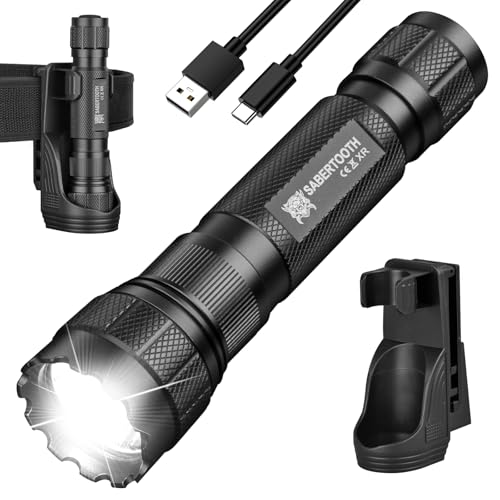
SABERTOOTH Rechargeable LED Police Tactical Flashlight

SABERTOOTH Police Tactical Flashlight 1800 Lumen

SABERTOOTH Green Hunting Tactical Flashlight 1800LM

SABERTOOTH Red Hunting Tactical Flashlight 1800LM
The Strengths Of Each Pick
The Streamlight PolyStinger DS has long been a staple on patrol belts, and the dual-switch layout is the kind of detail officers notice after a long shift. A head-mounted switch handles momentary and constant activation, while the tail switch gives you a clean tactical grip with one hand free. It runs on a rechargeable stick battery that recharges in the included AC/DC cradle, which is a real perk for shift work where a wall outlet is always within reach.
Compared with the keychain-sized Police Security Seeker that comes next, the PolyStinger is heavier and longer, so it lives on a belt loop or in a patrol bag rather than a pocket. For most sworn officers who already carry a full belt, that weight feels familiar. Anyone who needs a compact backup will want to read that next review.
The Helpful Details
- Up to 485 lumens with a beam reaching roughly 316 meters for spotting vehicles or license plates at distance.
- Three lighting modes (high, medium, low) let you balance brightness against the up to 16-hour runtime claim.
- 25,000 candela peak beam intensity, which translates into a tight, focused hotspot rather than a wide flood.
- Dual-switch system lets you operate the light without changing your grip, useful under stress.
- Polymer body construction keeps the weight lower than aluminum-bodied duty lights of similar size.
Things To Consider
- Bigger and heavier than the pocket torches on this list, so it is not ideal as an everyday off-duty carry.
- The dedicated charging cradle takes up space in a locker or trunk and is harder to replace in the field.
Made For
Sworn patrol officers and security staff who run a full belt and want a proven duty torch with a long throw.
Skip It When
Anyone wanting a featherweight pocket backup should look at the Police Security Seeker instead.
The Police Security Seeker is one of the smallest torches on this list, and that is the whole point. It clips to a keyring or rides in a coin pocket, ready to light a path from the car to the front door, peek inside a dark locker, or confirm something suspicious without drawing a full-size duty light. The internal Li-Po 150 mAh rechargeable battery keeps the size minimal and removes the need for coin cells.
Used in tandem with the Streamlight PolyStinger DS, the Seeker covers the awkward gap where your primary torch lives on a charger and you still want something on you. It is not meant to reach out across a parking lot, but the honest read is that few keychain lights really are.
Where It Helps
- Pocket- and keychain-sized body that disappears on a keyring until you need it.
- Built-in rechargeable battery means no spare cells to lose in a glove box.
- Useful for door locks, glove boxes, and the short walks where a full-size torch is overkill.
- Quick-activation button sized for one-handed use without fumbling.
Worth Noting
- Output is modest compared with the SABERTOOTH tactical picks, so it is a backup rather than a primary.
- The small battery means you may need to recharge weekly with frequent use.
Who It Suits Best
Anyone who already carries a full-size duty light and wants a featherweight backup that lives on the keys.
Look Elsewhere When
Patrol officers wanting primary illumination should step up to the SABERTOOTH Rechargeable LED Police Tactical Flashlight.
The SABERTOOTH XR tactical light jumps to a much higher output than the Streamlight PolyStinger DS, hitting 1800 lumens with a stated range of about 1000 feet. That throw makes it useful for clearing large lots, searching rooftops, or any scene where the suspect may be much further away than the next room. A double-click burst mode gives you instant full power without scrolling through brightness levels with one hand on a suspect.
Compared with the Streamlight, the SABERTOOTH trades Streamlight’s proven dual-switch ergonomics for raw lumen count and a more aggressive body. People who already own a rechargeable duty light and want a hotter backup often land here.
What Helps Most
- 1800-lumen output with roughly 1000 feet of stated reach, more than enough for large outdoor scenes.
- Burst mode activated by a quick double-click, useful for short-term disorientation without locking into it.
- Two-tier output (super-bright and a softer low mode) so you are not stuck at full power for paperwork tasks.
- Duty-belt friendly form factor that pairs with the rotating holster from the SABERTOOTH line.
Room For Improvement
- Higher output drains the battery faster at peak brightness, so top mode is a short burst rather than an all-night setting.
- The aggressive knurling (the textured grip pattern on the body) can snag on loose fabric in some uniform pockets.
Right Fit For
Officers and security pros who want maximum throw from a rechargeable duty-belt torch.
Swap It Out When
Those wanting a color-specific beam for night hunting should consider the SABERTOOTH Green Hunting Tactical Flashlight instead.
The XR3.0 variant in this lineup swaps the standard white LED for a 450 to 460 nanometer blue beam, a wavelength that makes blood trails stand out against dark ground and keeps night vision mostly intact. That makes it the unusual pick on this list: equal parts patrol light and tracking aid. The body is the same SABERTOOTH XR3.0 platform with the hidden USB-C charge port and a 360-degree rotating holster.
Versus the white-light SABERTOOTH I covered in review three, this one trades some color rendering for tracking utility. Officers who only need one torch and want both general patrol and search work will appreciate the holster, since the rotating mount stays put on a belt loop or backpack strap.
Reasons It Performs
- Blue 450-460nm LED highlights blood trails and fluoresces fishing line, useful in search and recovery work.
- Hidden USB-C charge port keeps the body sealed from debris during outdoor use.
- 360-degree rotating tactical holster lets you angle the beam without removing the light from your belt.
- Rechargeable platform avoids disposable batteries and runs on a common cable most people already own.
Points To Note
- Blue light renders colors poorly, so reading maps, badges, or color-coded tags is harder than with a white LED.
- Specialty color means this is a niche buy for people who actually need that wavelength.
Best Suited To
Patrol officers and game wardens who track or recover evidence in low light and want one tool that covers both patrol and tracking.
Consider Something Else When
Officers who mostly need standard patrol light should reach for the SABERTOOTH Rechargeable LED Police Tactical Flashlight instead.
The green-beam SABERTOOTH is another XR3.0 variant, this one aimed at night hunting and vermin control where green light is far less likely to spook coyotes, hogs, or other quarry than white light. Green sits in the wavelength band the human eye is most sensitive to, so a lower-output green beam still reads as bright, and the throw is rated around 1000 feet. For anyone mixing patrol hours with property defense against night predators, the same beam setup serves both jobs.
Compared with the blue XR3.0 from review four, green renders slightly more usable detail at distance while still preserving dark adaptation. It is a more natural fit for rural officers and ranch security than the blue version.
What Stands Out
- Green LED is harder for game to detect, making it useful for nighttime predator control.
- 1800-lumen output with around 1000 feet of reach, similar to the white-light SABERTOOTH models.
- Hidden USB-C charging port and 360-degree rotating holster carried over from the XR3.0 platform.
- Preserves dark adaptation better than white light when you need to glance back at notes or a phone.
Honest Caveats
- Color rendering is weaker than white light, so reading printed text is harder under the beam.
- Specialty use means it is overkill for officers who never work at night in rural settings.
Who Will Love This
Rural officers, game wardens, and security staff who patrol after dark in places where white light gives away position.
Reach For A Different Pick When
Anyone who needs maximum darkness preservation in a low-light urban setting may prefer the red-beam SABERTOOTH Red Hunting Tactical Flashlight instead.
The red-beam SABERTOOTH rounds out the color trio with the same XR3.0 platform, but with a red LED optimized for the lowest visible signature of any beam on this list. Red light is the standard choice for preserving full dark adaptation, which is why astronomers, military navigators, and tactical medics use it. On a quiet patrol where you do not want to broadcast your position, red is the gentlest option.
Stacked against the green and blue SABERTOOTH siblings from reviews four and five, red loses some color detail but wins on stealth. Officers who already carry a primary white torch will find this a thoughtful companion rather than a replacement.
Positive Points
- Red LED preserves night vision better than white, blue, or green for low-light navigation.
- Harder to spot from a distance, which helps when approaching a scene quietly.
- XR3.0 platform means USB-C charging and a 360-degree rotating holster are included.
- 1800 lumens with roughly 1000 feet of throw, so you are not sacrificing reach for color.
Things To Weigh
- Red renders the least detail of the three color options, so fine inspection work is harder.
- Like the other SABERTOOTH color variants, it is a specialty pick rather than an all-purpose torch.
Built With In Mind
Covert operators, K-9 handlers, and patrol staff who need a low-signature beam alongside a primary white light.
A Better Fit Elsewhere
Officers who prioritize long-distance tracking should look at the SABERTOOTH Green Hunting Tactical Flashlight instead.
Choosing A Torch That Survives The Shift
A duty torch is one of the few tools on a belt that gets pulled out dozens of times a night, so the right pick depends on how it fits your hand and your routine. Beam throw, battery type, switch layout, and carry method all matter more than peak lumen counts. Think about your shift first, then match the light to it.
Throw Distance Versus Flood
Throw distance tells you how far a focused beam reaches before it fades, while flood describes how wide the lit area is up close. The Streamlight PolyStinger DS leans toward throw with a tight hotspot for spotting down a street. The SABERTOOTH models push throw even further with roughly 1000 feet of reach, useful for large parking lots and rural scenes. A pocket torch like the Police Security Seeker is mostly flood, which is fine for door locks and short walks.
Power Source And Charging
Rechargeable batteries save money over time but only if you can keep them topped off. Officers with a wall outlet near their gear will appreciate the Streamlight’s charging cradle or the SABERTOOTH family’s hidden USB-C port. People who rotate between vehicles may find a USB-C cable more convenient since it works with phone chargers. The Police Security Seeker runs on its own internal Li-Po (lithium polymer) cell that recharges through its own port.
Carry Method And Grip
Body shape and grip texture change how a torch rides on a belt or in a hand. The SABERTOOTH XR3.0 platform includes a 360-degree rotating holster that keeps the light at a comfortable angle, which matters during long patrols. The Streamlight PolyStinger DS has a dual-switch layout that lets you change modes without shifting grip, helpful when one hand is occupied. Smaller torches trade grip security for portability.
Color Choice For Night Work
White light shows true color but gives away position. Blue highlights blood trails and fluoresces fishing line, which is useful in evidence recovery. Green sits in the wavelength the eye reads as brightest and is harder for game to notice. Red preserves full dark adaptation for the most covert work. Each color is a real trade-off, not a gimmick.
What To Know Before You Click Buy
Where Shoppers Go Wrong
Most duty-light regret comes from chasing the highest lumen number without thinking about runtime. A 1800-lumen burst that lasts minutes is less useful on a long shift than a 500-lumen beam that runs for hours. Officers sometimes buy a tactical torch for patrol work and then realize the controls are optimized for one-handed burst use rather than reading documents.
Another common slip is ignoring carry method. A torch that does not fit your belt loop or rides awkwardly in a pocket will stay in the bag. Try to match the holster or clip to your actual carry setup before settling on a model.
What Separates Premium From Basic
Higher-tier torches tend to add better switch ergonomics, longer warranties, and refined beam profiles rather than raw output. The Streamlight earns its place with a thoughtful dual-switch system, while the SABERTOOTH line earns its tier with a rotating holster, hidden USB-C port, and specialty color options. People who already own a budget torch and want fewer compromises at work often find the upgrade pays off in daily comfort, not just peak brightness.
Frequently Asked Questions
What lumen count do most patrol officers actually need?
Most patrol work happens well within 100 meters, so a focused 400 to 800 lumen beam handles the bulk of shift tasks. Higher outputs help in rural or open-lot settings.
Are rechargeable batteries reliable enough for duty use?
Modern rechargeable torches use protected lithium cells that hold capacity for years with normal care. Carrying a charging cable or cradle keeps the cell topped off between shifts.
Is a colored LED practical for patrol?
Colored LEDs are great for specific tasks like tracking, night vision preservation, or vermin control. For paperwork and general navigation, a white light remains the most practical.
How important is a rotating holster?
A rotating holster lets you angle the beam without pulling the torch off your belt, which adds comfort during long shifts. Fixed mounts work but force you to reach awkwardly in some positions.
Can a keychain torch really replace a primary light?
A keychain torch works as a backup but rarely replaces a primary duty light. Output, runtime, and grip are all limited compared to full-size models like the Streamlight or SABERTOOTH picks.