

I spend a lot of time picking out the right corner of my couch for an evening read, and I’ve learned that a bad floor lamp turns a good book into a squinting contest. The right reading floor lamp casts a tight pool of light exactly where you need it without flooding the rest of the room. For home office workers, crafters, and late-night page-turners alike, a dedicated reading lamp earns its space.
This roundup looks at five floor lamps built around the reading experience: some focused entirely on task lighting, others doubling as ambient room lights with a reading head. I’ll walk through what each one does well, where it makes trade-offs, and which reader profile it actually fits.
The Picks In Brief

Eye-Care LED Floor Lamp with Remote, 30 Light Modes

Brightech Sky Dome Plus LED Floor Lamp (Black)

JONATHAN Y Aria 63″ Faceted Crystal LED Floor Lamp (Clear/Chrome)

Brightech Litespan LED Floor Reading Lamp (Havana Brown)
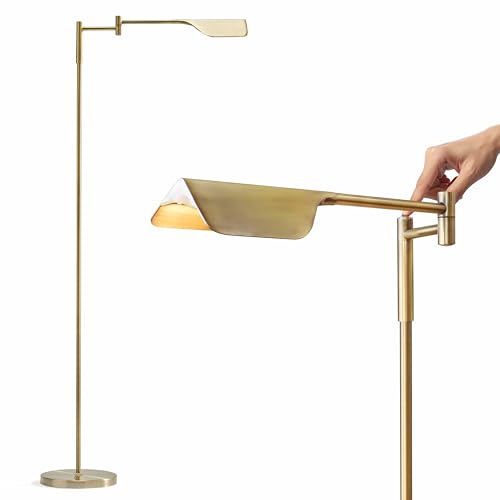
Brightech Leaf Pharmacy LED Reading Lamp (Antique Brass)
The Strengths Of Each Pick
Tall at 69 inches and built around a side-emitting LED panel rather than a traditional bulb, this LitONES reading floor lamp aims at people who put in serious hours with a book or a laptop. The 30 light modes combine brightness steps with color temperature shifts, so I can dial in warm light for evening fiction or cool white for spreadsheet work without leaving the chair.
For night-shift readers and home office workers, the eye-care framing is the real pitch. The 4-layer optical panel diffuses output across a wider area than a single bulb, and a remote keeps adjustments within arm’s reach. Compared to the Brightech Litespan coming up later, this one trades the tight focused beam for a broader, softer spread.
Notable Gains
- 30 light modes let you shift from warm ambient glow to crisp task light in seconds
- 69-inch height places the light over a shoulder rather than in your eyeline
- Side-emitting diffusion panel softens glare during long reading sessions
- Remote control means no fumbling with a base switch when you’re settled in
Points To Keep In Mind
- The wide diffusion panel floods more area than a focused pharmacy lamp, so it is less ideal for fine crafts
- Owners commonly report that the remote requires line-of-sight in some room layouts
Best Suited To
Daily readers and remote workers who want one lamp that handles evening fiction and daytime paperwork with equal comfort.
A Better Fit Elsewhere
Detailed crafters who need a tight, narrow beam should look at the Brightech Litespan instead.
The Sky Dome Plus solves a problem most single-purpose reading lamps ignore: a living room needs both ambient light and a focused reading beam, and most people don’t want two floor lamps fighting for space. This torchiere pairs an uplight dome with a separate side reading lamp on a flexible arm, all on one slim pole.
For shared living rooms and open-plan offices, the dual-head approach keeps the whole room softly lit while still aiming task light at the chair. The 3,000K warm white tone reads as cozy rather than clinical, which matters when the lamp is doing double duty as décor. Compared to the JONATHAN Y Aria, the visual personality is more functional than ornamental.
Real Benefits
- Two light sources cover ambient and task use on a single footprint
- 3,000K warm white keeps shared rooms from feeling sterile
- Plastic dome shades diffuse uplight evenly across the ceiling
Trade Offs To Consider
- The reading arm is shorter than a dedicated task lamp, so positioning over a recliner takes trial and error
- The torchiere dome and reading lamp share one dimmer, which limits fine control
Quick Facts
Right Fit For
Households where one lamp has to cover movie night ambience and an evening reading session without dominating the room.
Look Elsewhere When
Someone looking for a sculptural centerpiece should consider the JONATHAN Y Aria faceted crystal lamp instead.
The JONATHAN Y Aria treats a floor lamp like jewelry. At 63 inches tall with a faceted crystal body and a polished chrome base, the lamp itself is the design statement. The pineapple-inspired facet pattern catches light from every angle, which matters in rooms where the lamp sits near a window or another light source.
For formal living rooms and bedrooms with curated décor, the Aria pulls double duty as accent lighting and reading support. It is less of a clinical task lamp and more of an ambient piece that happens to provide reading illumination. Compared to the more utilitarian Brightech Leaf further down, the Aria trades adjustability for atmosphere.
Benefits That Matter
- Faceted crystal body refracts light into the surrounding space, adding visual texture
- 63-inch height works behind most sofas and beside armchairs
- Chrome base anchors the look on hardwood and tile floors
Honest Caveats
- Crystal facets show dust, so routine wiping is part of ownership
- The fixed head offers minimal adjustability, so chair placement has to fit the lamp rather than the reverse
Who It Suits Best
Anyone furnishing a formal living room who wants the lamp to read as décor first and reading light second.
Swap It Out When
Readers who need to aim the beam precisely should reach for the Brightech Leaf Pharmacy LED Reading Lamp instead.
The Litespan earns its reputation with crafters, estheticians, and detail-oriented readers. Output sits around 850 to 950 lumens with a tight, cool beam aimed by a gooseneck arm, which makes it the lamp I would pick for lash work, cross-stitch, or reading small print. The 12W draw also keeps electricity use modest for a lamp that often runs long sessions.
The Havana Brown finish blends with wood furniture in a way that the brighter white or chrome models don’t, so the lamp disappears into a study or sewing corner rather than fighting the room. For anyone comparing this to the Eye-Care LED Floor Lamp above, the Litespan narrows the focus while the LitONES broadens it.
Useful Strengths
- High-contrast beam supports color work like lash extensions or model painting
- Gooseneck arm holds position exactly where you aim it, no spring drift
- 12W draw costs less to run than older incandescent equivalents
- 20,000-hour LED lifespan reduces the maintenance cycle over time
Things To Weigh Up
- The cool beam can feel clinical during novel reading by the fire
- Gooseneck arms occasionally loosen with repeated repositioning, which is widely reported
Spec Overview
Made For
Crafters, estheticians, and anyone doing close work who needs contrast more than ambiance.
Consider Something Else When
A reader who wants softer warmth for novels should consider the Eye-Care LED Floor Lamp by LitONES.
The Leaf leans into the classic pharmacy lamp silhouette, which is a shape with a long history in libraries and reading rooms for good reason. The slim shade pivots smoothly to aim light over a chair or a desk, and the antique brass finish gives it a warmer presence than the satin black Brightech Litespan I just covered.
Sewers, knitters, and home hobbyists will get the most out of this shape, since the narrow shade focuses light exactly on the work area. Output around 1,150 lumens sits a touch brighter than the Litespan, so the Leaf handles larger projects and bigger pattern books. The dimmer on the pole helps when switching from detailed work to casual reading.
Standout Benefits
- Pivoting pharmacy shade directs a tight pool of light exactly where needed
- Antique brass finish complements traditional furniture and bookshelves
- Dimmer on the pole adjusts brightness without leaving the chair
Some Limits To Know
- Pharmacy shade shape is decorative, so it won’t blend into minimalist rooms
- The narrow beam floods less area than the LitONES panel lamp in open plans
Feature Snapshot
Perfect Match For
Sewers and hobbyists who want a traditional-style lamp that doubles as room décor.
Another Choice May Suit
Readers who prefer a softer panel glow over a focused beam should try the LitONES Eye-Care LED Floor Lamp instead.
Choosing Reading Light Floor Lamps That Fit Your Routine
Picking the right reading floor lamp comes down to how and where you actually read. Start by looking at the beam shape: a tight focused beam from a pharmacy-style shade suits close work like sewing, cross-stitch, or studying small print, while a broader diffused panel handles long reading sessions and shared rooms. Lumens, the unit that measures visible brightness, sit somewhere between 800 and 1,200 for most reading lamps, which is plenty for a chair without flooding the rest of the room.
Color temperature shapes how the light feels. A 3,000K warm white reads cozy and flatters wood furniture, while cooler 4,000K to 5,000K tones support focus and color accuracy for crafts. For most evening readers, warm tones prevent the harsh “office ceiling” feeling. Height matters too: lamps between 60 and 70 inches place the light source over your shoulder rather than in your eyeline, which reduces squinting.
Beam Shape And Aim
A gooseneck or pivoting pharmacy arm lets you aim the beam as you shift between a chair and a desk. Fixed-panel readers are simpler, but you commit to one light spread for the life of the lamp. For a reading chair that doubles as a work spot, an adjustable arm earns its keep.
Brightness And Color Tuning
Multi-mode lamps that shift color temperature and brightness give one fixture the range to cover evening fiction and daytime tasks. For households that want one lamp for everything, the extra modes are worth it. For a hobbyist with one job to do, a simpler dimmer is enough.
Style And Finish
A lamp lives in the room even when it’s off, so finish matters as much as beam. Antique brass suits traditional studies, matte black disappears into modern décor, and crystal or faceted bodies pull double duty as decorative objects. Match the lamp to the room you already have, not the room you wish you had.
Practical Ownership
Look for LED modules with long rated lifespans (often 20,000 hours or more), which reduces the replacement cycle over years of evening reading. A heavy base keeps the lamp planted when kids, pets, or vacuum cords brush past. Dimmable models need compatible switches, but most lamps here include their own dimmer on the pole or body.
Common Pitfalls And Smart Upgrades
Pitfalls Shoppers Hit
The most common mistake is choosing a lamp for how it looks in the photo rather than how the beam lands on a real chair. A pretty lamp with a fixed head often disappoints when the reader moves to the opposite side of the seat. Another trap is underestimating lumens for detail work; 500 lumens sounds bright on paper, but it’s too dim for sewing dark fabric or reading fine print. Buyers also forget to check the base diameter, which matters in tight reading corners where a wide footprint won’t fit.
Where The Extra Money Goes
Premium reading floor lamps earn their higher price in three places: better LED modules that hold color accuracy over years, sturdier pivots and goosenecks that don’t sag with use, and finishes that age gracefully instead of flaking. For someone reading a few hours a week, a budget-friendly option is fine. For daily use over a long stretch, the upgrade pays back in reliability and the kind of small satisfaction a wobbly arm can’t deliver.
Frequently Asked Questions
How many lumens do I need for a reading floor lamp?
For most reading and craft work, 800 to 1,200 lumens hits the sweet spot. Below that, you’ll find yourself shifting the lamp closer; above it, the beam tends to feel harsh in a small room.
What’s the best color temperature for reading?
Warm white around 3,000K is easiest on the eyes for evening reading, while cooler 4,000K to 5,000K helps when you need to see color and detail clearly during crafts or paperwork.
Are pharmacy-style lamps better than modern LED panels?
Pharmacy lamps with pivoting shades give you a tighter, more focused beam that excels at detail work. Modern LED panels cast a softer, broader glow that suits long reading sessions. The better choice depends on whether you read or craft more.
Can a floor lamp replace an overhead light in a reading corner?
For a single chair or small nook, yes. A bright torchiere or a tall panel lamp can fully light that corner without needing the ceiling fixture. For shared rooms, an overhead light still helps the rest of the space.
How tall should a reading floor lamp be?
A reading lamp between 60 and 70 inches tall places the light above your shoulder when seated. That height avoids glare in your eyeline and keeps the beam focused on the page or work in your lap.