

A short winter, a north-facing home office, or a basement studio can leave anyone craving real sunlight. Full spectrum bulbs are designed to mimic that natural daylight on a schedule your life actually keeps. I pulled together nine solid options covering smart color-shifting systems, fixed-tone workhorses, and warm-light picks that still reach a high CRI. There’s enough variety here for crafters, remote workers, and anyone just trying to make a dim room feel less gloomy.
A Closer Look At The Lineup

Philips Hue Smart 60W A19 Color Ambiance LED Bulb (2-Pack)

Philips Hue Smart LED A19 Bulb 7.2W E26 (1-Pack)
Philips Hue Smart 40W B39 Candle E12 LED Bulb
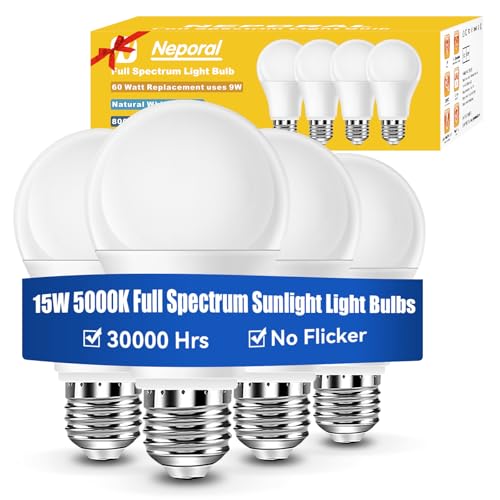
Neporal 15W 5000K Full Spectrum LED Bulb (4-Pack)

Neporal 6000K Full Spectrum A19 LED Bulb (3-Pack)

Neporal 6000K Full Spectrum A19 LED Bulb (4-Pack)

Neporal 15W 2700K Warm Full Spectrum LED Bulb (3-Pack)

Neporal 15W 5000K Full Spectrum LED Bulb (3-Pack)

Neporal 15W 2700K Warm Full Spectrum LED Bulb (4-Pack)
Taking A Closer Look At The Options
For shoppers building a connected home, this Philips Hue starter pack lands as a familiar entry point. The A19 shape fits standard E26 sockets, and the 800-lumen output sits roughly in line with a 60W incandescent. Color temperature (the warmth or coolness of white light) covers both ends of the spectrum, from amber evenings to cool daylight.
Bluetooth control works without a hub for one room, which keeps the upfront cost simple. Adding a Hue Bridge later extends control outside the home and unlocks deeper automations. Compared to the fixed-tone Neporal bulbs below, this one trades pure daylight accuracy for flexibility and full color.
Notable Upsides
- Voice control with Alexa, Google Assistant, and Apple Home keeps hands free during cooking or movie nights
- 16 million colors plus tunable white means one fixture covers movie lighting, focus lighting, and party mode
- Two-bulb pack covers a small living room or pair of bedside lamps at once
- Bluetooth pairing takes roughly a minute, so even non-technical shoppers can get started quickly
Things To Consider
- Full remote control and routines require the separate Hue Bridge, adding to the total spend
- At higher color settings, output reads more decorative than task-grade bright
Who It Suits Best
Smart home newcomers who want app and voice control without committing to a whole-home system on day one.
Consider Something Else When
The Philips Hue Smart LED A19 Bulb 7.2W is a better fit for those who want a wider daylight range and deeper dimming precision.
This single-bulb Hue model targets the daylight purist who still wants smart features. The CCT (correlated color temperature) range stretches from below 2700K up to 12000K, covering relaxing amber tones through bright blue-sky whites. Ultra-low dimming drops to 0.2%, which is useful for movie credits or winding down at night.
Chromasync technology is the quiet standout here, keeping color matched across multiple bulbs in the same fixture. For crafters or anyone doing color-accurate work, that consistency matters. Compared to the color-shifting 2-pack above, this one focuses more on white-light precision than party effects.
A Favorable Mix
- CCT range wider than most competitors, useful for SAD-style routines or shift workers
- Dimming down to 0.2% supports late-night reading and cinema-dark viewing
- Chromasync keeps grouped bulbs visually identical, which helps in kitchens with multiple pendants
- Rated lifespan of 25,000 hours means roughly a decade of typical home use
Worth Noting
- Single-bulb pack means a multi-room setup adds up quickly
- Premium positioning compared to the no-frills Neporal daylight bulbs
Key Specs
Made For
Remote workers, artists, and households that want one smart bulb capable of replacing both warm and cool fixtures.
Look Elsewhere When
The Neporal 15W 5000K Full Spectrum LED Bulb (4-Pack) suits a basic home office better when color-shifting features and app control are not part of the plan.
Decorative fixtures need a different bulb, and this candle-shaped Hue fills that gap. The E12 candelabra base fits chandeliers, wall sconces, and pendant clusters where a standard A19 would look out of place. Output lands at 450 lumens, calibrated for accent rather than full-room task lighting.
Color and tunable white come built in, so the same bulb handles holiday reds and warm everyday glow. Bluetooth control works without a hub, with the Hue Bridge unlocking the deeper ecosystem. Where the A19 Hue models above focus on general lighting, this one targets ambiance in visible fixtures.
Positive Points
- Candelabra form factor opens smart color to chandeliers, sconces, and small fixtures
- Tunable white plus full color covers holidays, dinner parties, and quiet evenings in one bulb
- Compact candle shape hides cleanly behind glass shades and open-bulb fixtures
Trade Offs
- 450-lumen output suits ambient zones rather than primary room lighting
- Single-pack means a six-arm chandelier becomes a much larger order
Right Fit For
Anyone updating a dining-room chandelier or vintage sconce set who wants color control without sacrificing the original fixture style.
A Better Fit Elsewhere
The Philips Hue Smart 60W A19 Color Ambiance LED Bulb (2-Pack) suits living rooms better where the goal is bright, general-purpose smart lighting rather than decorative accent.
Shifting away from smart systems, this Neporal four-pack leans into fixed daylight output. The 5000K color temperature reads as a clean midday white, and CRI 90+ (Color Rendering Index, a 0–100 score for how accurately a bulb shows true colors) keeps paint colors and skin tones looking natural. Fifteen actual watts replaces roughly a 100W incandescent, useful for fixtures that ask for real brightness.
UV-free output makes these reasonable for bedrooms and reading nooks where long sessions happen. Unlike the Hue models above, there’s no app layer, no color shifts, just on-and-off simplicity. The trade-off shows up in flexibility, but for some rooms that’s exactly the point.
Everyday Advantages
- 1200 lumens per bulb handles overhead fixtures and large desk lamps comfortably
- CRI 90+ supports color-accurate hobbies like sewing, painting, or photo editing
- Flicker-free design reduces eye strain over long reading or screen sessions
- Four-bulb pack covers a typical kitchen ceiling fan or a small home office
Honest Caveats
- 5000K can feel cool and clinical in a bedroom or living room meant for relaxing
- No dimming or smart features beyond a wall switch
- Standard A19 size may not fit candelabra fixtures
At A Glance
Best Suited To
Home offices, craft rooms, and hobby spaces where accurate, bright white light matters more than tunable color.
Swap It Out When
The Neporal 15W 2700K Warm Full Spectrum LED Bulb (3-Pack) suits a living room or bedroom better where a softer 2700K tone fits the mood.
This Neporal bulb steps up to a cooler 6000K tone, closer to overcast daylight than the 5000K siblings. The 9W draw replaces a 60W incandescent, with 800 lumens per bulb in the A19 shape. CRI 90+ holds the same color accuracy as the other Neporal entries on this list.
The E26/E27 base covers the standard socket sizes used across the US and Europe, useful for mixed homes. Compared to the 5000K four-pack above, this runs cooler and slightly less bright per bulb. For task-focused rooms, that cool tone often helps focus, though it can feel harsh in the evening.
What Stands Out
- Cool 6000K tone helps daytime focus in studios and study corners
- Universal E26/E27 base fits most common household sockets
- Lower 9W draw suits lamps and fixtures with smaller wattage ratings
- Flicker-free output supports long screen sessions without extra eye fatigue
Small Caveats
- 800 lumens per bulb is moderate; large rooms may need more than one fixture
- Cool tone reads clinical in the evening, so dimmer switches help soften it
Quick Facts
Who Will Love This
Studiers, remote workers, and crafters running dedicated task zones who prefer a cool, alert-feeling light.
Reach For A Different Pick When
The Neporal 15W 2700K Warm Full Spectrum LED Bulb (3-Pack) is the better pick for a bedroom or living area where a warmer 2700K tone is the goal.
Same 6000K tone as the 3-pack above, but in a four-bulb configuration that suits bigger rooms. Output holds at 800 lumens per bulb with the same CRI 90+ accuracy. The main difference here is coverage, four bulbs spread across a kitchen ceiling or workshop track lighting.
For shoppers planning a whole-room swap, the four-pack covers more fixtures in one order. Same universal E26/E27 base fits standard US and European sockets. Where the 3-pack above suits a single lamp or desk fixture, this one handles broader renovations.
Reasons It Performs
- Four-bulb count suits full-room upgrades without back-to-back orders
- Cool 6000K tone keeps focus strong during daytime projects
- 9W draw keeps electricity use modest even with multiple bulbs running
- Flicker-free operation helps during long sessions at the workbench or desk
Points To Note
- Cool 6000K tone reads harsh in the evening for some households
- 800 lumens per bulb means large open-plan spaces may still feel underlit
Built With In Mind
Households refreshing an entire kitchen, basement, or workshop with consistent cool daylight at once.
Skip It When
The Neporal 15W 5000K Full Spectrum LED Bulb (4-Pack) is the better call for shoppers who want stronger 1200-lumen output in the same four-bulb layout.
For living areas and bedrooms, this 2700K Neporal entry softens the daylight formula. Fifteen watts draw still replaces a 100W incandescent, putting out 1200 lumens. CRI 90+ stays consistent across the Neporal family, so color accuracy holds even at the warm end of the spectrum.
Where the 5000K and 6000K Neporal bulbs lean clinical, 2700K reads more like late-afternoon sun through a window. That matters for evening reading or winding down before bed. Compared to the smart Hue models, this bulb trades app control for a fixed, comforting tone.
Notable Gains
- Warm 2700K tone suits bedrooms, dining rooms, and living areas without feeling sterile
- 1200 lumens per bulb fills overhead fixtures with strong output
- CRI 90+ keeps wood tones, fabrics, and skin looking natural
- Flicker-free design is gentle during long reading sessions in the evening
Less-Strong Areas
- Fixed tone limits use in work-focused rooms where a cooler light helps focus
- No app or dimming layer beyond a standard wall dimmer switch
Feature Snapshot
Perfect Match For
Bedrooms, dining rooms, and any space where the goal is a calm, natural-feeling warmth instead of crisp daylight.
Not Your Match When
The Philips Hue Smart 60W A19 Color Ambiance LED Bulb (2-Pack) is the better fit for shoppers who want app control and color flexibility at the same brightness level.
Three bulbs, 5000K daylight, and the same 1200-lumen output as the four-pack above. CRI 90+ keeps colors honest, useful for remote workers reviewing slide decks or doing color-sensitive screen work. Fifteen actual watts replaces roughly a 100W incandescent.
The three-bulb count suits a focused home office, studio, or reading corner without overbuying. Compared to the warm-toned sibling, this one keeps alertness high during daytime hours. For late evenings, pairing with a warm lamp or a dimmer helps bridge the transition.
A Few Strong Suits
- 5000K daylight tone supports focus during working hours
- 1200 lumens per bulb handles a single overhead or large desk lamp
- CRI 90+ supports accurate review of artwork, photos, or color-coded documents
- UV-free output for long, focused sessions
Some Limits To Know
- Fixed tone reads cool for evening routines, so an additional warm lamp helps
- Three-bulb count may leave larger rooms underfilled
Whose Shelf It Belongs On
Remote workers, students, and hobbyists running a single-room setup who want clean daylight output without smart features.
Where A Sibling Pick Shines
The Neporal 15W 2700K Warm Full Spectrum LED Bulb (3-Pack) is the better choice for bedrooms and living rooms where a softer glow fits better.
This four-pack extends the warm 2700K formula across a whole living space. Same 1200-lumen output and CRI 90+ color accuracy as the three-pack above, just more bulbs. For open-plan layouts, four warm bulbs keep the tone consistent from kitchen to dining to living area.
The trade-off is flexibility, since there’s no app or color shifting. For households that already know they want warm, full-spectrum light everywhere, that simplicity is the point. Compared to the smart Hue options above, this is the straightforward, set-and-forget path.
Why It Works Well
- Four-bulb count covers an open-plan living area in one order
- 2700K warmth reads comfortable in living rooms, hallways, and bedrooms
- 1200 lumens per bulb keeps output strong across multiple fixtures
- CRI 90+ keeps wood, fabric, and paint colors natural across rooms
What To Weigh
- No dimming or smart features beyond a standard wall dimmer
- Warm tone may feel too cozy for daytime work-focused rooms
- Standard A19 size won’t fit candelabra fixtures
Who Should Grab It
Households ready to refresh every main living area at once with a consistent, natural-feeling warm light.
Another Choice May Suit
The Philips Hue Smart LED A19 Bulb 7.2W is the better fit for shoppers who want tunable white plus voice and app control in a single-room setup.
What To Weigh Before Picking Full Spectrum Bulbs
Color Temperature And The Room’s Mood
Color temperature shapes how a room feels before anyone notices it. 5000K reads like midday sun and supports focus, useful for offices and craft tables. 2700K reads like late-afternoon warmth, easier on tired eyes in the evening. Picking a tone that matches the room’s job avoids the common complaint of a “too-blue” bedroom or a “too-yellow” kitchen.
CRI And Why It Matters
CRI, or Color Rendering Index, scores how accurately a bulb shows true colors on a 0–100 scale. Anything CRI 90 or above keeps paint colors, fabric, and skin looking natural. For crafters, remote reviewers, or anyone with color-sensitive hobbies, that accuracy is non-negotiable. Lower CRI bulbs can mute reds or shift greens in ways that bother the eye without being easy to name.
Smart Versus Fixed Output
Smart bulbs like the Hue line add app, voice, and tunable white, but cost more and may need a hub. Fixed-tone Neporal bulbs skip the smart layer for a simpler, often lower-priced setup. The honest read is that smart features pay off when routines and color shifts matter, and a fixed bulb is the right call when a room has one clear purpose.
Brightness, Socket Size, And Coverage
Lumens tell the real brightness story. Around 800 lumens suits a bedside lamp, while 1200 lumens handles overhead fixtures comfortably. A19 fits standard E26 sockets, while B39 candelabra bulbs cover chandeliers and sconces. Pack count matters too, since a four-pack covers a kitchen while a single bulb fits a reading nook.
Key Considerations Across These Picks
Where Shoppers Go Wrong
One common slip is grabbing the brightest bulb and assuming brighter is better, only to end up with a harsh, clinical feel in a living room. Another is ignoring CRI, since two 5000K bulbs at the same wattage can show colors very differently. Double-check the socket base before ordering candelabra fixtures, since E12 and E26 are not interchangeable.
When Paying More Pays Off
The premium tier in this category buys smart control, broader CCT range, and Chromasync-style color matching. For shoppers building a connected home or running a studio, that extra spend pays off in flexibility and consistency. For a single bedroom lamp, a simpler fixed-tone bulb gets the job done at a lower total cost.
Frequently Asked Questions
What Does “Full Spectrum” Actually Mean?
Full spectrum bulbs aim to reproduce the visible range of natural daylight, usually with a high CRI to keep colors honest. The result reads closer to sunlight than a typical soft white LED.
Can Full Spectrum Bulbs Help With Mood Or Energy?
Many people find daylight-toned bulbs helpful during darker months, though results vary by individual. They’re a popular option for home offices and SAD-style routines, paired with sensible sleep habits.
Do These Bulbs Work In Standard Lamps?
Most A19 bulbs on this list use the standard E26 base common in US households. Candelabra fixtures need E12 bulbs like the Hue candle option above.
How Long Do Full Spectrum LEDs Usually Last?
LED lifespans commonly land around 25,000 hours, which translates to roughly a decade of typical home use. Actual lifespan depends on fixture ventilation and daily run time.
Are Full Spectrum Bulbs Safe For Eyes?
Look for flicker-free designs and UV-free output, both noted on the Neporal entries above. Long sessions still benefit from regular screen breaks and proper fixture placement.
Closing Remarks
The right full spectrum bulb comes down to the room’s job and how much control you want over the light. Smart homes and color-shifting routines point toward the Hue family, while set-and-forget living spaces land naturally on the Neporal lineup. Pick the tone that fits the time of day you’ll spend there most, and the rest tends to fall into place.