

Picking the right exit light combo matters more than most people realize. These units have to stay lit during a power outage, survive a hot environment, and pass inspection. I put this list together for facility managers, small-business owners, and anyone retrofitting an older property with compliant emergency lighting that won’t fail when it counts.
The Choices Worth Comparing

NightBright USA Photoluminescent Exit Sign Red – Aluminum (ULR-050)

SITISFI Exit Signs with Emergency Lights Battery Backup (2 Pack)

TORCHSTAR 4-Pack Red Letter LED Exit Sign with Battery Backup

Freelicht 6 Pack Commercial Double-Sided Exit Sign with Adjustable Heads
NightBright USA Photoluminescent Exit Sign Green – Aluminum (ULG-050)

NightBright USA Photoluminescent Exit Sign Red – Framed Wall Mount (FRUL-050-R)

Spectsun Red Exit Signs with Emergency Lights, Two LED Adjustable Heads

Spectsun Red Exit Sign with Emergency Lights, LED Combo (120/277V)

Spectsun Green Exit Signs with Emergency Lights, Double-Face Combo

SPECTSUN Green LED Exit Signs with Battery Backup, Two Adjustable Heads
Why These Options Stand Out
I keep coming back to photoluminescent signs (glow-in-the-dark panels that charge from ambient lighting and emit their own glow during blackouts) for older buildings where running new circuits is a real headache. The NightBright USA ULR-050 sits at 14.25 by 7.5 inches, framed in aluminum, with a single red EXIT face and removable directional arrows tucked in the package. You mount it to a wall, leave the lights on, and the panel handles itself.
The honest read is that this is a niche pick, and a smart one for the right project. It skips wiring, batteries, and the electrician’s invoice, which is what most owners shopping around want anyway.
Useful Highlights
- No electrical wiring, no batteries, and no expiration date means almost zero long-term maintenance.
- UL 924 listing covers NFPA 101, the International Building Code, and the International Fire Code for inspection paperwork.
- Removable arrows let you redirect flow without buying a new sign.
- Made in the USA, which simplifies some municipal purchasing requirements.
Practical Considerations
- Needs roughly 5 foot-candles of ambient light to charge, so dim back rooms may need a small always-on fixture.
- Mounting screws are not included, which trips up first-time installers on every job.
- Single-sided only, so hallways with two-way traffic need a second unit.
Quick Facts
Right Fit For
Owners retrofitting older concrete or masonry buildings where running new electrical would mean cutting into finished walls.
Reach For A Different Pick When
Your corridors are long and need lit emergency heads, in which case the SITISFI combo on this list covers that need better.
Hardwired combos like this SITISFI pair tend to be where commercial buildings end up, and for good reason. Each unit is injection-molded thermoplastic with a UL-94V-0 flame rating (a plastics standard meaning the housing self-extinguishes within 10 seconds), accepts 120 or 277V input, and ships with adjustable light pipes that pivot to aim light down a hallway instead of into a wall. The two-pack format works out neatly for opposite ends of one corridor.
Compared to the NightBright ULR-050 above, this is the more traditional route. You get actual emergency lamp heads and battery backup, which inspectors expect in most jurisdictions.
Key Advantages
- Adjustable light pipes let installers aim illumination along the egress path.
- Flame-rated thermoplastic housing is rated for damp locations from 0 to 40°C.
- Top, wall, or side mounting from a single housing reduces SKU sprawl.
- Battery backup keeps the lamps on when utility power drops.
Things To Consider
- Hardwired install means you need a licensed electrician or you risk failing inspection.
- Battery packs typically need a 24-hour initial charge before the first real test.
- Double-sided format can read as too busy in narrow single-direction hallways.
Whose Shelf It Belongs On
Contractors wiring a small medical office, dental clinic, or tasting room where both signs and emergency lamps have to live in the same junction.
Swap It Out When
You only need a single unit and prefer compact sizing, in which case the TORCHSTAR 4-Pack may oversupply and the Spectsun single-packs from later in this list fit the bill.
The TORCHSTAR 4-Pack solves a very specific problem: outfitting an entire small building without buying four separate listings. Each unit uses fireproof ABS plastic with a 45mm housing depth, rounded corners that reduce collision damage, and three mounting configurations in one body. The curved corners are a small thing that matters more in tight service hallways where sharp edges keep snagging equipment.
Stacked against the SITISFI pair above, you trade adjustability for quantity. If your building has a single standard corridor geometry, that’s a worthwhile swap.
Real-World Strengths
- Four units in one box streamline multi-room installations.
- Rounded corner geometry reduces damage in back-of-house service areas.
- ABS fire-rated housing handles damp locations without corrosion concerns.
- Three mounting options reduce the “we need a different SKU” problem.
Worth Noting
- No adjustable emergency lamp heads, just the exit face itself.
- Plastic housing can yellow under prolonged UV exposure in glass-door vestibules.
- Battery backup adds weight to the ceiling-mount configuration.
Spec Overview
Best Suited To
Property managers upgrading several floors of an apartment building or office at once, where bulk pricing and consistent appearance matter.
Look Elsewhere When
Your space actually requires integrated emergency floodlights, in which case the Freelicht 6 Pack below pairs better.
When a project crosses into larger territory, a 6-pack starts to make economic sense, and the Freelicht option leans into that. The housing is injection-molded thermoplastic with a 5VA flame rating (the highest tier in the UL-94 scale, meaning the material resists ignition even under direct flame), and the units ship double-sided so a single fixture can serve two directions of foot traffic.
Compared to the TORCHSTAR pack I covered before, the Freelicht adds adjustable emergency heads. That moves it from “sign only” into full combo territory, which inspectors in stricter jurisdictions often require.
A Favorable Mix
- UL 924 certified for U.S. and Canadian inspection standards.
- Adjustable heads aim illumination toward stairs and turns.
- Double-sided face reduces the number of fixtures a hallway needs.
- High-impact housing stands up to accidental bumps from carts.
Honest Caveats
- Six units may be more than a tiny retail shop needs.
- Hardwired install raises the project cost versus photoluminescent options like the NightBright ULR-050.
- Double-sided format requires careful ceiling layout planning.
Made For
Mid-size commercial spaces like churches, community centers, and warehouse offices that need several units at consistent spec.
Skip It When
You only need two units and prefer lighter plastic housings, in which case the SITISFI pair is a tighter fit.
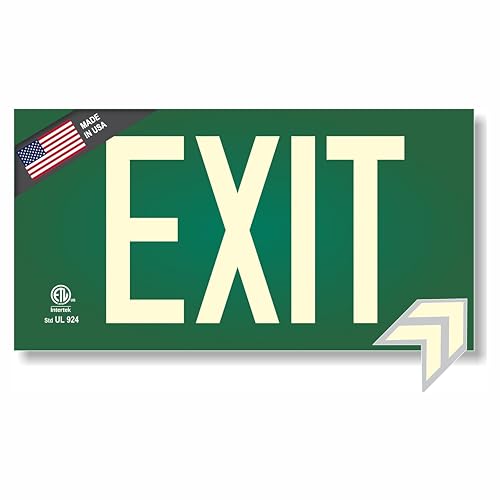
Green EXIT signs show up in places where the local code follows the international convention of green for safe egress, and the NightBright ULG-050 is the green twin to the red ULR-050 I covered first. Same aluminum frame, same 14.25 by 7.5 inch footprint, same no-wiring approach, and two removable arrows instead of one. The green color reads as more subdued against modern interior palettes.
Where the red photoluminescent sign gets the nod in older American buildings, this green version suits newer construction where the design language favors less industrial-looking safety gear.
A Few Strong Suits
- Lightweight aluminum cuts installer fatigue during ceiling work.
- Maximum glow formulation extends visibility during longer blackouts.
- UL 924 listed with NFPA 101 and International Fire Code compliance.
- Two removable arrows allow more flexible directional swaps.
Things To Weigh
- Mounting hardware is not included, so plan a stop at the hardware store.
- Single-sided design means back-to-back corridors need a second unit.
- Green-letter photoluminescent signs may face pushback in jurisdictions requiring red.
Feature Snapshot
Who Should Grab It
Owners of newer commercial interiors where green EXIT is the local standard and a clean aluminum frame fits the design.
A Better Fit Elsewhere
You need active emergency lamp heads and battery backup, in which case the SITISFI combo earlier on this list is purpose-built for that.
The FRUL-050-R rounds out the NightBright family with a flat-wall configuration that suits finished hallways better than a ceiling-hung flag mount. The aluminum frame gives it a more architectural look, which matters in lobbies, conference centers, and gallery-style spaces. It’s the same photoluminescent technology as the ULR-050 above, just packaged for a different mounting surface.
If your corridor already has crown molding, picture rails, or finished drywall, this framed face sits flush in a way that ceiling-mount signs cannot.
Positive Points
- Aluminum frame blends into finished interiors instead of looking industrial.
- Wall-mount geometry avoids low-clearance ceilings.
- Same UL 924 code compliance as the rest of the NightBright family.
- No electrical work means no patching drywall after install.
Some Limits To Know
- Wall placement requires a flat, finished wall surface, not exposed block.
- Single face only, which limits direction coverage in T-shaped hallways.
- Higher cost per unit than the frameless ULR-050.
Who It Suits Best
Design-conscious property managers outfitting lobbies, gallery spaces, or boutique offices where the framed look fits the interior.
Not Your Match When
You’re working with exposed concrete ceilings and want the most affordable install, in which case the ULR-050 frameless version costs less.
Single-pack commercial combos are where most small projects actually land, and Spectsun’s twin-head red option is a textbook example. It runs on 120 or 277V AC, ships UL Listed, and uses two adjustable LED heads to throw light along the egress path. For a single back-of-house corridor in a retail store or restaurant, one of these typically does the whole job.
Stacked against the SITISFI pair I covered earlier, this is the single-unit version with similar adjustability, but you only buy what you need.
Standout Benefits
- Two adjustable heads direct illumination to where occupants actually walk.
- UL Listed for inspection across most U.S. jurisdictions.
- 120/277V dual-voltage input covers both residential and commercial wiring.
- Single-pack format suits one-corridor retrofits without leftover inventory.
Practical Considerations
- Hardwired install requires electrical rough-in or an existing junction box.
- Single-sided face limits visibility from one direction.
- Battery pack adds bulk behind the housing.
Feature Rundown
Perfect Match For
Small shop owners installing a single unit above a back door where the local inspector expects an active emergency lamp, not a passive glow sign.
Consider Something Else When
You’d rather skip the wiring altogether, in which case the NightBright photoluminescent family earlier on this list is the better match.
This single-head Spectsun sibling is the smaller, more compact version of the twin-head unit I just covered. It uses Epstar SMD LEDs (surface-mounted diode chips known for even light distribution), takes 120 or 277V input, and runs a 24-hour initial charge cycle before the 90-minute discharge rating kicks in. The compact housing fits tighter ceilings and narrower door frames where a twin-head unit would look oversized.
Compared to the twin-head model above, you give up one of the adjustable lamps but gain a more discreet profile. For narrow corridors, that’s a fair trade.
What Pays Off
- Compact footprint fits tight ceiling drops and narrow corridors.
- Epstar SMD LEDs run cool and last through many years of standby cycles.
- 24-hour charge and 90-minute discharge meet standard egress runtime expectations.
- UL Listed and FCC compliant for U.S. inspection.
Smaller Caveats
- Single head covers less floor area than the twin-head Spectsun above.
- Plastic housing can scuff during ceiling installations.
- Hardwired install still requires a qualified electrician in most jurisdictions.
Built With In Mind
Home-office-to-commercial conversions and small business owners who want UL Listed compliance without bulk on the ceiling.
Where Another Pick Suits Better
You need longer throw illumination down a long hallway, in which case the Spectsun twin-head unit from earlier in this list does that job better.
Green-letter exit combos are rarer in U.S. listings, so this Spectsun double-face version stands out. It runs 120 to 277V AC, draws about 3.5W max, and outputs up to 4W during emergency mode. The double-sided housing is fire-resistant and intended for ceiling or wall mounting in spaces where the local authority wants active emergency lighting alongside the green EXIT face.
If the green NightBright ULG-050 earlier on this list fits a photoluminescent-only project, this version adds active emergency lamps to the same color choice.
Practical Advantages
- Double-sided face covers two directions from a single fixture.
- Low 3.5W draw keeps operating costs minimal on always-on circuits.
- Fire-resistant housing is rated for commercial ceiling use.
- Wall or ceiling mount from one body simplifies layout planning.
Worth Bearing In Mind
- Green EXIT may face pushback in jurisdictions requiring red.
- Single unit only, so larger buildings need multiple purchases.
- Output ceiling of 4W limits throw distance in very long corridors.
Right Fit For
Spaces already committed to green EXIT signage that also need emergency lamp coverage from a single fixture.
Skip It When
Your local jurisdiction strictly requires red EXIT lettering, in which case the Spectsun red twin-head unit from earlier in this list is the right pick.
The SPECTSUN twin-head green combo closes the list by mirroring the popular red twin-head format with green EXIT lettering. It accepts 120 to 277V input, mounts to wall or ceiling, and carries UL Listed commercial-grade construction. The double-sided housing means a single fixture can serve two-way corridor traffic, which keeps fixture counts down in T-shaped intersections.
Where the Spectsun single-head green above suits compact ceiling drops, this twin-head version covers wider intersections and longer throws.
Strengths Worth Knowing
- Twin adjustable heads cover both directions of T-shaped intersections.
- UL Listed commercial-grade housing passes inspection in stricter jurisdictions.
- Wall or ceiling mounting from a single SKU.
- Double-sided face reduces fixture count per corridor.
Potential Compromises
- Green EXIT face requires local code acceptance.
- Heavier housing than the photoluminescent NightBright ULG-050 earlier.
- Initial 24-hour charge window before the unit is fully operational.
Feature Card
The Right Fit
Green-code commercial buildings with wider corridors or T-shaped intersections where two adjustable heads make sense from one fixture.
Not Your Match When
You’re working in a tight residential-style ceiling where a single compact unit fits better, in which case the Spectsun single-head green above is the better match.
What To Look At Before Choosing An Exit Light Combo
Picking the right exit light combo starts with the local code, not the spec sheet. Most U.S. jurisdictions require UL 924 (the Underwriters Laboratories standard for emergency lighting equipment) along with NFPA 101 (the National Fire Protection Association’s life safety code) compliance, but they split on whether they accept red or green EXIT lettering and whether photoluminescent signs satisfy the lamp requirement.
Hardwired combos with battery backup handle stricter jurisdictions that want active emergency lamps, while photoluminescent signs work in retrofits where running new wire is impractical. Match the unit to the local authority first, then refine on housing material, mounting style, and bulk quantity.
For small offices and shops, a single hardwired combo per exit door is usually enough. For larger commercial floorplans, double-sided fixtures cut the count and bulk packs spread the per-unit cost. Plastic housings keep weight down for ceiling work, while aluminum frames look cleaner in finished interiors.
Key Considerations Across These Picks
Pitfalls Shoppers Hit
The most common slip is choosing a photoluminescent sign for a corridor with dim ambient lighting, since the panel needs roughly 5 foot-candles of charging light to glow properly. The second is assuming any hardwired unit passes inspection, since some jurisdictions specifically call for adjustable heads or a minimum lumen output during emergency mode.
When Paying More Pays Off
Higher-tier combos tend to earn their keep through adjustable heads, dual-voltage input (120 and 277V in one unit), and longer-rated battery chemistries. For a building with mixed residential and commercial circuits, dual-voltage input removes the need to stock separate SKUs. For longer corridor throws, adjustable heads pay back in fewer fixtures per run.