

Choosing the right bulb for artwork is not just about brightness. It involves color accuracy, heat output, beam control, and fixture compatibility. In 2026, several LED options stand out for balancing conservation with a faithful visual presentation, from tubular bulbs to focused GU10 spots. Some are better for wide coverage, while others suit tighter frames and display areas. The differences matter more than they first appear.



More Details on Our Top Picks
Leools 8.9-inch LED Tubular Bulb Warm White 4-Pack
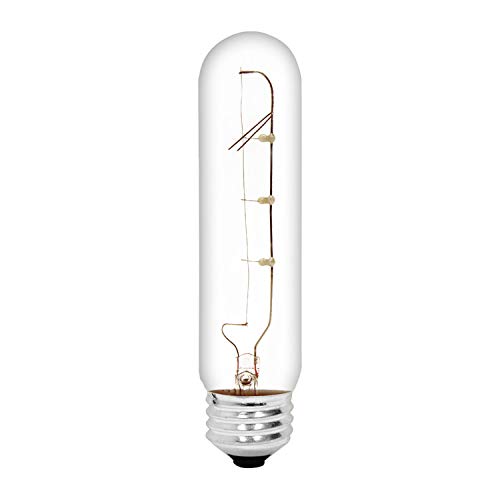
If you want artwork to look warm, natural, and true to color, the Leools 8.9-inch LED Tubular Bulb is a strong pick. You get 2700K warm white light with a CRI 90, so paintings and prints keep rich, accurate tones. Its 8W output delivers 600 lumens, matching a 60W incandescent while using less energy. You can dim it smoothly on most dimmers without buzz or flicker, which helps you adjust mood around your display. The frosted tubular glass and vintage style also suit pendant lamps, sconces, cabinets, and gallery-inspired rooms indoors.
- Bulb Shape:Tubular
- Base Type:E26
- Dimmability:Dimmable
- Color Temperature:2700K
- Brightness:600 lm
- CRI:90
- Additional Feature:Flicker-free lighting
- Additional Feature:Compatible with 90%+ dimmers
- Additional Feature:Vacuum-sealed helium fill
Feit Electric A19 100W Equivalent LED Light Bulbs
Feit Electric’s A19 100W-equivalent LED bulbs are a strong pick for anyone who wants artwork to look vivid and true to life, thanks to their 90 CRI, 3000K bright white light, and no-UV output. You’ll get 1,600 lumens from each bulb, so you can light larger pieces confidently. They dim smoothly, turn on instantly, and use only 17.5 watts. You can screw them into standard E26 fixtures, including enclosed and damp locations. With 25,000-hour life, UL listing, and a 5-year warranty, they’re a practical, efficient choice for your gallery wall.
- Bulb Shape:A19
- Base Type:E26
- Dimmability:Dimmable
- Color Temperature:3000K
- Brightness:1600 lm
- CRI:90
- Additional Feature:Damp rated
- Additional Feature:Enclosed fixture safe
- Additional Feature:5-year warranty
Dimmable E26 T10 LED Tubular Bulb Pack of 2
The Dimmable E26 T10 LED Tubular Bulb is a strong pick for artwork displays when you want a warm, high-CRI light that keeps colors looking natural. You get 2700K light, CRI 90, and 400 lumens, so your pieces look rich without harsh glare. Its 360° beam and clear filament-style glass create a decorative glow in sconces, chandeliers, or curio cabinets. You can dim it smoothly from 0% to 100% with many Lutron, Leviton, and Eaton dimmers. At 4W, it saves energy and lasts up to 25,000 hours.
- Bulb Shape:T10 tubular
- Base Type:E26
- Dimmability:Dimmable
- Color Temperature:2700K
- Brightness:400 lm
- CRI:90
- Additional Feature:360° beam angle
- Additional Feature:ETL certified
- Additional Feature:30-day return guarantee
GE Appliance Light Bulb T10 25-Watt Warm White
GE Lighting’s Appliance Light Bulb T10 25-Watt Warm White suits you when you want a simple, crystal-clear bulb that makes artwork and visible fixtures pop with warm, natural-looking light. Its 2500K glow and 100 CRI help colors stay accurate, so your pieces look rich instead of washed out. You get about 250 lumens from a tubular T10 shape with an E26 base, making it easy to use in picture lights, sconces, cabinets, and chandeliers. It’s a corded, indoor bulb, not smart-home compatible, and it lasts about 1,000 hours.
- Bulb Shape:T10 tubular
- Base Type:E26
- Dimmability:Non-dimmable
- Color Temperature:2500K
- Brightness:250 lm
- CRI:100
- Additional Feature:Crystal clear finish
- Additional Feature:Appliance bulb design
- Additional Feature:1,000-hour lifespan
6-Pack GU10 Dimmable LED Bulbs 3000K Soft White
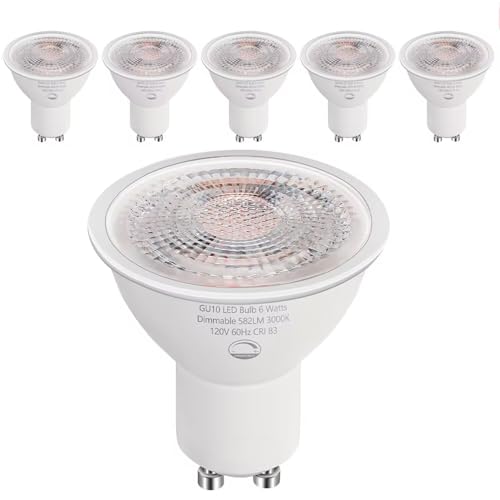
If you want a simple, budget-friendly way to light artwork with warm, flattering color, this 6-pack of GU10 dimmable LED bulbs is a strong fit. You get 3000K soft white light, about 580 lumens, and a 38-degree beam that helps highlight framed pieces without harsh spill. At just 6 watts, it replaces a 50W halogen and runs cool, so it won’t bake delicate art. The CRI 80 rating keeps colors fairly accurate, and the smooth dimming works with most standard dimmers. You can install them in GU10 sockets fast, with no rewiring needed.
- Bulb Shape:GU10 / MR16
- Base Type:GU10
- Dimmability:Dimmable
- Color Temperature:3000K
- Brightness:580–582 lm
- CRI:80
- Additional Feature:38-degree beam
- Additional Feature:Most dimmers compatible
- Additional Feature:30,000–50,000 hour life
2-Pack LED T10 Glass Bulbs (3.5W)
For a warm, gallery-style glow in a small fixture, the Landlite 2-pack LED T10 glass bulbs is a smart pick for artwork, piano lights, and banker lamps. You get 3.5W LED output that replaces a 25W incandescent while delivering 320 lumens of soft 2700K light. The tubular opal glass form looks classic and suits traditional fixtures. Because they’re dimmable and instant-on, you can fine-tune brightness without delay. With an E26 base, 120V compatibility, and about 15,000 hours of life, they’re practical for indoor display lighting, though you should handle the fragile glass carefully.
- Bulb Shape:T10 tubular
- Base Type:E26
- Dimmability:Dimmable
- Color Temperature:2700K
- Brightness:320 lm
- CRI:80
- Additional Feature:Opal glass finish
- Additional Feature:Piano light use
- Additional Feature:6-month warranty
Maelsrlg R14 LED Bulb 4W Soft White 4-Pack
Maelsrlg’s R14 LED Bulb 4W soft white 4-pack is a smart pick for you if you want a compact, low-profile bulb that keeps artwork lighting clean and focused without crowding the fixture. You get 400 lumens, a 2700K glow, and a 45° beam that works well in curio cabinets, bookcases, and other display fixtures. Its 2-inch height helps it hide inside shades, while instant-on LED performance avoids warm-up lag. It’s non-dimmable, so skip dimmer switches. With 25,000-hour life, no mercury, and 2-year warranty, it’s practical and efficient.
- Bulb Shape:R14 reflector
- Base Type:E26
- Dimmability:Non-dimmable
- Color Temperature:2700K
- Brightness:400 lm
- CRI:82
- Additional Feature:Mini reflector flood
- Additional Feature:Non-dimmable design
- Additional Feature:100% recyclable materials
Factors to Consider When Choosing Light Bulbs for Artwork
Selecting the right bulb for artwork often begins with color temperature and a high CRI, since both affect how faithfully colors appear. Dimmability can add flexibility, while glare control helps keep the viewing experience comfortable. Bulb shape also matters, because it must fit the fixture and direct light appropriately.
Color Temperature Choice
Color temperature plays a central role in how artwork is perceived, and a warm-to-neutral range of about 2700K to 3500K usually preserves painted warmth without making whites look overly blue. Traditional oil paintings often benefit from 2700K to 3000K, where richer tones feel balanced and inviting. Contemporary works and gallery installations may look clearer under 3000K to 3500K, which can sharpen edges without becoming stark. Consistency matters as well: every fixture lighting a single piece should use the same color temperature to prevent visible shifts in hue. Mixed-media and photographic works with subtle gradients should be evaluated under the planned setting before installation. That step helps confirm that skin tones, neutrals, and transitions remain believable.
High CRI Importance
Along with choosing the right color temperature, CRI deserves close attention because it determines how faithfully a bulb reveals an artwork’s colors. A bulb with a CRI of 90 or higher is generally preferred, since it helps colors appear accurate and vibrant rather than shifted or washed out. Ratings in the 90–100 range also improve subtle gradations in paint, photography, and skin tones, letting fine detail read more naturally. For critical color work or valuable pieces, CRI 95 and above is a stronger target for gallery-quality presentation. Because CRI is only a broad metric, TM-30 data or sample testing can add confidence when pigment accuracy matters. Pairing high CRI with a suitable Kelvin range further supports the artwork’s intended appearance.
Dimmability Benefits
Dimmable bulbs give artwork lighting far greater control, allowing illumination to be adjusted to reduce glare and hotspots while still preserving detail and texture. This flexibility supports both conservation and presentation, since lower output reduces light exposure intensity and can help slow photochemical fading over time. For artworks viewed in varied settings, dimming also creates a clearer visual hierarchy: softer levels suit ambient display, while brighter levels emphasize close inspection. Smooth, flicker-free performance is important, because unstable dimming can distort color perception at reduced intensities. Compatible dimmers should also maintain strong color rendering and a steady color temperature, ensuring hues remain accurate as brightness changes. When properly matched, dimmability adds precision, longevity, and versatility without requiring any change in fixture placement.
Glare Control
Glare control begins with how the light reaches the artwork, not just how bright it is. Wide beam angles, ideally 120° or more, or diffusers help spread illumination and reduce hot spots on glossy surfaces. Baffles, louvers, shades, and frosted covers further soften the source and limit uncomfortable brightness ratios. Keeping the artwork surface only about 3–5 times brighter than nearby wall areas helps prevent visual strain. Lower apparent source brightness can also be achieved with multiple low-output lamps or recessed and track fixtures that stay out of direct sight from common viewing positions. For glazed or varnished pieces, oblique lighting, typically 30° or more from the normal, reduces specular reflections and keeps the image legible.
Bulb Shape Fit
Once glare is under control, the next step is making sure the bulb itself fits the fixture and the artwork display. The socket type and interior clearance should be measured so the bulb’s length and diameter do not touch the shade, glass, or artwork. Tubular or slender shapes, such as T or R variants, suit visible fixtures because their narrow profile helps limit shadowing and keeps the display visually clean. In recessed or track housings, reflector or directional forms are preferable because they manage beam spread and prevent spill onto nearby surfaces. The base size, whether E26, GU10, or another standard, must also match any cages, guards, or framing. For pieces behind glass or in shallow frames, shorter, low-profile bulbs are often the safest fit for even illumination.
Brightness Levels
For artwork, brightness should be set to match both viewing needs and conservation limits. For general display, 200–300 lumens per square foot suits most pieces, while detailed inspection or gallery viewing may call for 300–500 lumens per square foot. Consistency matters: adjacent fixtures should stay within about ±10% in output to prevent hot spots and preserve even balance. Beam spread also affects perceived brightness; narrow beams concentrate light for accenting, whereas wider beams need greater lumen output to achieve the same visual impact. Sensitive works such as watercolors, textiles, and photochemical materials should remain below 50 lux, and less sensitive pieces below 200 lux. Slightly higher initial output can offset 10–20% loss from aging and optical components over time.
Fixture Compatibility
When selecting bulbs for artwork, the fixture itself should be checked first: the base and bulb shape must fit the socket and clear any shade or housing, whether that means an E26 medium base, a GU10 twist-lock, or a tubular lamp. Voltage should also match the fixture’s rating, and LED retrofits must be supported; many residential fixtures accept 100–120 V. Enclosed or damp-rated housings need compatible bulbs, since some LED designs are not suitable there. If dimming is desired, both the fixture’s dimmer and the bulb’s dimmer compatibility must align to prevent flicker. Beam angle matters as well: track heads, cans, pendants, and picture lights should spread light evenly across the artwork without hot spots or spill.
Heat Output Safety
Heat output is a critical safeguard in artwork lighting, so LEDs are generally preferred over incandescent or halogen bulbs because they produce far less radiant heat at the same lumen output. Lower heat helps reduce surface warming and slows deterioration in sensitive paints, paper, and textiles. Fixtures should be positioned at a safe distance, with lower-wattage sources chosen so artwork temperature rise stays roughly 3–5°C above ambient. Lamps with minimal infrared emission are also important, since IR can penetrate materials and warm them internally; filters can help when needed. Framed or glazed pieces benefit from ventilation or shallow-angle mounting to prevent heat buildup behind glass. Exhibit temperatures should be checked regularly with a surface thermometer and kept under conservation limits, typically below 24–25°C.
Frequently Asked Questions
How Do Uv-Free Bulbs Protect Artwork Colors?
UV free bulbs help protect artwork colors by limiting ultraviolet exposure, which reduces fading, yellowing, and pigment damage in paint and paper. Their lower UV output helps keep colors closer to their original appearance and supports longer preservation of displayed pieces.
Can Smart Bulbs Improve Art Display Lighting?
Yes, smart bulbs can improve art display lighting by letting you fine tune brightness, color temperature, and timing. They make it easier to set the light to suit both the artwork and the room, although true color accuracy still depends on the quality of the bulb.
What Beam Angle Works Best for Framed Paintings?
A beam angle of 30 to 45 degrees usually works best for framed paintings. It keeps light concentrated, reduces spill, and brings out texture without distracting from the artwork. Wider beams can suit larger pieces, but a narrower angle usually gives better control and visual focus.
Do Warm Bulbs Flatter All Artwork Styles Equally?
No, warm bulbs do not flatter every artwork style in the same way. They often bring out traditional, earthy, and portrait pieces, but they can dull cool palettes, contemporary works, and color accurate reproductions, so lighting balance matters.
How Often Should Art Display Bulbs Be Replaced?
Art display bulbs should be replaced every 1 to 3 years, or sooner if they begin to dim, flicker, or change color, so artworks keep their intended lighting and atmosphere.