

Joining a morning standup from a dim spare room, presenting a client pitch from a sun-flooded kitchen, or running a late-night coaching session from the basement: each one exposes the same problem. The webcam is fine, the microphone holds up, but the light on your face looks washed out, shadowed, or just plain tired. A dedicated video conference light solves that without forcing you to renovate the room. Below are five options I narrowed down after comparing form factors, mounting styles, and how each one handles the realities of everyday remote work.
The Essentials At A Glance

NEEWER Basics NL-60AI Selfie Light with Clip, 60 LED, 2000mAh

Yarrashop Desk Ring Light with Stand
Yarrashop Desk Ring Light, Zoom Edition
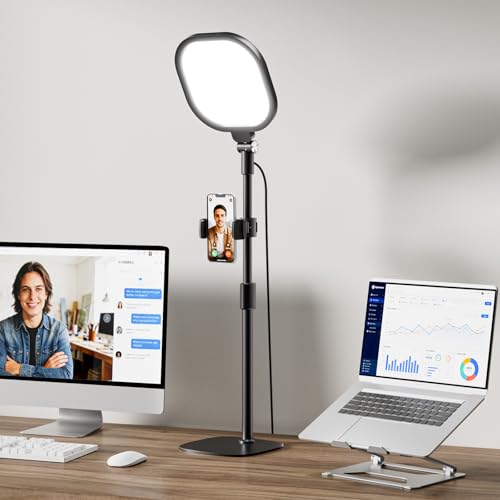
LitONES Video Conference Lighting for Zoom

Godox Litemons LE200Bi 220W Bi-Color COB LED
More Details On Our Top Picks
The NEEWER Basics NL-60AI is the kind of light I keep recommending to friends who bounce between their laptop, phone, and tablet throughout the day. Its front-and-back clip design grips a phone case, a laptop lid, or a thin monitor bezel without sliding around, which matters more than people expect once they actually start using one. The 2000mAh built-in battery means you can take it from the home office to a hotel desk without hunting for an outlet, and the 60 SMD LEDs (small surface-mounted diodes that sit flush with the panel) deliver a soft, even wash that flatters skin tones instead of spotlighting every pore.
For most people working a hybrid week, the three lighting modes and 10-step dimming cover the awkward transitions between morning sun, overcast afternoons, and a lamp-lit evening. CRI95+ (a color rendering index of 95 or higher out of 100, meaning the light reveals true-to-life colors) keeps your face from looking jaundiced on camera. Compared with the larger desk rings below, this one trades broad coverage for portability, and that is a worthwhile exchange for anyone whose workspace changes daily.
Real Benefits
- Front-and-back clip holds steady on phones, tablets, and laptops alike
- Rechargeable 2000mAh battery frees you from the wall outlet during a long day
- CRI95+ rating renders skin tones naturally on most webcams
- 10% to 100% dimming in 10% steps lets you match ambient light without fuss
- Slip it into a bag and forget it’s there, since the whole unit weighs very little
Points To Keep In Mind
- The clip is happiest on thinner lids; chunky gaming laptops may need a small adjustment
- Battery life drops noticeably at maximum brightness, so plan a top-up for long sessions
Whose Shelf It Belongs On
Hybrid workers, traveling consultants, and anyone who hops between devices during the day will get the most out of this little panel.
A Better Fit Elsewhere
Callers who stay parked at one desk all day and want a wider, more atmospheric glow will likely prefer the Yarrashop Desk Ring Light with Stand.
The Yarrashop Desk Ring Light takes the classic ring design and adds a noticeably curved 10.5-inch lamp head rather than a flat panel. That curve is the headline feature, because it spreads light more evenly across the face and shoulders instead of blasting a hot spot right between the eyes. You get 120 LEDs tucked behind a thicker, upgraded coating that softens the beam, which is the difference between a light you can stare at for an hour and one that has you squinting into the webcam by minute ten.
It sits on its own stand, so setup is genuinely plug-and-play. Compared with the compact NEEWER above, this one claims a permanent spot on your desk and rewards that real estate with broader coverage that works well for two-person calls or product demos. I find the curved shape is most helpful for people who record sitting slightly off-center, since the light wraps around instead of fading off to one side.
Bright Spots
- Curved 10.5-inch head wraps light around the face, flattering off-center camera angles
- 120 LEDs provide a wider, more even pool than clip-on panels
- Upgraded coating diffuses the beam, reducing eye strain during long calls
- Stand-mounted design stays put, freeing your hands for notes or demos
Small Caveats
- Takes up more desk space than a clip-on, which matters in tight setups
- Best results assume you sit at a consistent distance; constant repositioning is awkward
Key Specs
Made For
Office professionals and remote workers who sit at a fixed desk for back-to-back meetings and want soft, dependable fill light.
Reach For A Different Pick When
Streamers and presenters who need precise color tuning across many moods should consider the LitONES Video Conference Lighting for Zoom with its 30 modes.
The Yarrashop Zoom edition leans hard into one specific problem: the eye fatigue that creeps in by your third hour of video meetings. It uses a ring nano-diffuse cover paired with 120 high-reflection LED beads, which is the brand’s way of saying the light is scattered across many small reflective surfaces before it reaches you. The result is a soft pool that knocks out face shadows without the glare that flat-panel rings tend to leave behind.
This is the pick I would hand to teachers running virtual classes, support agents on long shifts, or anyone who treats the webcam like a second office. Owners commonly report that the diffused output makes a real difference when they read from a second monitor, since the eye doesn’t keep refocusing between the bright panel and the screen. Stacked next to the larger Yarrashop above, it shares the same family of features but prioritizes the comfort angle.
What Helps Most
- Nano-diffuse cover scatters light before it reaches the eyes
- Eliminates the harsh glare common to flat ring lights
- Bright enough to clear shadows, soft enough for hour three and beyond
- Stands on its own, no permanent install or mounting hardware needed
Things To Consider
- Output is more about diffusion than raw punch; darker rooms may need extra ambient lighting
- Cleaning the textured diffuser cover takes a soft cloth, since buildup can dim the output over time
Best Suited To
People who run back-to-back video sessions and notice dry eyes, squinting, or that mid-afternoon headachy feeling from glare.
Swap It Out When
Creators who film in darker studios and want serious output will get more from the Godox Litemons LE200Bi COB LED Video Light.
Where the Yarrashop rings keep things simple, the LitONES panel leans into versatility. It ships with 30 light modes, which sounds like marketing fluff until you realize that covers color temperature (the warmth or coolness of the light, measured in Kelvin), brightness levels, and combinations in between. A CRI rating above 98 puts it close to the ceiling of accurate color reproduction, which is the spec cinematographers and product photographers chase, and the 4-layer optical soft panel spreads the output before it ever reaches your skin.
The physical design is a panel rather than a ring, with edge-lighting technology that diffuses across the whole face. It comes with a stand, so the unboxing-to-first-call time is short. Compared with the more basic Yarrashop Zoom edition, this one trades plug-and-play simplicity for finer control. I think of it as the right answer for a content creator who also takes client calls and wants a single light that handles both.
Notable Gains
- 30 modes cover nearly any mood, time of day, or camera setting
- CRI above 98 keeps colors true on the screen and in recordings
- 4-layer optical panel softens output without losing brightness
- Stand-mounted, so it works on most desks right out of the box
Honest Caveats
- 30 modes can overwhelm casual callers who just want a single warm setting
- Panel shape takes a bit more adjustment to angle just right, since it has less wraparound than a ring
Right Fit For
Tuners, content creators, and professionals who present on camera often and want one fixture that adapts to many situations.
Where Another Pick Suits Better
Mobile workers who hop between cafés and co-working spaces will find the NEEWER Basics NL-60AI clip-on far easier to pack and reposition.
The Godox Litemons LE200Bi is a different animal from the rest of this list, and that is exactly why it earns its place. This is a 220W bi-color COB LED (a single, high-output chip-on-board diode that produces a powerful, focused beam, with adjustable color temperature) with a Bowens mount, which is the industry-standard attachment point used to swap in softboxes, reflectors, and other light modifiers. The 57,700 lux output at one meter is the kind of figure that lives in studio gear, not on a typical desk. For streamers, podcasters, and anyone filming interviews in a controlled space, that headroom matters.
Bi-color means you can dial the warmth from a candle-like glow to clean daylight without swapping filters. Compared with the consumer-friendly rings above, this one assumes you already know what you want from a light, and it gives you the controls to get there. It is overkill for a casual Zoom call, but the right answer when video quality is the actual product.
Noteworthy Benefits
- 57,700 lux at 1m provides headroom for softboxes and modifiers
- Bowens mount opens up a huge ecosystem of professional light shaping tools
- Bi-color adjustment means no gel filters to swap in and out
- 220W COB source punches through ambient room light without struggling
Practical Considerations
- Significantly larger and heavier than the other picks, so it needs a real stand and a permanent spot
- Heat output at full power means giving it some breathing room in a small room
- Requires familiarity with studio lighting concepts to use well, depending on your background
Key Specs
Who Will Love This
Content creators, podcasters, and broadcasters who need broadcast-grade lighting and are comfortable with studio gear.
Not Your Match When
Remote employees who just want cleaner lighting on a daily Zoom call will get more value from the Yarrashop Desk Ring Light with Stand at a fraction of the footprint.
What Matters Most Before Choosing Video Conference Lights
Mounting Style and Where You Actually Work
The first question I always ask is simple: where will this light live? Clip-on panels like the NEEWER Basics NL-60AI are ideal for people who move between rooms, cafés, and travel days, since they attach directly to the device and travel in a bag. Stand-mounted rings and panels claim a fixed spot on your desk, which is great for consistency but harder to relocate. Consider your chair, monitor, and how much desk real estate you can spare before falling in love with a form factor that doesn’t fit your space.
Brightness vs. Diffusion Trade-offs
Raw brightness is only half the story. A blinding light creates harsh shadows, blown-out highlights, and that washed-out webcam look everyone is trying to escape. Diffusion, which spreads the beam into a softer pool, is what makes the difference between a flattering image and a clinical one. The LitONES panel and Yarrashop Zoom edition both prioritize diffusion through layered panels and nano-covers, which pays off during long sessions where glare becomes a genuine fatigue issue. Higher-end options like the Godox LE200Bi solve this differently, by giving you enough power to push light through large softboxes, though that approach demands more space and know-how.
Color Accuracy and the CRI Question
CRI, or Color Rendering Index, scores how accurately a light source reveals true colors compared to natural daylight, on a scale of 0 to 100. A score of 90 or above is generally considered strong, and the picks here all sit in that range or higher. Higher CRI matters most if you present physical products, review color-sensitive material on camera, or care about how your skin tone reads to clients. For plain talking-head calls, anything in the mid-80s and up is usually plenty, but most shoppers land on 95+ once they see the difference side by side.
Power Source and Portability
Battery-powered lights are a quiet luxury. The NEEWER clip-on runs on a built-in 2000mAh cell, which means a full day of meetings without hunting for a free outlet. Plug-in models like the Yarrashop rings and the Godox LE200Bi trade that flexibility for sustained output and, in the Godox’s case, studio-grade power. Match the power source to your routine: travelers and couch-office workers benefit from batteries, while dedicated home-office users get more from a plug-in setup.
Key Considerations Across These Picks
Mistakes Worth Dodging
The most common error I see is chasing the brightest light on the spec sheet, then realizing it blows out the webcam. Raw lumens (a unit measuring the total visible light a source produces) tell you how much light comes out, not how it lands on a face. Another slip-up is ignoring the mount: clip-on lights do little for someone who presents while standing several feet from the laptop, and a heavy stand-mounted panel is equally wrong for a kitchen-counter worker who packs up each morning. Measure your typical distance from the camera first, and choose a light whose intended use matches that range.
Where The Extra Money Goes
Stepping up to a higher-tier light usually buys you better color accuracy, more output headroom, and the ability to shape the light with modifiers. A panel like the Godox LE200Bi costs more because it is a studio tool in a category full of consumer helpers, and the Bowens mount alone opens up a deep ecosystem of accessories. For most office-based remote workers, mid-tier lights deliver the visible improvement they care about, and the premium tier pays for itself only when video quality is part of the actual job description.