

A grow light left on for 18 hours straight can burn tender seedlings, and forgetting to flip the switch during the 6-hour dark cycle ruins a photoperiod schedule entirely. That’s where a dedicated outlet timer steps in, automating the on/off rhythm so the lights behave like a miniature sun. I pulled together six solid options spanning outdoor weatherproof builds, simple mechanical dials, and full digital programming, so you can match a timer to the exact light schedule your plants need.
How The Shortlist Stacks Up

Southwire Woods Outdoor 24-Hour Mechanical Timer

BN-LINK Indoor Countdown Timer with Repeat Function

BN-LINK Indoor 7-Day Programmable Digital Timer Outlet

DEWENWILS Indoor 1/2/4/8 Hours Countdown Timer Outlet 2 Pack
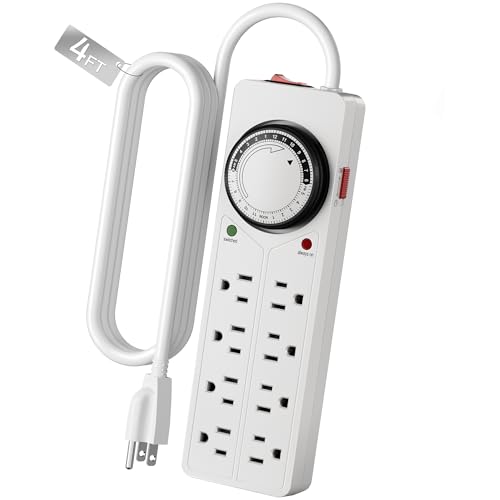
BN-LINK 8 Outlet Surge Protector with Mechanical Timer

BN-LINK 24-Hour Heavy Duty Mechanical Timer Outlet
What Each Pick Brings To The Table
Grow tents and indoor racks are easy, but a backyard greenhouse or cold-frame setup throws weather at your timer all year. The Southwire Woods outdoor mechanical timer handles that exposure with a waterproof housing built to shrug off rain and humidity. Two grounded outlets give you room to run a light and a small circulation fan on the same schedule.
The 24-hour dial repeats daily, so once you set the dark and light windows, the timer marches on without programming fuss. It’s the kind of plug-and-forget hardware that suits someone whose growing space sits outside or in a damp basement.
Noteworthy Benefits
- Waterproof casing handles outdoor humidity and splashes without shorting out.
- Dual grounded outlets let you automate a light and a fan together.
- Mechanical dial repeats the same daily schedule indefinitely, no batteries required.
- Simple tripper-pin design is approachable for anyone hesitant about digital menus.
Things To Consider
- Limited to one repeating 24-hour pattern, so veg/bloom split cycles aren’t possible.
- The dial’s 15-minute increments may feel coarse for growers chasing precise photoperiods.
- Mechanical internals can wear over many seasons of constant use in extreme temperatures.
Feature Snapshot
Whose Shelf It Belongs On
Greenhouse growers and anyone running a light in an outdoor shed or cold frame benefit most from the rugged weatherproof body.
Swap It Out When
Veg-to-bloom transition growers should reach for the BN-LINK Indoor 7-Day Programmable Digital Timer Outlet instead, since it supports multiple daily programs.
New growers often stall at the programming stage, staring at a digital screen wondering whether 18/6 means on at 6 or off at 6. The BN-LINK countdown timer sidesteps that confusion with six preset buttons for 15 minutes, 30 minutes, 1 hour, 2 hours, 4 hours, and 6 hours. Press once, and the unit counts down, then shuts off. The repeat function restarts the same countdown every cycle.
For a leafygreens vegetative schedule, hitting the 6-hour button twice gets you close to a 12/12 rhythm without menus. The two 3-prong outlets handle a modest LED panel and a small fan, making this a tidy entry point for anyone dipping into indoor growing.
The Case For It
- Preset countdown buttons remove any guesswork around scheduling.
- Repeat function rebuilds the same cycle after each countdown ends.
- Two grounded 3-prong outlets let you automate a light and fan in tandem.
- Manual override button pauses the schedule for watering or inspection days.
Points To Note
- Maximum countdown tops out around 15 hours and 45 minutes, so extended bloom cycles need checking.
- Fixed button increments don’t suit growers who need exact half-hour photoperiod tuning.
Who Should Grab It
First-time indoor gardeners who want a low-fuss countdown schedule without diving into weekday programming.
Consider Something Else When
Growers running multiple daily schedules should consider the BN-LINK Indoor 7-Day Programmable Digital Timer Outlet for richer weekly control.
A single daily pattern suits herbs and lettuce, but fruiting plants want different schedules as they move from vegetative growth into flowering. The BN-LINK 7-day digital timer solves that with up to eight individual on/off programs and a one-minute resolution. Set 18 hours of light for veg, then dial it back to 12 hours for bloom, all on the same wall outlet.
Compared to the BN-LINK countdown timer above, this one asks for a learning curve at setup, but the daily-savings mode button and weekday combinations pay off over a full grow cycle. The backup battery retains programs through power blips, which matters in older homes where the grid hiccups now and then.
The Practical Payoff
- Eight independent on/off programs support complex schedules like 18/6 veg and 12/12 bloom.
- Daylight-savings mode adjusts the clock without reprogramming each program.
- Backup battery preserves settings through short outages, preventing schedule resets.
- Pre-set day combinations speed up weekday selection for repeating routines.
Honest Caveats
- Setup takes longer than a mechanical dial, especially for first-time users.
- Both outlets are controlled together, so two lights always share one program.
Quick Facts
Best Suited To
Growers transitioning plants through veg and bloom phases who need more than one daily program.
Look Elsewhere When
Someone running a single, repeating daily cycle may prefer the simpler BN-LINK 24-Hour Heavy Duty Mechanical Timer Outlet.
A single tent sometimes runs two separate chambers, one for mother plants under 18 hours of light and another for seedlings on a shorter cycle. The DEWENWILS 2-pack gives you two independent countdown timers in one purchase, each cycling through 1, 2, 4, or 8 hours of on-time before shutting off.
Press the button once for 1 hour, twice for 2, and the cycle repeats once it finishes, so a clone dome running 4-hour misting cycles can share an outlet strip with a vegetative panel running 8 hours. The always-on and off positions round out the modes for when you want to bypass the timer entirely.
A Strong Showing
- Two-pack value lets you automate two zones or tents from a single order.
- Four preset intervals cover most common photoperiod targets.
- Always-on mode skips the timer for transplanting or inspection work.
- Compact body fits behind furniture without crowding the outlet.
Room For Improvement
- Preset gaps mean non-standard photoperiods (3 or 6 hours) aren’t directly supported.
- No screen readout, so you confirm the active mode by counting button presses.
Perfect Match For
Multi-zone indoor growers running separate propagation and vegetative areas who want matched hardware.
Not Your Match When
Anyone needing a true 12/12 flower cycle should step up to the BN-LINK Indoor 7-Day Programmable Digital Timer Outlet for finer scheduling.
A serious grow room rarely runs on a single outlet. The BN-LINK 8-outlet surge protector combines a mechanical timer on four of the outlets with four always-on sockets, so your lights cycle while fans and monitors stay powered continuously. A built-in circuit breaker protects against surges that can fry a ballast or driver.
The 4-foot cord reaches across a grow tent without needing an extension cable. Owners commonly appreciate the pin dial for its no-fuss 15-minute increments, though the cord length is actually 3 feet on this listing, which matters for tight setups where the outlet sits behind a tent pole.
A Favorable Mix
- Eight outlets handle multiple lights, fans, and a humidifier from one strip.
- Surge protection with a resettable circuit breaker shields expensive drivers and ballasts.
- Four timed plus four always-on outlets let you split cycles by accessory.
- Mechanical dial repeats daily without programming or batteries.
Factors To Consider
- Pin dial only supports one repeating daily schedule, limiting photoperiod changes.
- The unit is large and may not fit on a narrow shelf without rearranging the tent.
Feature Rundown
Made For
Multi-light growers running a full tent or dedicated grow room who want surge protection alongside scheduling.
Skip It When
A single-light starter setup is better served by the BN-LINK 24-Hour Heavy Duty Mechanical Timer Outlet to avoid paying for unused outlets.
The classic pin-style timer has a long-standing reputation for breaking when one of those tiny removable pins gets lost behind a shelf. The BN-LINK mechanical timer addresses that frustration with a built-in pin dial where each toggle pushes down for ON and stays up for OFF. No loose pieces, no fumbling under furniture.
The indicator light glows when the outlet is energized, so a quick glance confirms whether the schedule is currently feeding power to the light. For a single-panel herb garden or a small clone dome, this is exactly the kind of low-fuss hardware that earns its place on the wall.
Bright Spots
- Integrated pin dial eliminates the loose-pin problem common to older mechanical timers.
- Indicator light confirms the current power state at a glance.
- 3-prong grounded outlet accepts standard grow light plugs securely.
- Mechanical design runs indefinitely without batteries or software updates.
Small Caveats
- Only one daily schedule is supported, so transitioning to bloom requires manual pin resets.
- Tick sound during operation may be noticeable in quiet rooms.
Who Will Love This
Single-light growers who want a dependable mechanical schedule without worrying about lost pins.
Reach For A Different Pick When
Anyone running multiple daily programs should pick the BN-LINK Indoor 7-Day Programmable Digital Timer Outlet for richer scheduling.
Picking The Right Schedule For Your Garden
The first thing to lock down is the photoperiod, or the on/off light cycle, your plants actually need. Leafy greens and herbs run happily on 18 hours of light and 6 hours of dark, while flowering plants like tomatoes and peppers shift to a 12-hour cycle to trigger bloom. Match the timer’s resolution and program count to that target. A coarse mechanical dial handles a single daily pattern fine, but a digital weekly timer earns its keep when veg and bloom schedules need to coexist.
Next, think about where the timer will live. Outdoor greenhouses and damp basements push moisture toward the plug, so a waterproof outdoor housing pays for itself by preventing corrosion. Indoor tent setups stay dry, which opens the door to compact plug-in models that hide behind a pole.
Capacity matters more than most growers expect. A single LED panel draws modest current, but multiple high-wattage lights stack up fast. Check the rated wattage and amperage on the timer against your total draw, and leave a margin so the contacts aren’t running at their ceiling every cycle. The 1875W/10A surge-protector model handles a multi-light room, while a 2-outlet countdown unit suits a small single-panel garden.
Why Mechanical And Digital Both Have A Place
Mechanical pin timers trade flexibility for reliability. They run without batteries, survive power outages without losing their schedule, and cost less, but they only repeat one daily pattern. Digital timers cost a bit more and ask for setup patience, yet they deliver multiple programs and one-minute resolution. For growers running one stable cycle, mechanical wins on simplicity. For anyone juggling propagation, veg, and bloom, digital pays off fast.
Common Pitfalls When Picking A Grow Light Timer
Watch for these traps before committing to a timer. The first is matching the photoperiod to the plant stage, not just the timer. A countdown model with a 6-hour max won’t cover an 18-hour veg cycle. The second is forgetting surge protection for higher-draw HID setups, where a single power spike can destroy a ballast. The third is overlooking the cord length and outlet spacing, which sounds minor until your timer physically blocks the second socket on the wall.
What Spending More On A Timer Actually Buys You
Higher-tier timers justify their cost in three places: program count, outlet count, and protection. A weekly digital unit with eight programs handles a full garden cycle without manual resets. An 8-outlet surge protector consolidates a grow room’s wiring into one strip, reducing cable clutter and adding a circuit breaker for safety. For most beginners, a simple mechanical timer covers the basics, but once the garden expands, the upgrade simplifies daily routines noticeably.
Frequently Asked Questions
Do Grow Lights Really Need A Timer?
Yes, because consistent photoperiods, or repeatable daily light cycles, drive healthy plant development, and a timer delivers that consistency without daily manual effort.
Can One Timer Run Multiple Grow Lights At Once?
Yes, provided the combined wattage stays below the timer’s rated capacity and you use a power strip or surge protector to expand the outlet count.
What’s The Difference Between Mechanical And Digital Grow Light Timers?
Mechanical timers use a physical pin dial that repeats one daily schedule without power, while digital timers store multiple programs with finer time resolution at the cost of setup complexity.
Will A Grow Light Timer Survive A Power Outage?
Most digital timers retain their programs through short outages via a backup battery, while mechanical timers resume automatically once power returns without losing their dial setting.
Can Outdoor Grow Light Timers Handle Rain?
Outdoor-rated timers with waterproof housings are designed for that exposure, but indoor models should stay under cover or inside a weatherproof enclosure.