

Provided you’re building a HomeKit setup in 2026, the best smart bulbs do more than turn on with Siri. You want reliable local control, smooth dimming, solid color accuracy, and the right shape for each fixture. Some options are better for everyday rooms, while others fit accents or flood lighting. The differences matter more than you could expect, especially once you compare how each bulb handles scenes, automation, and color.
| SYLVANIA WiFi LED Smart Light Bulb 4-Pack (75674) |  | Best for Alexa | Smart Control: Alexa, Google Assistant, Siri Shortcuts | Wi‑Fi: 2.4 GHz Wi‑Fi | Color Changing: Millions of colors | CHECK LATEST PRICE | Check Our Analysis |
| Sylvania Smart Bluetooth A19 Color Tunable Bulb (75627) |  | Best Budget Option | Smart Control: Alexa, Apple HomeKit, Google Assistant | Wi‑Fi: Bluetooth Mesh | Color Changing: Full color | CHECK LATEST PRICE | Check Our Analysis |
| Govee E12 Smart Color Changing Bulbs (4 Pack) | Best for Small Fixtures | Smart Control: Matter, Alexa, Google Assistant, Siri | Wi‑Fi: 2.4 GHz Wi‑Fi | Color Changing: Millions of colors | CHECK LATEST PRICE | Check Our Analysis | |
| meross Smart WiFi LED Bulb RGBWW HomeKit Compatible |  | Best HomeKit Pick | Smart Control: Apple HomeKit, Alexa, Google Assistant, SmartThings | Wi‑Fi: 2.4 GHz Wi‑Fi | Color Changing: RGBWW multicolor | CHECK LATEST PRICE | Check Our Analysis |
| Meross Smart WiFi LED Flood Bulb 2-Pack | 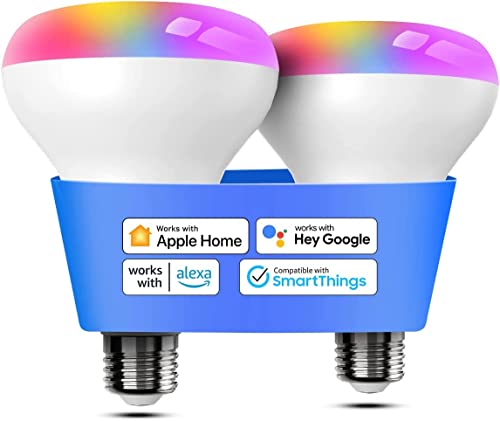 | Best Flood Bulb | Smart Control: Apple HomeKit, Alexa, Google Assistant, SmartThings | Wi‑Fi: 2.4 GHz Wi‑Fi | Color Changing: 16 million colors | CHECK LATEST PRICE | Check Our Analysis |
More Details on Our Top Picks
SYLVANIA WiFi LED Smart Light Bulb 4-Pack (75674)
Should you already use Alexa, these SYLVANIA bulbs fit right in. You can also control them with Google Assistant and Siri Shortcuts, but they don’t work with Apple HomeKit, so omit them in case that’s your priority. Use voice commands or the free SYLVANIA Smart WiFi app to set up the bulbs, adjust brightness, and create routines, timers, and scenes. You’ll get millions of colors, a tunable white range from 2700K to 6500K, and 90+ CRI for vivid results. They need 2.4 GHz Wi‑Fi, no hub, and indoor use only.
- Smart Control:Alexa, Google Assistant, Siri Shortcuts
- Wi‑Fi:2.4 GHz Wi‑Fi
- Color Changing:Millions of colors
- White Range:2700K–6500K
- Dimmable:Yes
- App Control:SYLVANIA Smart WiFi App
- Additional Feature:Works with Siri Shortcuts
- Additional Feature:90+ CRI color accuracy
- Additional Feature:No hub required
Sylvania Smart Bluetooth A19 Color Tunable Bulb (75627)
Should you want HomeKit color control without extra hardware, Sylvania’s 75627 fits a tight budget. You can pair it with Apple HomeKit, Alexa, or Google Assistant, then control color, dimming, schedules, and automations from the SYLVANIA Smart Home app. Its integrated Bluetooth Mesh helps improve reliability and range, so you don’t need a hub. The A19 bulb delivers 800 lumens, full color, and tunable white with a CRI of 80. It also matches a 60W incandescent, is dimmable, and should last up to 20,000 hours, making it a practical single-bulb buy for your HomeKit setup.
- Smart Control:Alexa, Apple HomeKit, Google Assistant
- Wi‑Fi:Bluetooth Mesh
- Color Changing:Full color
- White Range:Full color plus tunable white
- Dimmable:Yes
- App Control:SYLVANIA Smart Home app
- Additional Feature:Bluetooth Mesh technology
- Additional Feature:Apple HomeKit compatible
- Additional Feature:20,000-hour lifetime
Govee E12 Smart Color Changing Bulbs (4 Pack)
Govee’s E12 smart bulbs fit small fixtures with vivid color and easy HomeKit-friendly control. You get a 4-pack of candle-style bulbs that drop into candelabra sockets and brighten your space with up to 450 lumens. Use the Govee Home app or voice control through supported Matter setups, Alexa, Google Assistant, or Siri. You can pick from millions of colors, tune white from 2700K to 6500K, and set schedules, scenes, or sunrise modes. They run on 2.4 GHz Wi‑Fi or Bluetooth, and they don’t work with dimmer switches.
- Smart Control:Matter, Alexa, Google Assistant, Siri
- Wi‑Fi:2.4 GHz Wi‑Fi
- Color Changing:Millions of colors
- White Range:2700K–6500K
- Dimmable:Yes
- App Control:Govee Home app
- Additional Feature:Matter compatible
- Additional Feature:Music sync effects
- Additional Feature:50+ preset scenes
meross Smart WiFi LED Bulb RGBWW HomeKit Compatible
Meross’s RGBWW bulb is a strong HomeKit pick should you want Siri control and broad smart-home compatibility. You can use it with Apple HomeKit, Apple Watch, Siri, Alexa, Google Assistant, and SmartThings, so it fits easily into mixed setups. Its 2.4 GHz Wi‑Fi connection needs no hub, and you can manage it from the Home or Meross app whenever you’re online. You get dimmable RGBWW lighting, warm-to-cool whites from 2700K to 6500K, and scenes for arrivals. At 9W, it delivers 60W brightness while helping you save energy.
- Smart Control:Apple HomeKit, Alexa, Google Assistant, SmartThings
- Wi‑Fi:2.4 GHz Wi‑Fi
- Color Changing:RGBWW multicolor
- White Range:2700K–6500K
- Dimmable:Yes
- App Control:Meross app, Apple Home app
- Additional Feature:Apple Watch control
- Additional Feature:CarPlay support
- Additional Feature:AWS data storage
Meross Smart WiFi LED Flood Bulb 2-Pack
Should you want bright, color-rich HomeKit flood lighting, this Meross BR30 2-pack fits well. You get two BR30 E26 bulbs that deliver up to 1,300 lumens, 16 million colors, and tunable white from 2,700K to 6,500K. They work with HomeKit, Siri, Alexa, Google Assistant, and SmartThings over 2.4GHz Wi‑Fi, so you don’t need a hub. Use the Meross or Apple Home app for dimming, scenes, and schedules. With 14W use, a 100 CRI, and FCC/UL certifications, they suit family rooms, kitchens, and recessed fixtures.
- Smart Control:Apple HomeKit, Alexa, Google Assistant, SmartThings
- Wi‑Fi:2.4 GHz Wi‑Fi
- Color Changing:16 million colors
- White Range:2700K–6500K
- Dimmable:Yes
- App Control:Meross app, Apple Home app
- Additional Feature:1300-lumen brightness
- Additional Feature:100 CRI lighting
- Additional Feature:HomeKit bridge required
Factors to Consider When Choosing Smart Light Bulbs For Homekit
At the time you choose Smart Light Bulbs for HomeKit, make sure they’re fully HomeKit compatible and connect in a way that fits your setup, whether that’s Wi‑Fi, Bluetooth, or Thread. You’ll also want to check voice assistant support so they work smoothly with Siri and any other assistants you use. Finally, compare brightness output and color range so the bulbs match the lighting needs and mood you want in each room.
HomeKit Compatibility
For a smooth HomeKit setup, make sure the smart bulb explicitly supports Apple HomeKit in the Home app so you may add it, control it, and build Siri scenes natively, often with iOS 13 or later. You should also confirm that the bulb exposes its main features in HomeKit as separate controls, such as on/off, dimming, color temperature, and RGB color. That way, you can tweak each setting from the Home app or with Siri rather than relying on a vendor app. Check for HomeKit automations and secure sharing should you want advanced routines or family access. Finally, verify the pairing method, required updates, and 2.4 GHz network support so HomeKit stays reliable and secure.
Connection Type
Connection type matters just as much as HomeKit support, because it affects setup, range, reliability, and whether you can control your bulbs from outside the home. Most HomeKit bulbs use 2.4 GHz Wi‑Fi or Bluetooth, so check your network band and where you need coverage. In case you want direct pairing, pick a HomeKit over IP bulb that doesn’t need a hub. That keeps installation simpler and usually gives you full remote access through your home setup. Bluetooth bulbs work well for local control and use less power, but their range is short, and they won’t reach remotely unless you have a HomeKit hub. Wi‑Fi bulbs skip the extra bridge, yet they add traffic to your network. For bigger setups, Thread or Matter can improve responsiveness and stability.
Voice Assistant Support
Voice assistant support should be a top priority, because the bulb needs to work smoothly with Siri, not just show up in the Home app. You should confirm it explicitly says “Works with Apple HomeKit” so Siri can find it reliably and you can add it to HomeKit scenes. Check whether remote control and automations need a Home Hub, such as a HomePod, Apple TV, or always-on iPad, because some voice-triggered features won’t run without one. In case you like custom routines, look for Siri Shortcuts and native scene support, so you can say things like “Good night” and trigger several actions at once. Also, make sure the bulb’s Wi‑Fi, Bluetooth, or Thread setup supports fast, low-lag responses and doesn’t depend on extra bridge delays.
Brightness Output
Brightness matters just as much as compatibility whenever you’re choosing a HomeKit smart bulb, because the right lumen output determines how well it fits the space. For most living rooms and bedrooms, aim for about 800 lumens; for desks, kitchens, or flood-style lighting, look for 1100 to 1300 lumens; for bedside lamps or accents, 400 to 450 lumens usually feels right. Don’t stop at the max rating: make sure the bulb can dim smoothly to 5–10% for night scenes without flicker or cutoff. Effective brightness can shift with color temperature, so a bulb’s lumen spec and CCT range matter together. Also check beam spread, since narrow bulbs can leave dark corners, while BR-style bulbs throw light more evenly across your room and fixtures.
Color Range
Color range is where a good HomeKit bulb starts to feel truly flexible, since you’re not just picking between on and off—you’re choosing how your room looks and feels. You’ll want RGBWW support provided that you care about both vivid colors and a usable gamut. A wide tunable range, around 2700–6500K, gives you warmer evenings and cooler daytime whites that look natural across rooms. Check CRI too: 90+ helps colors appear richer and whites look truer than lower-rated bulbs. In case you need consistent results for artwork, cooking, or product shots, verify brightness at different color temperatures, since output can change. Also, make sure HomeKit exposes both hue and color temperature controls so you can build scenes and routines that actually match your setup.
Dimming Control
Dimming control can make or break how practical a HomeKit bulb feels day to day. You should choose a bulb that dims smoothly through the Home app and Siri, especially below 10%, so you don’t get flicker or a uselessly bright minimum level. Make sure it supports HomeKit’s native dimming API, because that usually means faster, more reliable responses to sliders and voice commands. Also confirm the bulb handles dimming inside the LED driver, not through an external triac switch, since that can cause buzzing, flicker, and shorter life. Check the minimum brightness and color temperature at low levels too, so tunable white stays accurate. Should you want wake and sleep routines, look for fine-grained fades and preset dim levels.
App Automation Features
While you’re choosing a HomeKit bulb, don’t overlook its automation features, because that’s what turns a light into part of your routines. You want support for HomeKit scenes and automations so the bulb can join setups like “Good Morning” or “Movie Time” without fuss. Check that you can control on/off, dim level, color temperature, and RGB color, since those options let you build circadian schedules, mood lighting, and color alerts. Make sure the app or HomeKit integration supports time-based triggers, sunrise and sunset actions, geofencing, and WHEN/THEN conditions. WHEN possible, pick a bulb that runs automations locally on your Home hub, because that’s usually faster and works better offline. Also confirm grouping, scene presets, shifts, and gradual fades for smoother changes.
Fixture Fitment
Before you buy a HomeKit smart bulb, make sure it actually fits the fixture you plan to use it in. Check the base initially: E26, E27, E12, GU10, or BR30 must match the socket exactly. Then compare the bulb’s shape and size, like A19, B11, or BR30, with your fixture’s clearance and shade so it doesn’t stick out or get blocked. Also confirm the fixture’s wattage limit and heat tolerance; choose an LED smart bulb at or below that rating. In case you’re using a recessed or enclosed fixture, pick a bulb rated for that space and make sure air can move around it. Finally, in the event the fixture has a dimmer or multi-way switch, verify compatibility or swap in a smart-friendly controller.
Frequently Asked Questions
How Do Homekit Bulbs Affect My Wi-Fi Network Speed?
HomeKit bulbs use very little bandwidth, so they rarely slow your connection. If you add many bulbs, they can still increase Wi Fi traffic a bit and make a crowded network work harder.
Can I Use Homekit Smart Bulbs Without a Hub?
Yes, you can if they support HomeKit over Wi Fi. You pair, control, and automate them from your iPhone or Home app. Some Matter bulbs also skip hubs, but you still need a Home hub for remote access.
What Happens to Presets After a Power Outage?
In most cases, your presets stay intact after a power outage, and your bulbs come back to their previous state or scene when power is restored. Some models can reset, so it is best to review each bulb’s power loss recovery settings.
Are Smart Bulbs Safe to Use in Enclosed Fixtures?
Usually, you can use smart bulbs in enclosed fixtures if the packaging says they are rated for that use. I once watched an unventilated bulb heat up like a kettle left on too long, so it is wise to check the wattage limit and leave enough space around it.
Can Multiple People Control the Same Homekit Bulbs?
Yes, you can share HomeKit bulbs with multiple people by inviting them in the Home app. After they accept, they can control the lights, run scenes, and change settings from their own Apple devices.
Wrap Up
You’ve got plenty of strong HomeKit smart bulb options, whether you want reliable white light, rich color, or specialty shapes like E12 and BR30. One useful stat: high-CRI bulbs can make colors look up to 20% more natural, which helps rooms feel more vivid and comfortable. Should you choose Thread, Matter, or solid 2.4 GHz Wi‑Fi support, you’ll get smoother control, better automations, and a smarter home that just works.