

I went deep on WiFi LED strip controllers this round, because the boring little box that runs your lights matters more than the strips themselves. Pick the wrong one, and you’ll spend weekends cursing a finicky app or chasing a controller that can’t talk to your strips.
These six BTF-LIGHTING controllers cover the whole color spectrum of setups, from basic single-color runs to full RGBCCT projects.
An Overview Of The Picks

BTF-LIGHTING C01W WiFi Controller for 2pin Single Color LED Strip

BTF-LIGHTING C03W WiFi Controller for 4pin SMD COB RGB LED Strip
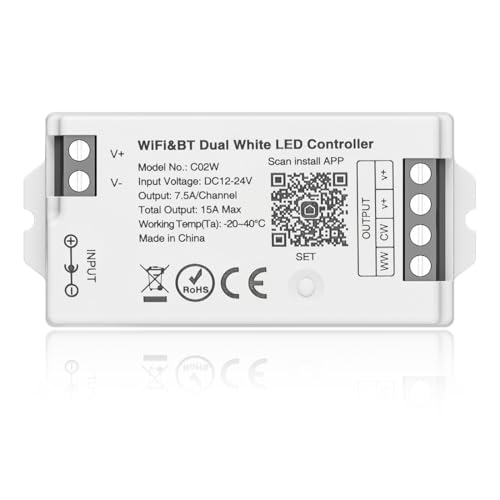
BTF-LIGHTING C02W WiFi Controller for 3pin SMD/COB CCT LED Strip

BTF-LIGHTING C04W WiFi Controller for 5pin RGBW LED Strip

BTF-LIGHTING WB5 2.4GHz WiFi LED Controller 5-in-1 PWM LED Dimmer

BTF-LIGHTING C05W WiFi Controller for 6pin RGBCCT LED Strip
Why These Options Stand Out
The BTF-LIGHTING C01W sits at the entry point of this lineup, and it knows exactly what it’s for. It drives 2-pin single-color strips, the kind you’ll find under cabinets, in closets, or along a stair tread where all you want is warm white at a chosen brightness.
For someone wiring their first smart setup, that focus is the appeal. You skip the learning curve around color channels and just decide how bright the room should be. Compared to the multi-channel units lower in this list, the C01W trades flexibility for a cleaner, less fiddly install.
Everyday Advantages
- Three control methods run at once, so the app, an RF remote, and a voice assistant can share the room without conflict
- Dimming from the app means you can soften a hallway at night without walking back to a switch
- Timers and countdown routines handle the boring stuff, like turning off after you forget
- Group control lets one phone manage multiple single-color zones around the house
Things To Consider
- This box speaks 2-pin single-color strips only, so it’s not a future-proof upgrade path
- Setup lives inside Tuya or Smart Life, which adds a second app to your phone if you’re already deep in another ecosystem
Made For
First-time smart lighting shoppers running warm-white strips under cabinets or in a reading nook who want a quiet, no-surprise setup.
Skip It When
The BTF-LIGHTING WB5 is a better fit when you’d like one controller that can also handle color strips down the road.
Step up from a single-color setup and you land here. The BTF-LIGHTING C03W runs 4-pin RGB strips, the standard format for adding color without dedicated white. Think TV backlights or a gaming shelf where mood matters more than task lighting.
It’s the practical middle child of the lineup, more capable than the C01W but simpler than the RGBCCT option I’ll cover later. For most people adding color to one or two rooms, that’s exactly the right size.
A Few Strong Suits
- Access to 16 million colors means accent lighting actually fits the moment, not just the room
- Saturation control is genuinely useful for toning down a harsh primary color into something livable
- Scene customization lets you save a “movie night” preset and recall it with one tap
- Works with the same RF remotes and voice ecosystem as the rest of the BTF line, so mixing units stays consistent
Trade Offs
- No dedicated white channel, so pastel whites often look slightly purple or green compared to a true tunable strip
- Owners commonly report that 2.4GHz WiFi is required, and a crowded router environment can slow pairing
Right Fit For
Gaming rooms, TV backlighting projects, and renters who want colorful accents without rewiring a fixture.
Where A Sibling Pick Shines
The BTF-LIGHTING C04W is the smarter choice when you also want a clean dedicated white channel alongside color.
The BTF-LIGHTING C02W handles 3-pin CCT strips, the format built around tunable white. Cool white for a home office in the morning, warm white for a living room at night, all from the same physical strip.
This is the controller for people who care more about the feel of light than its color. In a kitchen or workspace, where task clarity matters, the smooth shift between cool and warm is the whole point of the upgrade.
A Favorable Mix
- Tunable white is a real daily-use feature, especially for shift workers who want energizing light by day and relaxing light by evening
- Smooth dimming keeps the transition between scenes gentle rather than stepped
- Sleep and wake routines can ride on the color temperature shift itself, simulating a natural sunrise
- Compatible with both SMD and COB strip variants, giving flexibility when sourcing spools
Honest Caveats
- No color channels at all, so this is a strictly white-light solution
- The 3-pin wiring is less common than RGB, and matching the wrong strip is a common first-install mistake
Best Suited To
Home offices, kitchens, and bedrooms where you want the white tone to follow the time of day rather than stay fixed.
A Better Fit Elsewhere
The BTF-LIGHTING C05W is the smarter call when you’d like tunable white and full RGB color from the same controller.
The BTF-LIGHTING C04W solves a real complaint about standard RGB strips: their whites look muddy. By adding a fourth wire dedicated to pure white, this controller gives RGBW strips their own clean channel for actual white light.
In a kitchen, that difference is obvious. Pastel whites finally read as white instead of faintly pink or green, which is what most homeowners expect from a “white” preset in the first place.
What Earns Its Place
- The dedicated white channel produces cleaner everyday lighting than mixed RGB whites
- 16 million colors plus saturation control give plenty of range for accent scenes
- Group and multi-zone control scale nicely across several rooms or runs
- Voice and RF remote compatibility matches the rest of the family, keeping the setup uniform
Points To Note
- 5-pin strips are slightly trickier to source and splice than 4-pin, so plan ahead
- The extra channel adds a small amount of setup complexity versus the simpler C03W
Key Product Details
Who Should Grab It
Anyone running RGBW strips in a kitchen, dining room, or living space where clean white light matters as much as accent color.
Look Elsewhere When
The BTF-LIGHTING WB5 is a more useful choice if you want one controller that can adapt to whatever strips you end up buying later.
The BTF-LIGHTING WB5 is the do-it-all box in the lineup. Instead of buying one controller per strip type, this single unit can switch between single-color, CCT, RGB, RGBW, and RGBCCT modes through a setting button. That’s huge for DIYers and anyone upgrading over time.
It’s also the one I’d hand to a friend who isn’t sure what strips they’ll end up with. You pick the WB5, decide later what you actually want to run, and you’re not locked in.
What It Does Well
- Covers all five common LED strip types from a single unit, removing the need to match controller to spool
- PWM dimming (a method that adjusts brightness by pulsing the LED current on and off) keeps colors clean at low brightness levels
- Works on standard 12V and 24V low-voltage setups, which covers most residential lighting projects
- Compatible with Tuya, Smart Life, Alexa, and Google Home, so it usually drops into an existing smart-home setup without friction
Points To Keep In Mind
- Switching modes requires a button press and re-pairing the app, which adds an extra step versus dedicated single-mode controllers
- It’s a denser feature set than most people need, so beginners may find the setup screens busier than expected
Feature Snapshot
Built With In Mind
DIYers renovating multiple rooms, RV or workshop owners, and smart-home beginners who want flexibility without committing to a single strip format.
Reach For A Different Pick When
The BTF-LIGHTING C01W is a simpler, less overwhelming choice for someone running only warm-white strips in one room.
The BTF-LIGHTING C05W is the most capable dedicated controller in the family. RGBCCT strips pack six wires for red, green, blue, cool white, and warm white, which means full color plus tunable white in one strip.
For a media room or open-plan living space, that’s the configuration that does everything. Cool white for focus, warm white for movie night, any color for parties, all from the same wire run.
What Helps Most
- Full RGBCCT control means you skip the trade-off between clean whites and rich colors
- 16 million colors combined with tunable white unlocks more nuanced scenes than simpler controllers allow
- Voice, app, and RF remote options cover every household comfort level
- Group and multi-zone control scale to whole-home installations
Practical Considerations
- 6-pin strips are the most involved to wire and the easiest to get wrong, so plan connector stock ahead of time
- It’s overkill for a single under-cabinet run and only earns its keep across larger projects
Whose Shelf It Belongs On
Homeowners outfitting media rooms, open-plan living spaces, or anywhere both tunable white and full color will be used regularly.
Consider Something Else When
The BTF-LIGHTING C02W is a calmer choice for someone who only needs tunable white without the color side at all.
Choosing The Right Smart Led Strip Controller
The first question is what kind of strip you actually have or plan to buy, because every controller in this list is built around a specific pin count. 2-pin runs single color, 3-pin is tunable white, 4-pin is RGB, 5-pin is RGBW, and 6-pin is RGBCCT. Mismatching these is the single most common install mistake.
Match The Controller To The Strip
Count the contacts on your strip’s connector before anything else. BTF-LIGHTING’s lineup is consistent in software, so once you commit to the app and remote ecosystem, switching between controllers takes minutes rather than hours. If your project is small and settled, the dedicated single-mode controllers give you a simpler app experience with fewer settings to navigate.
Plan Voltage And Capacity Together
Most residential LED strip projects run on 12V or 24V DC power supplies. Confirm the controller’s input range before buying, especially when mixing older strips with newer ones. RGB and RGBW setups draw meaningfully more current per meter than single-color strips, so your power supply sizing matters as much as the controller choice.
When Flexibility Beats Specialization
Homes with evolving projects benefit from the BTF-LIGHTING WB5, which switches between all five strip modes through a button press. It’s the right call when you might move from a kitchen under-cabinet job today to a media room accent tomorrow, and don’t want a drawer full of single-purpose controllers.
Ecosystem And Voice Compatibility
All six controllers work with Tuya Smart and Smart Life apps, plus Alexa and Google Home voice control. If you’re already invested in another smart-home platform, double-check the integration list before settling on a unit. RF remote compatibility also lets the household operate the lights without a phone, which matters in rentals or shared homes.
Smart Led Strip Controller Essentials
Pitfalls Shoppers Hit
The most common slip-up is buying a controller whose pin count doesn’t match the strip. A 4-pin RGB controller won’t drive a 5-pin RGBW strip, no matter how many features it has. The second is ignoring power supply capacity. A controller can be technically compatible but unable to deliver enough current for a long strip run, which results in dimming at the far end or flickering under load.
What The Higher Tier Buys
Stepping up from a single-color controller to RGB, RGBW, or RGBCCT isn’t just about color, it’s about having the right channel layout for the lighting effect you actually want. RGBCCT costs more because it adds dedicated cool and warm white channels alongside full RGB, giving the cleanest whites and the richest colors from the same wire. For a single under-cabinet strip, that extra is hard to justify. For a media wall or open-plan living space, it’s the difference between compromise and a finished look.
Frequently Asked Questions
Can I use any of these controllers with my existing LED strips?
Only if the pin count matches. Count the metal pads on your strip’s cut line and match that to the controller’s supported format before purchasing.
Do these controllers work without internet?
Voice and app control require WiFi, but RF remotes continue to operate the strips locally even if your network drops.
What is PWM dimming?
Pulse Width Modulation dims LEDs by rapidly switching current on and off. It produces smoother dimming at low levels than older analog dimming methods.
Can one controller run multiple strip zones?
Yes, all six support multi-zone control through the app, but each zone still needs its own controller and power supply pair at the strip end.
Will these work with Apple HomeKit?
Not directly through the listed ecosystems. HomeKit users typically need a Tuya-compatible bridge or a separate HomeKit controller to integrate them.