

A dark driveway or side alley turns into a guessing game after sunset, and most of us have walked that path with keys in hand. The right security flood lights flip that script, washing the area in clean, even brightness the moment someone (or something) steps in. I’ve spent weeks comparing specs, beam patterns, sensor ranges, and weather ratings across this category, and the six picks below cover the main scenarios I’d recommend.
The Shortlist At A Glance

Lightodt 1000W LED Flood Light with Adjustable Bracket

HYPERLITE 30W LED Flood Light 2 Pack Knuckle Mount

Litezone 120W LED Wall Pack with Dusk to Dawn Photocell

Onforu 75W Three-Head Motion Sensor Flood Light
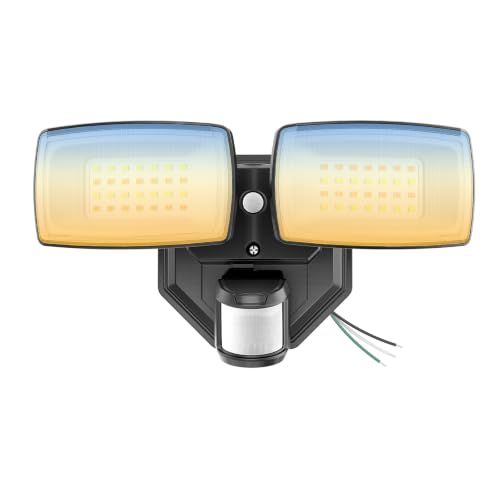
Onforu 32W Two-Head Motion Sensor Flood Light

Onforu 100W Three-Head Motion Sensor Flood Light
A Closer Look At Each Pick
If your property has a wide stretch that needs serious illumination, this Lightodt unit is the heavyweight of the group. The two-module head spreads a 120-degree beam, which means a single fixture can wash a long driveway or a parking apron without leaving dim pockets in the corners. The plug-and-play wiring keeps setup friendly for someone comfortable with an outdoor outlet, and the adjustable bracket lets you tilt the throw up toward a tall facade or down across a walkway.
Compared to the smaller Onforu units later in this list, this one skips a motion sensor entirely. It’s built for people who want full-time brightness from dusk to whenever they switch it off, not triggered bursts. Homeowners with large lots, small commercial yards, or anyone lighting a barn area will find the lumen count generous for the job.
Real-World Strengths
- Two-module head creates a noticeably wider coverage than single-head designs, useful for open lots.
- 120-degree beam angle reduces the number of fixtures needed for big spaces.
- Adjustable bracket tilts smoothly, so aiming up a wall or down a slope is straightforward.
- Plug-and-play setup means no junction box gymnastics for someone with an outdoor receptacle.
- High output handles tall trees, fence lines, and deep side yards without looking underlit.
Honest Caveats
- No motion sensor, so it runs on a switch or timer only.
- The fixture runs hot to the touch during extended operation, which is normal for high-output LEDs but worth noting near siding.
Feature Snapshot
Best Suited To
Owners of large driveways, open lots, or barn-style properties who want full-time, high-output coverage without managing sensors.
Skip It When
The Onforu 100W Three-Head Motion Sensor Flood Light is a smarter call if you only need triggered lighting near a smaller yard.
The HYPERLITE pair feels like the practical cousin in this lineup. Two 30W heads ship in the box, which solves the “I need to light two sides of the house” problem in one order. The knuckle mount is a small but useful detail, pivoting freely so you can aim each fixture independently without loosening a bracket.
Where the Lightodt from pick one focuses on raw output, this one keeps things modest and friendly. The 5000K color reads as clean daylight white, and the IP65 rating (an industry standard meaning the fixture is sealed against rain and dust jets) handles typical weather. Garden sheds, side gates, and the narrow strip between garage and fence are exactly where these shine.
The Value In It
- Two-pack format covers both sides of a path or two separate zones in one purchase.
- Knuckle mount allows smooth aiming without tools once installed.
- UL listing gives a baseline safety standard many shoppers look for.
- Modest 30W draw keeps energy use low for everyday security lighting.
Points To Note
- 3,300 lumens per fixture is plenty for a doorway, but you’ll want more for an open yard.
- No motion sensor, so it relies on a manual switch or external timer.
Made For
Shoppers lighting a garden path, side gate, or shed who want a clean two-zone solution without sensor complexity.
Look Elsewhere When
The Onforu 32W Two-Head Motion Sensor Flood Light is a stronger match when you want one fixture that activates on movement.
This Litezone wall pack leans commercial in its build. The glass lens is the detail that matters most: plastic covers on cheaper fixtures tend to yellow after a season or two in the sun, while glass holds its clarity over time. The die-cast aluminum body adds weight and helps pull heat away from the LEDs, which is the main thing extending the lifespan of any high-output fixture.
The dusk-to-dawn photocell (a small light sensor that turns the fixture on automatically at sunset and off at sunrise) handles itself, so there’s no app, no remote, no programming. Warehouses, parking strips, and apartment walkways are the obvious homes for this one. It’s overkill for a small porch, but it earns its keep anywhere the light runs for hours on end.
A Few Highlights
- Glass lens resists the yellowing that hits cheaper plastic covers after a year or two outdoors.
- Die-cast aluminum housing pulls heat away from the diodes, helping long-term reliability.
- Dusk-to-dawn photocell removes the need for a manual switch or timer.
- Two-pack format suits larger buildings or opposite walls.
Trade Offs
- The 120W output is more than most homes need, so it can feel harsh in a quiet backyard.
- Glass lens adds weight, and the fixture needs a sturdy mounting surface.
- Hardwired install calls for someone comfortable routing cable through a wall or junction box.
Right Fit For
Property managers and homeowners with warehouse-style spaces, parking strips, or large building exteriors that need long-hour lighting.
Reach For A Different Pick When
The Lightodt 1000W LED Flood Light is the better call for someone who wants high output on an adjustable bracket rather than a fixed wall mount.
The Onforu 75W is the pick I’d point most homeowners toward. Three adjustable heads spread light in directions a single-head design can’t, and the 270-degree motion-detection zone means the fixture catches movement coming from a side path, not just straight ahead. The IP65 rating handles rain, and the dusk-to-dawn mode keeps the unit from triggering in daylight.
For an entryway, garage corner, or the stretch between a house and a fence, the 7000-lumen output is generous without being stadium-bright. Compare it to the smaller Onforu 32W later in this list: that one is friendlier for tight porches, while this 75W covers wider territory with more headroom.
Useful Highlights
- Triple heads pivot independently, letting you cover three directions from one mount point.
- 270-degree detection zone catches side approaches, not just straight-on movement.
- Dusk-to-dawn mode disables the sensor during daylight hours, saving energy.
- 6500K color reads as crisp daylight, helpful for identifying faces and details at the door.
Points To Keep In Mind
- Hardwired install means you’ll want an existing junction box or a comfortable DIYer on hand.
- The motion sensor’s range depends on mounting height; placing it too high can shrink the effective zone.
Best Suited To
Homeowners covering an entryway, garage corner, or wide side path who want motion activation with broader head coverage than a dual-head model.
Consider Something Else When
The Onforu 32W Two-Head Motion Sensor Flood Light is a cleaner fit for a small porch where three heads would be overkill.
This is the fixture I’d suggest to a neighbor replacing a single porch light. Two heads pivot enough to aim across a back door and down a step, and the 3200-lumen output is plenty for a small zone without flooding the whole side of the house. The 180-degree detection angle with up to 72 feet of range catches anyone walking up a driveway in most residential layouts.
It skips the extras, which is part of the appeal. No camera, no solar panel, no plug-in cord. Just a hardwired motion light that turns on, does its job, and stays out of the way. For someone who wants security lighting without managing a device, that simplicity is the main draw.
Key Advantages
- Compact dual-head design fits tight spaces where three heads would feel excessive.
- 180-degree detection with up to 72 feet of range covers most residential approaches.
- Hardwired setup means no batteries or charging panels to maintain.
- Cool-white 6500K output reads clearly at typical mounting heights.
A Few Limitations
- Lower lumen output means it underperforms in larger yards where the Onforu 100W would feel right.
- Hardwired only, so it isn’t a quick swap for renters without modifying the existing wiring.
Perfect Match For
Homeowners covering a small porch, back door, or narrow side step who want motion activation without extra features to configure.
Swap It Out When
The Onforu 75W Three-Head Motion Sensor Flood Light handles a wider zone, while the Onforu 100W Three-Head Motion Sensor Flood Light covers a full backyard.
The Onforu 100W closes out the list as the highest-output motion-activated option in the Onforu family. 11,000 lumens is a serious number, and combined with three adjustable heads, the fixture can throw light across a backyard, a driveway, or a patio with room to spare. The dusk-to-dawn mode keeps the unit dark during the day, so it’s not wasting cycles when nobody’s around.
It’s the natural step up from the 75W Onforu covered earlier: same general layout, but more reach. Most homeowners with a mid-size yard will find the 100W is the sweet spot between the compact 32W and the industrial Litezone wall pack.
Positive Points
- 11,000-lumen output covers mid-size backyards and driveways from a single mount.
- Three adjustable heads let you aim across multiple zones without adding fixtures.
- Dusk-to-dawn mode prevents daytime triggering and saves energy.
- IP65 rating handles rain and dust for typical outdoor placement.
- Cool-white daylight tone helps with color recognition at a distance.
Potential Drawbacks
- Higher output means a stronger glare if the fixture is mounted near a window or neighbor’s line of sight.
- Hardwired install requires routing cable, which adds complexity for first-time installers.
- The motion sensor’s range depends on placement; mounting too high can shorten the effective zone.
Who Should Grab It
Homeowners with a mid-size backyard, driveway, or patio who want motion-triggered brightness that fills the space without a commercial-grade fixture.
Where Another Pick Suits Better
The Litezone 120W LED Wall Pack is a stronger fit for warehouse-style buildings that need a fixed, full-time wall mount.
What To Weigh Before Picking Security Flood Lights
The lumen count grabs attention first, but it’s only one piece. Beam angle determines how wide a fixture throws light: a narrow 60-degree beam reaches farther down a driveway, while a 120-degree spread covers more ground at close range. For most homes, somewhere between 90 and 120 degrees gives the best balance.
Motion detection range matters more than people expect. A sensor with a 180-degree angle catches side approaches, which is the most common way visitors reach a door. Look for ratings between 40 and 70 feet for typical residential lots, and remember that mounting height changes the effective zone. Weather ratings also deserve a look: an IP65 rating (the international standard marking how well an enclosure keeps out solids and water) means the fixture handles rain jets and dust, which covers most climates.
Color temperature shifts the feel of the light. The 5000K to 6500K range reads as daylight white, which helps with face recognition and detail. Warmer 3000K options feel cozier but can flatten colors at a distance. For pure security purposes, cooler temperatures tend to perform better.
Key Considerations Across These Picks
Pitfalls Shoppers Hit
A common slip is choosing by lumen count alone, then ending up with a beam that’s too narrow for the space. Equally common is underestimating install complexity. Hardwired units need a junction box and basic electrical comfort, and skipping that step turns a Saturday project into a longer one. Outdoor placement also matters more than indoor shoppers expect. A fixture aimed straight at a bedroom window creates glare problems that no spec sheet predicts.
When Paying More Pays Off
The jump from a budget unit to a higher-tier model usually shows up in three places: heat dissipation, lens material, and sensor quality. A die-cast aluminum body pulls heat away from the LEDs, which extends the lifespan noticeably. A glass lens holds clarity where plastic yellows. A better sensor cuts down on false triggers from passing cars or small animals, which keeps the fixture from becoming a neighborhood annoyance. For a fixture that runs nightly, those upgrades tend to justify the difference.