

Pathway lighting should feel easy, not finicky. I’ve talked to enough homeowners to know the frustration: a row of solar stakes that dim after one season, a wire-free dream that turns into a weekend of replacements. This guide covers six solar kits I think genuinely earn their spot in a real yard, with notes on what each one does well and where you might want something else.
Your Options, Compared

Vibrant Solar Garden Lights, Ultra Bright Solar Powered Firefly Lights Outdoor Waterproof

Solar Pathway Lights Outdoor, IP65 Waterproof, Auto On/Off, 10 Pack
XMCOSY+ Solar Lights Outdoor Waterproof, 4 Pack

XMCOSY+ Solar Lights Outdoor 6 PCS, 2 Lighting Modes

XMCOSY+ Solar Pathway Lights Outdoor, 6 Pack
Solar Lights Outdoor Waterproof, Warm White 12 Pack 2-in-1 Ground Lights
More On The Choices That Made The List
These firefly stakes are aimed squarely at atmosphere, not navigation. The light heads sit on softer, more pliable stems than most solar stakes, so even a mild breeze gets them swaying like little insects on a stem. In a flower bed or beside a patio, that motion gives the row a feel the other picks on this list don’t try for.
Each head carries 8 LEDs, which sounds modest until you see them in person. The cluster reads as dozens of soft points rather than a single bright dot. People decorating for a wedding, a backyard dinner, or just a quiet evening outside will get the most out of the look. Compared to the stiffer stakes later on this list, this one is more about charm than crisp illumination.
Positive Takeaways
- The flexible stems keep lights moving in light wind, giving the “swarm” effect most solar lights can’t match.
- 8 LEDs per head create a layered, multi-point glow that flatters planters and borders.
- Low stakes mean almost no tripping concern, useful around kids and lawn games.
- Outdoor-rated housing means no end-of-season teardown for normal weather.
Things To Consider
- These read as decoration, not as pathway lighting, so don’t expect a clear walking guide.
- Stems that bend in the breeze can also bend underfoot or in heavier storms, depending on your soil.
- Charging depends on direct sun exposure; shaded spots will noticeably shorten the night.
Who Will Love This
Garden decorators, party hosts, and anyone who wants mood over mileage from their path lights.
Reach For A Different Pick When
The Berrtinfn 10-Pack is a better call for someone who actually needs a long, bright walk to the front door every night.
This Berrtinfn set is the practical backbone of the list. You get 10 stakes and a monocrystalline solar panel on each one (a single-crystal panel that converts sunlight slightly more efficiently than the cheaper multi-piece panels), which translates to roughly 6 to 8 hours of charge time and a serious nighttime run. The IP65 rating (an outdoor electronics standard meaning dust-tight and resistant to low-pressure water jets) is the level I look for when a light stays outside through winter.
The housing is plastic rather than metal, which keeps weight down and installation easy, though owners in coastal areas may notice some surface wear over time. For a long driveway, this is the kind of kit that lets you set it and forget it. Where the firefly pick above chases mood, this one is built to quietly keep working.
Everyday Perks
- Up to 24 hours of claimed runtime per charge covers the longest winter nights in most climates.
- Ten stakes mean a full walkway or driveway on one purchase, with spares for any odd casualties.
- Automatic dusk-to-dawn switching removes a daily step.
- IP65 sealing handles rain, sleet, and sprinkler overspray without drama.
Honest Caveats
- The look is plain, so it won’t win points for curb appeal the way the copper-bodied XMCOSY+ kits do.
- Plastic bodies can fade under harsh UV over several seasons depending on exposure.
- A solid 6 to 8 hours of direct sun is needed for that full runtime on cloudy stretches.
Feature Snapshot
Made For
Homeowners with long driveways or paths who care more about bright, reliable coverage than design flourishes.
Swap It Out When
The ulaiyohome firefly lights suit someone who’d rather lean into whimsical garden decor than utility.
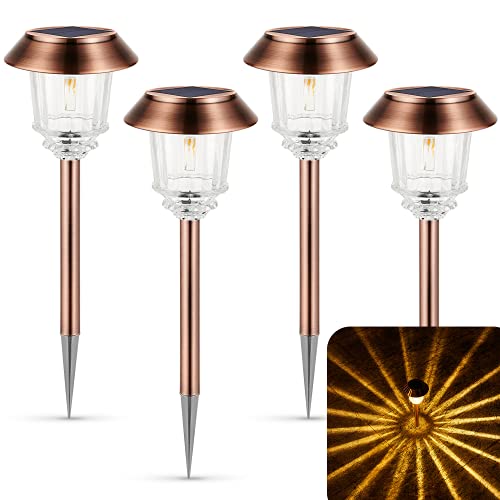
The XMCOSY+ 4-pack leans into a more traditional garden look. The body is electroplated copper with a vintage diamond-faceted glass shade, the kind of finish you see on classic coach lanterns. Around an older home or a cottage-style bed, this set blends in where plastic stakes would look out of place.
Each light uses a 4.5V monocrystalline solar panel paired with a 600 mAh (milliamp-hour, a measure of battery capacity) lithium battery. In practice that translates to a dusk-to-dawn run on most summer evenings, though heavily shaded yards may see shorter nights. Four units are enough for a small front walk or to flank a patio entrance.
Advantages To Know
- The copper body and patterned glass give a finish most solar stakes can’t match at this size.
- Compact 4-pack suits tight projects like a side gate or a short porch walkway.
- Automatic dusk-to-dawn sensor means no manual switching.
- Monocrystalline panel supports a claimed sunlight conversion rate in the 25 to 30 percent range.
Worth Bearing In Mind
- Only four lights limits how far down a path you can go without buying a second set.
- The vintage glass needs a gentle wipe-down now and then, as grit collects in the facets.
- Brightness is decorative; don’t plan on these for security-style illumination.
Whose Shelf It Belongs On
Anyone styling a cottage or heritage-style garden where the fixture matters as much as the light.
Where A Sibling Pick Shines
The XMCOSY+ 6-pack adds a second brightness mode and a rust-resistant body, making it the better call for harsher climates.
This is the most utility-focused XMCOSY+ kit on the list. The big upgrade over the basic 4-pack is the dual-mode switch: a 10-lumen low setting good for roughly 10 hours, and a 25-lumen high setting for about 8 hours. That’s a real difference in winter versus summer when runtime shrinks naturally.
The body uses upgraded rust-resistant and anti-corrosion material, which matters if you’re near a coast or have heavy sprinkler contact. With six units, you can line a medium path or define a driveway edge. The trade-off versus the 4-pack is a slightly larger head, so spacing matters more.
What It Does Well
- Two brightness modes let you trade intensity for runtime, useful across the seasons.
- Rust-resistant body supports long-term outdoor exposure.
- Six lights cover a typical suburban walkway without needing extras.
- The 25-lumen high mode handles summer nights when battery drain accelerates.
Trade-Offs To Consider
- Bigger lamp heads may look out of scale in tight flower beds.
- Mode switching is manual, which means occasional visits to each light.
- Charge time stretches in cloudy weather, which can leave you with dim nights mid-winter.
Best Suited To
Households that leave their lights out year-round and want a setting that adjusts to the season.
Skip It When
The Flacchi 12-pack is the smarter buy if you want to mix in-ground installation with surface mounting.
The 6-pack variant splits the difference between the smaller 4-pack and the more rugged dual-mode kit. You get the same electroplated copper body and vintage diamond glass, but in a count that handles a full side path or front walk. The 4.5V solar panel and 600 mAh battery are familiar from the smaller set.
In real yards, this kit tends to look right at home beside brick walks and wood-edged beds. It’s not the brightest light on the list, and the pattern is more about warmth than visibility, but the design language is consistent across the row. Owners report that the glass holds up fine in normal weather, with only seasonal cleaning needed.
Practical Pluses
- Six units is the right count for typical residential walkways.
- Copper finish ages gracefully, blending into mature landscaping.
- Same dusk-to-dawn automation as the rest of the XMCOSY+ family.
- Compact footprint keeps it from competing with plants or statuary.
Some Limits To Know
- No high/low mode, so runtime depends entirely on battery size and incoming sun.
- The diamond facets look great but collect dust that needs occasional cleaning.
- Output is decorative rather than functional, like the 4-pack sibling.
Spec Overview
The Right Fit
Traditional garden layouts where the look of the fixture matters as much as the lumen count.
A Better Fit Elsewhere
The XMCOSY+ 6-pack with two modes suits anyone who needs winter-to-summer flexibility.
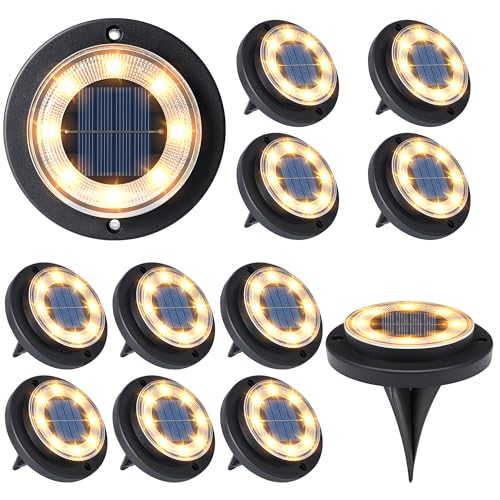
The Flacchi set rounds out the list with a different mounting approach. Each light works two ways: pushed into the ground as a stake, or screwed onto a deck, step, or wood board. That flexibility is the whole point, since most path-only kits can’t do both without an extra bracket.
The pack is 12 lights, which is generous for a multi-zone yard. The hermetic seal is the practical headline; in plain terms, these are sealed against rain, snow, frost, and sleet. Warm white is the only colorway, so the tone stays consistent across a deck edge or a garden border.
What Helps Most
- Dual-mount design works on soil and on wood without buying accessories.
- Twelve units cover a long project like a wraparound deck or multi-bed garden.
- Warm white output reads as comfortable rather than harsh, especially on stairs.
- Improved hermetic seal handles freeze-thaw cycles without internal fogging.
Potential Sticking Points
- Two-in-one mounting means a slightly thicker head than dedicated stakes.
- Ground-installation mode still needs soft soil; hard clay may require pre-drilling.
- Twelve is more than some smaller projects need, leaving extras if your layout is short.
Perfect Match For
Homeowners with both a garden path and a deck or staircase who want one kit to handle both.
Not Your Match When
Smaller yards may be better served by the XMCOSY+ 4-pack, which keeps the count lean.
What To Weigh Before Picking Your Solar Garden Lights
Brightness Versus Battery Size
Lumen count tells you how bright a light looks, but the battery (measured in mAh) decides how long that brightness lasts. A 25-lumen mode sounds modest until you pair it with a large battery and a full summer day of sun. In winter, expect runtime to drop, sometimes by half, especially on shorter days with cloud cover. Match the kit’s claimed runtime to your darkest expected night, not your average.
Weather Rating And Real-World Climate
IP65 is the level most shoppers should look for. That rating means dust-tight and protected against water jets, which covers everything short of submersion. If you live somewhere with driving rain, deep snow, or sprinkler overspray, an IP65 rating is the floor, not the goal. Plastic bodies fade under UV over years; metal-bodied kits like the XMCOSY+ copper sets handle sun better but show scratches more readily.
Solar Panel Type And Placement
Monocrystalline panels convert sunlight more efficiently than the older amorphous designs, which matters when your light sits in partial shade. Even the best panel underperforms in heavy shade, so think about where the stake will sit at noon as much as at dusk. The firefly lights on this list, for example, look magical in a breezy bed but need clear exposure to keep their glow going.
Count, Spacing, And The Project At Hand
A 4-pack is right for a small porch or a tight side yard, while 10 to 12 packs suit longer drives and full-perimeter decks. Spacing matters more than total count: lights placed too close read as a runway, while too-wide spacing leaves dark gaps. For most walkways, somewhere around 4 to 6 feet between stakes tends to feel right without looking crowded.
Picking The Right Setup Without Second-Guessing
Where Shoppers Go Wrong
Counting on solar lights to deliver full security-style brightness is the most common mistake. These kits are designed for ambiance, low-level navigation, and decoration, not floodlight output. Another trap is buying a kit with too few stakes to actually cover your path; doubling back later means mismatched finishes between sets.
Skipping the cleaning step is the third misstep. Solar panels collect pollen, dust, and grit, and a dirty panel can quietly halve your nightly runtime. A quick wipe every few months keeps output honest, especially in dry or dusty regions.
Where The Extra Money Goes
The kits that command a higher cost tend to offer upgraded body materials (like the rust-resistant build on the XMCOSY+ dual-mode set), longer runtime from larger batteries, or a more refined finish like electroplated copper. You’re paying for fewer replacements over a five-year span and a more deliberate look.
For a small project with modest goals, the budget-friendly kits already on this list deliver genuine value. For larger installations, harsher climates, or homes where the fixture design matters, the upgrade often pays for itself in fewer replacements and better curb appeal.
Frequently Asked Questions
How long do solar garden lights typically last before needing replacement?
Most quality solar garden lights last 2 to 4 years before battery capacity drops noticeably. The body often outlasts the battery, and some owners swap in replacement cells to extend life.
Can solar pathway lights stay outside through winter?
Yes, as long as they carry an IP65 or higher weather rating. Snow and ice are less of an issue than the shorter days, which simply mean shorter nightly runtimes.
Do solar lights need direct sunlight to charge?
Full direct sun produces the strongest charge, but most monocrystalline panels still top off in partial shade. Heavy tree cover or north-facing placement will noticeably shorten nightly runtime.
How many solar lights do I need for a typical walkway?
A standard residential walkway usually needs 4 to 8 stakes for a balanced look. Longer driveways often run 10 or more, depending on how bright you want the run to feel.
Are warm white and cool white solar lights very different?
Warm white sits in the 2700K to 3000K range (Kelvin, a color-temperature scale where lower numbers read yellower and higher numbers read bluer) and feels more like incandescent light. Cool white sits higher on the Kelvin scale and reads crisper, often better for security use than for garden mood.