

LED tube grow lights have become a practical choice for indoor growers who want efficient, even coverage without bulky fixtures. In 2026, the best options stand out for full-spectrum output, strong build quality, and easy expandability across seedling and flowering stages. From compact strips to higher-output 4-foot tubes, the field is wider than it first appears, and a few models rise above the rest for reasons that become clear quickly.



More Details on Our Top Picks
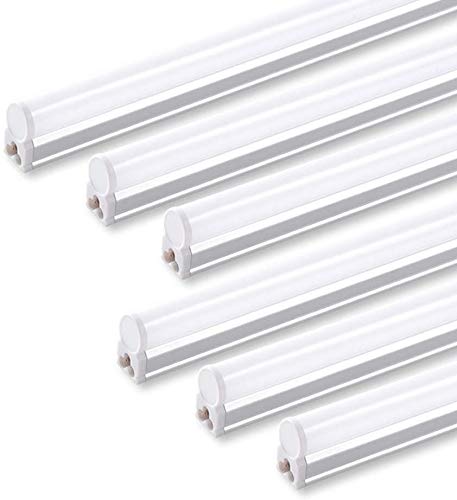
Barrina 6-Pack LED T5 Shop Light 3FT
If you want a bright, budget-friendly LED tube light for a garage, workshop, basement, or indoor grow setup, the Barrina 6-Pack T5 Shop Light is an easy pick. You get six 3-foot tubes that each draw 16 watts and deliver up to 1,900 lumens at a crisp 6,500K. The linkable design lets you connect up to 10 lights, and the second-gen connectors help you do it safely. You can mount them on the ceiling, use the included cords and clips, and power them with a simple push-button switch. It’s ETL listed and indoor-only.
- Light Type:LED
- Tube Form:T5 tube
- Length:3 ft
- Wattage:16 W
- Color Temperature:6500 K
- Linkable Design:Yes
- Additional Feature:1900 lumens per tube
- Additional Feature:ETL listed
- Additional Feature:Hardwire option included
4ft T8 Full Spectrum LED Grow Lights (4-Pack)
For growers who want a ready-to-use setup for seedlings, vegging, and flowering, the TYAGMAM 4ft T8 Full Spectrum LED Grow Lights (4-Pack) is a strong pick, since it gives you four linkable 45W tubes with a 5,000K full-spectrum output and up to 7,200 lumens. You’ll get plug-and-play installation, included mounting clips, and 36-inch cords for chaining up to four units. The aluminum housing helps manage heat and support long LED life, while the integrated reflector boosts efficiency. At 120V, it’s a practical choice for indoor grows.
- Light Type:LED
- Tube Form:T8 tube
- Length:4 ft
- Wattage:180 W
- Color Temperature:5000 K
- Linkable Design:Yes
- Additional Feature:95% usable light energy
- Additional Feature:100% aluminum housing
- Additional Feature:20% efficiency boost
Barrina T5 4FT LED Shop Light (6 Pack)
Barrina’s T5 4FT LED Shop Light 6-pack is a smart pick when you want bright, dependable grow lighting with easy expansion in mind. You get 2,200 lumens per fixture, 5,000K daylight output, and just 20 watts of draw, so you can light shelves, benches, or a small indoor grow area efficiently. The linkable design lets you connect multiple fixtures with included cords and connectors, while the plug-and-play setup keeps installation simple. Aluminum construction, ceiling or under-cabinet mounting, and UL-required compliance give you a practical, durable lighting solution indoors.
- Light Type:LED
- Tube Form:T5 tube
- Length:4 ft
- Wattage:20 W
- Color Temperature:5000 K
- Linkable Design:Yes
- Additional Feature:UL required compliant
- Additional Feature:2200 lumens per fixture
- Additional Feature:20-inch extension cords
FREELICHT 2 Pack 4FT LED Grow Light 40W
The FREELICHT 2 Pack 4FT LED Grow Light, 40W is a smart pick if you want a simple, linkable setup that covers more growing space without driving up energy use. You get two 4-foot LED bars with a full-spectrum, sunlike output that supports seedlings, herbs, and flowering plants. Each light delivers up to 4,000 lumens at 3,500K, while using just 40 watts. You can hang or ceiling-mount them with the included hardware, then link up to four units for wider, more even coverage in greenhouses, kitchens, windowsills, or indoor grow areas.
- Light Type:LED
- Tube Form:4ft tube
- Length:4 ft
- Wattage:40 W
- Color Temperature:3500 K
- Linkable Design:Yes
- Additional Feature:2-year warranty
- Additional Feature:168 LEDs per light
- Additional Feature:59-inch power cord
VIVOSUN T5 24W Full Spectrum LED Grow Lights
VIVOSUN’s T5 24W full spectrum LED grow lights fit best if you want a compact, linkable setup that’s easy to install and control. You get four 1-foot strips with 30 LEDs each, delivering up to 5,000 lumens at 5,000K and 130 lm/W. Use them to boost germination, seedling growth, bloom time, and yield. Mount them with screws, tape, or cable ties, then daisy-chain them by connector or extension cable. If you add a GrowHub A22 or A10, you can control them through the app. They’re durable, dimmable, and backed by a two-year warranty.
- Light Type:LED
- Tube Form:T5 strip
- Length:1 ft
- Wattage:24 W
- Color Temperature:5000 K
- Linkable Design:Yes
- Additional Feature:130 lm/W efficacy
- Additional Feature:GrowHub app compatible
- Additional Feature:Dimmable switch included
Barrina 6 Pack LED T5 Utility Shop Lights
With six linkable 4-foot fixtures that each deliver up to 2,200 lumens at just 20W, the Barrina T5 LED shop light set is a strong pick if you want bright, efficient indoor lighting for a garage, workshop, basement, or even a grow-light setup. You get warm 3000K light, plug-and-play installation, and built-in switches on every cord. Connect up to six units with seamless links or 20-inch cords. The ETL-listed, indoor-only design mounts to ceilings, walls, or under cabinets. You’ll also get a 3-year warranty and six complete accessory kits.
- Light Type:LED
- Tube Form:T5 tube
- Length:4 ft
- Wattage:20 W
- Color Temperature:3000 K
- Linkable Design:Yes
- Additional Feature:3-year warranty
- Additional Feature:3000K warm white
- Additional Feature:Flush mount capable
4FT 54W T5 HO 6500K Fluorescent Tubes Grow Light Bulbs Pack of 5
If you need a straightforward plant-growing bulb that delivers cool daylight, the 4FT 54W T5 HO 6500K Fluorescent Tubes Grow Light Bulbs Pack of 5 is a strong fit for seed starting, clones, and indoor grow setups. You get five 54W T5 HO fluorescent tubes with up to 5,000 lumens each, a 6500K full-spectrum output, and standard 100–120V operation. The GX53 base makes installation simple, and the glass build keeps things familiar. With 286 reviews and a 4.1-star average, you can trust it for reliable growth support indoors.
- Light Type:Fluorescent
- Tube Form:T5 HO tube
- Length:4 ft
- Wattage:54 W
- Color Temperature:6500 K
- Linkable Design:No/standard bulb
- Additional Feature:54 CRI
- Additional Feature:GX53 bulb base
- Additional Feature:Glass construction
Factors to Consider When Choosing Led Tube Grow Lights
When choosing LED tube grow lights, light spectrum and wattage should be matched to the crop’s growth stage and output needs. Tube length compatibility, mounting method, and installation requirements also affect whether the fixture will fit and function properly in the growing space. Linkable expansion options can further determine how easily the system scales as lighting demands increase.
Light Spectrum
Light spectrum is a major factor in how effectively LED tube grow lights support plant development, since different wavelengths drive different stages of growth. Blue light, around 400–500 nm, supports vegetative growth and leaf formation, while red light, around 600–700 nm, encourages flowering and stem elongation. A full-spectrum fixture with blue near 450 nm, red near 660 nm, and some green or yellow light better resembles sunlight and can improve overall morphology and photosynthesis. For seedlings and clones, a higher blue-to-red balance helps produce compact, sturdy plants. During flowering or fruiting, more red is generally preferred. Fixtures should be judged by PAR and PPFD for the crop stage, not color temperature alone. Narrow-spectrum lights without supplemental wavelengths may limit development and yield.
Wattage And Output
Wattage and output determine whether LED tube grow lights deliver enough usable energy for a crop stage, regardless of how balanced the spectrum may be. For supplemental use, 4-foot tubes often fall between 20 and 50 watts each; full-cycle systems may combine multiple tubes for 40 to 180 watts total, depending on canopy size. Delivered light matters more than raw wattage, so lumens or PAR should be checked alongside efficacy. Fixtures above 100 lm/W can provide more useful light per watt. Seedlings and clones need lower photon flux, while vegetative and flowering growth require stronger output. Higher-wattage tubes create more heat, so thermal management matters. Total system wattage and watts per square foot also help estimate electricity use and coverage.
Tube Length Compatibility
Tube length should match the fixture or mounting space so the grow light fits securely and functions as intended, with common options such as 1-foot, 3-foot, and 4-foot tubes. Standard 4-foot tubes, about 46 inches, often simplify replacement because many connectors and cords are built for that size. Longer tubes can cover a wider area per fixture, but they should be checked for adequate clearance and support due to added length and weight. When several fixtures are used, consistent tube lengths help maintain even light distribution and make daisy-chaining easier with compatible connector cord lengths. Replacement tubes, end caps, and clips should also match the tube’s diameter and length to avoid weak contact, instability, or mounting failures.
Mounting And Installation
When selecting LED tube grow lights, mounting height and installation method should be matched to the plants’ stage and the space available, since flush mounts, hanging cables, and under-shelf clips each affect intensity and coverage differently. Seedlings usually need fixtures 6–24 inches above the canopy, while mature plants often benefit from closer placement. Installation should also account for power access, whether through plug-and-play cords or hardwire kits, and for local voltage and outlet availability. Tube length and spacing matter as well; center-to-center spacing often mirrors tube length to maintain even PAR across the canopy. Aluminum housings or open frames help dissipate heat, while easy-release clips and hanging systems simplify cleaning, replacement, and adjustment without rewiring.
Linkable Expansion Options
For larger racks or benches, linkable LED tube grow lights can reduce outlet clutter by chaining multiple fixtures from a single power source. That setup lowers the number of wall outlets and cords required, but it also demands attention to chain limits. Many systems support only 4 to 10 units, so the total load should stay within the manufacturer’s current capacity. Connector style matters too, whether seamless plug, male–female, or corded links, along with the length of included cables for spacing. It is also important to check whether chained fixtures keep individual switching or dimming control, since some operate as one circuit. Finally, electrical ratings for wattage, voltage, and amperage should match extension cords, hardwire options, and local codes.
Build Quality And Safety
Build quality and safety should be treated as core purchase criteria, not afterthoughts, because durable aluminum or polycarbonate housings, secure end caps, and solid thermal design help fixtures run cooler and resist cracking or warping under continuous use. ETL, UL, or equivalent safety listings, along with proper insulation ratings, indicate better compliance with electrical standards and lower fire or shock risk. Strong connector assemblies and strain-relief on power cords matter as well, since weak links can lead to disconnection, arcing, or exposed wiring during installation. Thermal management details, including heat sinks and stated operating temperature ranges, help gauge longevity. Ingress protection and indoor or outdoor ratings should match the intended environment, because moisture exposure can accelerate corrosion and electrical failure.
Control And Dimming
Control and dimming should be evaluated with the same rigor as light output itself, since a system that can smoothly adjust from low-intensity seedling settings to full flowering power is far more versatile and efficient. Full-range dimming, ideally from 0–100%, lets fixtures match crop stages without wasting energy. Digital control, such as PWM or 0–10V, is preferred because it preserves spectral stability and reduces flicker compared with crude resistive methods. At low output, the dimmer should maintain consistent PAR and color balance, since some drivers skew red or blue ratios. For multi-rack operations, independent channels or addressable controls allow separate zoning. Compatibility between drivers, voltages, and currents must be verified, along with protections like overcurrent, thermal shutdown, and soft-start during dimming.
Frequently Asked Questions
How Long Do LED Tube Grow Lights Typically Last?
LED tube grow lights typically operate for 30,000 to 50,000 hours, and well built models can reach 60,000 hours or more. Their lifespan depends on heat control, daily use, and construction quality, and brightness often fades gradually before the light stops working.
Can LED Tube Grow Lights Replace Sunlight Completely?
In this age of wonder, no. LED tube grow lights cannot fully replace sunlight. They can supplement it and sometimes nearly match it indoors, but natural sunlight still offers broader intensity, a fuller spectrum, and important environmental cues.
Are LED Tube Grow Lights Safe for Seedlings?
Yes, LED tube grow lights are safe for seedlings when kept at the right distance and brightness. They give young plants steady light without much heat, but you should still watch for leaf bleaching, soil drying too fast, or signs that the light is too strong.
Do LED Tube Grow Lights Increase Electricity Costs Significantly?
No, LED tube grow lights usually do not raise electricity costs much because they use less power than older lighting options. The total cost depends on the wattage, how many hours they run each day, and how many tubes you use.
Can I Daisy-Chain Multiple LED Tube Grow Lights Together?
Yes, multiple LED tube grow lights can often be daisy chained if the manufacturer allows it. For example, a 4 foot greenhouse setup may link three fixtures safely, provided wattage limits and connection ratings are respected.