

Picking a ceiling light sounds simple until you stare at a bare bulb and realize the wrong fixture can flatten a kitchen. Some homeowners want warm farmhouse character, others need serious lumen output for meal prep, and renters often need something slim that fits a tight ceiling box. I put together seven fixtures that handle those different jobs well, mixing industrial cages, ultra-thin LEDs, and commercial-grade troffers so any home style finds a match.
The Essentials At A Glance

Faymart Industrial Flush Mount Ceiling Light Fixture

HDASIC 1-Light Farmhouse Semi Flush Mount Ceiling Light

YPII 2×4 FT LED Center Basket Troffer Panel Light
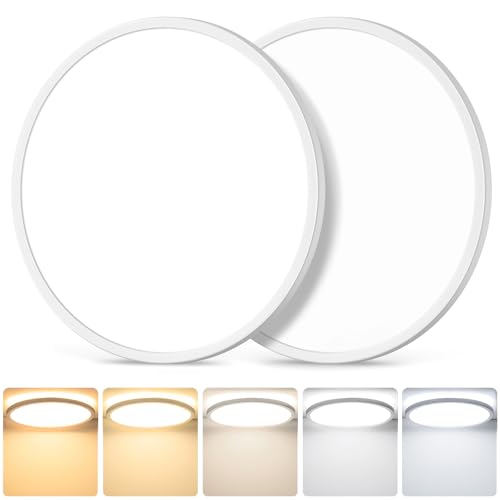
GoBright 12 Inch Ultra Thin LED Flush Mount Lights

YPII 4Pack 2×2 LED Flat Panel Light 5CCT Selectable

Pathson 2-Light Semi Flush Mount Ceiling Light

YPII 2×4 LED Flat Panel Light 5 CCT Adjustable
Why These Options Stand Out
The Faymart fixture starts the list because farmhouse character with industrial bones is one of the most-requested looks in today’s kitchens. The square, caged design at roughly 8.27″ L x 8.27″ W x 6.5″ H hugs the ceiling closely enough for an 8-foot room, while the full-metal cage lets light spill in every direction without harsh glare. Compared to the bulkier semi-flush options later in this roundup, this piece reads more like a refined industrial accent.
Dimmable E26 compatibility (the standard medium screw socket used across most US fixtures) means homeowners can swap in a smart bulb and adjust mood without rewiring. The black powder-coated finish tends to hold up against kitchen grease and steam with a quick wipe-down, making maintenance manageable.
Positive Takeaways
- Open cage design throws light wider than enclosed domes, which helps smaller kitchens feel brighter.
- E26 base accepts standard Edison-style bulbs, including vintage filament and dimmable LEDs.
- Compact 8.27-inch footprint works in closets, hallways, and modest kitchen entries.
- Metal construction generally outlasts plastic fixtures in steamy cooking environments.
- Flush-mount profile sits safely above walking paths in rooms with low ceilings.
Things To Consider
- Bulb ships separately, so plan for an extra purchase before installation.
- Open cage shows dust and cobwebs more easily than enclosed shades, depending on ceiling height.
- Single-bulb output may feel modest in kitchens larger than 100 square feet.
Key Product Details
Right Fit For
Homeowners redoing a farmhouse or industrial-style kitchen on a moderate budget who want a statement piece without hiring an electrician.
Consider Something Else When
You need a wider, brighter wash across a large kitchen; in that case the YPII 2×4 FT LED Center Basket Troffer Panel Light covers more ground with much higher lumen output.
Where the Faymart fixture leans square, HDASIC’s offering narrows down for tight spaces. At roughly 5.5″ L and 7.84″ H, this semi-flush mount slips into narrow hallways, compact entryways, and small kitchens where a chunky chandelier would feel out of scale. The matte black canopy paired with a metal cage shade echoes the same farmhouse-industrial language as pick #1, but in a smaller silhouette.
For renters or first-time homeowners who want a character-driven fixture without modifying the junction box, the simpler hardware typically translates to a faster install. The matte black finish hides fingerprints better than glossy options, a small practical win in busy households.
Positive Points
- Small footprint fits hallways and foyers that reject wider flush mounts.
- Matte black powder coat resists fingerprints and smudges.
- Compatible with standard E26 bulbs, including dimmable and smart variants.
- Cast light-and-shadow pattern adds visual texture to plain ceilings.
Worth Noting
- Single-bulb design may under-light kitchens over 80 square feet.
- Open cage requires occasional dusting, especially in kitchens with cooking residue.
- Semi-flush height of 7.84″ may feel low in rooms with ceilings under 7.5 feet.
Who It Suits Best
Apartment dwellers outfitting a narrow hallway or modest kitchen who want farmhouse style without giving up head space.
Look Elsewhere When
The room demands more output or a flush profile; the GoBright 12 Inch Ultra Thin LED Flush Mount delivers 3200 lumens from a much slimmer housing.
The YPII troffer steps away from farmhouse charm entirely and into serious lumen territory. Output tops out around 9360 lumens at 150 lm/W (lumens per watt, a measure of efficiency), with five wattage settings (30W, 40W, 50W, 60W, 72W) accessible from a back-panel switch. For open-plan kitchens where a single decorative fixture just won’t cut it, this 2×4 panel slides into a standard drop ceiling grid and floods the space with even light.
Five selectable color temperatures (3000K, 3500K, 4000K, 5000K, 6500K) let you tune the room from warm residential glow to bright task lighting, and 0-10V dimming gives compatibility with commercial-grade dimmers. In our view, this is the closest thing on the list to commercial-grade output in a residential package.
Useful Touches
- Up to 9360 lumens covers large kitchens and combined living areas without dark spots.
- Selectable wattage and color temperature on the unit avoids second trips to the store.
- 50,000+ hour lifespan often translates to a decade or more of daily use.
- Slim 1.97-inch profile clears most standard drop ceiling grids.
Trade Offs
- Requires a compatible drop ceiling grid or surface-mount frame for non-grid installs.
- 0-10V dimming needs a matching dimmer, which costs more than a standard wall dimmer.
- Plain white troffer aesthetic won’t suit kitchens with a farmhouse or vintage design language.
Feature Snapshot
Made For
Homeowners with drop ceilings who need commercial-grade output, such as big kitchens, finished basements, or converted workspaces.
Skip It When
Style matters as much as brightness; the Pathson 2-Light Semi Flush Mount Ceiling Light offers a glass-shade alternative that suits more decorative kitchens.
The GoBright fixture exists for ceilings that punish anything thicker than a pancake. At just 0.86 inches thick and 12 inches across, this 2-pack tucks into low ceilings, attic conversions, and rentals where drilling a recessed can isn’t an option. Each panel pushes 3200 lumens with dimmable support, a useful benchmark for everyday kitchens that need clean, even light without visible bulk.
Unlike the caged picks earlier on this list, the GoBright leans modern with its frosted diffuser, softening shadows for tasks like chopping or reading recipes. Most owners install these over a standard junction box with the included hardware, which is helpful for DIY-friendly setups.
Advantages To Know
- Ultra-thin 0.86-inch body clears the tightest ceiling clearances.
- 3200 lumens per fixture suits mid-size kitchens without crowding the ceiling.
- Frosted diffuser spreads light evenly, reducing harsh shadows on countertops.
- Two-pack gives flexibility for larger rooms or matching hallway installs.
Room For Improvement
- Color temperature isn’t selectable on the unit, so pick the right model at checkout.
- Modern aesthetic won’t blend with farmhouse or rustic interiors.
- Surface-mount appearance may show wiring at the junction box if old boxes stick out.
Best Suited To
Renters and apartment owners with shallow ceilings who want bright, dimmable light without cutting into drywall.
Not Your Match When
You prefer a vintage or industrial look; the HDASIC 1-Light Farmhouse Semi Flush Mount Ceiling Light delivers that cage character in a similarly small package.
The YPII 4-pack trades the 2×4 form factor for a smaller 2×2 grid that fits tighter ceiling layouts. Each panel delivers 5200 lumens at 130 lm/W, and the 5CCT switch on the back lets you choose between warm and daylight tones after the panels are already on the ceiling. Four panels ship together, which makes this kit a smart move for basements, garage conversions, or any space where one fixture alone won’t reach every corner.
Surface frame not included is worth flagging for anyone planning a non-grid install, since adding one shifts the budget. For typical drop ceiling renovations, the 1.38-inch slim body slots in cleanly.
Why It Works Well
- Five selectable color temperatures accommodate living, work, and storage zones.
- Four-panel kit lights large areas with fewer trips up the ladder.
- 130 lm/W efficiency keeps operating costs down across the long lifespan.
- 1.38-inch slim depth fits most 2×2 ceiling grids.
Honest Caveats
- Surface frame sold separately, which adds cost for non-grid ceilings.
- Plain panel aesthetic reads as commercial rather than decorative.
- Wiring four panels takes more planning than a single fixture.
Quick Facts
Who Should Grab It
DIY renovators finishing a basement or garage workshop who want tunable, high-output lighting in one bulk order.
Reach For A Different Pick When
A single decorative fixture is enough; the Faymart Industrial Flush Mount suits homeowners after a single statement piece instead of a grid layout.
Where the caged picks lean industrial, Pathson shifts toward glass and warm light. This two-bulb semi-flush mount combines a metal canopy with a glass shade that softens the glow, a nice counterbalance for kitchens with vintage or transitional decor. Rated for standard 120V North American wiring, it accepts E26 incandescent, LED, CFL, or halogen bulbs, so picking the right bulb changes the entire mood of the room.
Two-bulb output helps when a single cage feels underpowered, and the semi-flush drop suits rooms with ceilings between 8 and 9 feet. Compared to the slim GoBright panel, this fixture has more visual presence.
The Helpful Details
- Glass shade softens light for warmer, more flattering color on countertops.
- Two E26 sockets give roughly double the output of single-bulb cages.
- Compatible with standard dimmers when paired with dimmable bulbs.
- Transitional styling fits farmhouse, industrial, and modern interiors.
A Few Limitations
- Bulbs ship separately, adding to the total cost.
- Glass shade requires gentle cleaning, especially in kitchens near the cooktop.
- Semi-flush height may crowd ceilings under 7.5 feet.
Whose Shelf It Belongs On
Homeowners decorating kitchens, hallways, or bar areas where a refined glass-shade fixture complements the surrounding finishes.
A Better Fit Elsewhere
You need flat, even brightness for tasks; the YPII 2×4 FT LED Center Basket Troffer Panel Light delivers wider coverage from a single ceiling drop.
The YPII 2×4 back-lit panel closes the list with the same 9360-lumen ceiling as the earlier troffer, but a different light distribution. The back-lit design (where LEDs sit behind the diffuser rather than the edges) reduces dark spots common in edge-lit panels, giving more uniform coverage across wide kitchens, classrooms, or office conversions. ETL listing signals third-party safety certification for North American electrical standards, useful for code-conscious renovations.
Five wattage and color temperature settings are tunable from the back panel before mounting. The four-pack format suits anyone lighting an entire floor at once, though it may be overkill for a single small kitchen.
Features That Help
- Back-lit design produces more even coverage with fewer visible hot spots.
- ETL listing meets common code requirements for commercial and residential installs.
- Up to 9360 lumens per panel tackles large rooms without multiple fixtures.
- Adjustable wattage and CCT customize output without rewiring.
Softer Spots
- Four-pack quantity may exceed what a single kitchen actually needs.
- Recessed back-lit body requires adequate ceiling depth or a compatible frame.
- No dimmer included; 0-10V dimming hardware adds extra cost.
Built With In Mind
Property managers and homeowners outfitting offices, classrooms, or large kitchens where certified, uniform lighting is the priority.
Swap It Out When
A single decorative fixture suffices; the Pathson 2-Light Semi Flush Mount Ceiling Light offers glass-shade warmth in a simpler one-piece install.
What To Weigh Before Choosing A Kitchen Ceiling Light
Measure The Ceiling First
Ceiling height drives the fixture decision more than style. Flush mounts under 7 inches tall fit ceilings under 8 feet, while semi-flush mounts between 7 and 10 inches suit standard 8- to 9-foot rooms. In our view, ignoring clearance is one of the most common mistakes, since a low-hanging fixture can make a normal kitchen feel cramped. Drop ceiling troffers require grid compatibility, and ultra-thin panels like the GoBright shine in shallow attic conversions.
Match Brightness To The Room
Lumens measure total visible light output, and kitchens typically need 70 to 80 lumens per square foot for comfortable task lighting. A 100-square-foot kitchen usually wants around 7,000 to 8,000 lumens spread across fixtures, which is why tunable panels or multi-pack kits earn their keep in larger spaces. Smaller kitchens can rely on a single 3,000-lumen fixture or a couple of caged pendants.
Pick The Right Bulb Base
Most decorative fixtures use the E26 medium base, the same socket found across standard US lamps. Commercial-style panels typically use integrated LEDs (the light source is built into the fixture, not replaceable) with 0-10V dimming instead. Confirming dimmer compatibility before purchase prevents the frustrating scenario of a flickering new install.
Consider Style And Finish
Black metal cages lean farmhouse-industrial, glass shades soften transitional kitchens, and slim white panels read as modern or commercial. The finish has to match surrounding hardware like faucets and cabinet pulls, since mismatched metals tend to look unintentional. For high-traffic kitchens, finishes that wipe clean, such as matte powder coat or frosted acrylic, save maintenance time.
Smart Habits Before You Buy
Pitfalls Shoppers Hit
Buying by style alone leads to under-lit kitchens, especially when a single decorative fixture gets stretched across 150 square feet. Skipping a dimmer check is another common miss, since not every fixture pairs with every dimmer type. Always confirm bulb base, wattage limits, and ceiling clearance before checkout.
When Paying More Pays Off
Higher-tier panels earn their premium through tunable color temperature, higher lumen output, and longer lifespans that reduce replacement trips. In a kitchen you use daily, the extra cost typically shows up as fewer frustrations over a decade. For guest rooms or low-use hallways, simpler fixtures usually do the job at a friendlier price point.
Frequently Asked Questions
How Many Lumens Does A Kitchen Need?
Most kitchens do well with 70 to 80 lumens per square foot, so a 120-square-foot space targets roughly 8,400 to 9,600 lumens. Adjustable panels help fine-tune that number after installation.
Can I Use A Flush Mount On A Vaulted Ceiling?
Flush mounts work on vaulted ceilings only when the slope is gentle, since steep angles can leave a visible gap behind the fixture. For steeper vaults, a swivel-mount semi-flush or recessed light usually fits better.
Are LED Panels Worth The Higher Cost?
LED panels typically last much longer than incandescent or fluorescent alternatives and use a fraction of the energy. Over a decade of kitchen use, the energy savings often offset the higher upfront cost.
What Color Temperature Works Best For Cooking?
A neutral 3500K to 4000K tends to balance task clarity and warmth, since cooler tones can feel clinical while very warm tones skew orange on food. Tunable panels let you shift between settings depending on the time of day.
Do I Need An Electrician To Install A Ceiling Light?
Swapping a like-for-like fixture on an existing junction box is often manageable for confident DIYers, but new wiring or dimmer changes benefit from a licensed electrician, especially in older homes.
Wrap Up
The right kitchen ceiling light depends on ceiling height, room size, and the look you want to live with for the next several years. Industrial cages and glass shades handle character-driven kitchens, while tunable panels cover open layouts with serious task demands. Match the fixture to the room, not the other way around, and the kitchen will feel right the moment you flip the switch.