

Starting an indoor garden on a tight budget can feel like guesswork. Sunlight streaming through a south window covers only so much, and leggy seedlings quickly remind anyone why a dedicated grow light matters. After spending time comparing wattages, spectrums, and stand heights, I pulled together ten budget grow lights that handle the basics without forcing anyone to overthink the setup.
A Snapshot Of The Selections

GLOWRIUM 48W Grow Lights With Stand
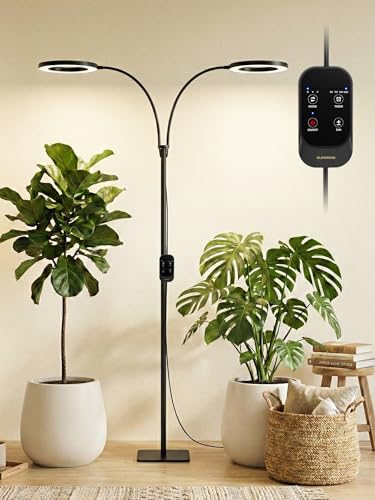

GLOWRIUM Grow Light With Stand

VIPARSPECTRA 150W Grow Light


SDOVUERC Full Spectrum Grow Light

Barrina T8 2FT Grow Lights 6-Pack


Abriselux 800 LEDs 8-Head Grow Light

VIPARSPECTRA 70W Dimmable Grow Light
The Details Behind The Selections
This GLOWRIUM model stretches up to 79 inches tall, which gives it room to grow alongside anything from a seedling tray on a low table to a mature pothos on a plant stand. The pole breaks into four sections, so the height can be dialed down for shorter shelves without a wobbly top-heavy feel.
Stepless dimming (a smooth brightness adjustment rather than fixed steps) and three spectrum modes let the same fixture cover germination through flowering without swapping bulbs. Compared to the GLOWRIUM Tall Plant Grow Light covered next, this one trades dual heads for a simpler single-head layout, which makes it tidier in tight reading nooks where plant racks hug the wall.
Real-World Strengths
- Four-section pole reaches 79 inches, suiting plants that climb fast on a windowsill.
- Stepless dimming removes the jump between fixed brightness steps many budget lamps leave behind.
- Three spectrum presets cover seedlings, leafy greens, and flowering herbs in one fixture.
- Single enlarged lamp head spreads light evenly without needing two arms to position.
Things To Consider
- The taller configuration needs a stable base, so carpeted floors may show slight wobble if bumped.
- Single-head layout covers a smaller footprint than dual-head options like the GLOWRIUM Tall Plant Grow Light.
Quick Facts
Who It Suits Best
Herbs and houseplants that grow tall through summer and need one fixture to follow them from seedling to flower.
Look Elsewhere When
Anyone running a multi-shelf seed-starting rack should consider the Barrina T8 2FT Grow Lights 6-Pack for broader coverage.
Twin lamp heads on a 70.9-inch floor stand give this GLOWRIUM model a wider reach than its single-head sibling. The 268 LED diodes spread output across both heads, which helps when a small cluster of plants shares one corner and needs even light from multiple angles.
Dedicated Seedling, Vegetative, and Flowering modes (labeled S, V, and F) make it easy to match the spectrum to the stage without guesswork. Versus the GLOWRIUM Grow Light With Stand covered below, this one leans toward gardeners who want a taller pole and dual coverage over a compact three-height adjustment.
Strong Points
- Dual lamp heads cover a wider footprint than single-head floor lamps in the same range.
- Three labeled spectrum modes remove the trial-and-error of mixing red and white light ratios.
- 70.9-inch stand keeps taller floor plants within the recommended lighting zone.
Worth Noting
- The dual-head design needs more clearance to angle both heads freely in narrow corners.
- Owners commonly report the base feels lighter than the tall pole suggests, so placement near foot traffic should be deliberate.
Feature Snapshot
Made For
Plant parents tending a small cluster of mixed houseplants in a corner that needs wider, taller coverage.
Not Your Match When
Shoppers wanting a more compact clip-on for a single windowsill pot should look at the VIIVUU Clip-On Plant Light instead.
A detachable three-section pole snaps together without tools, which is a relief for anyone who hates fiddly assembly. Three height presets (32, 47, and 63 inches) cover most windowsill herbs and modest houseplants, and the 360-degree rotating head keeps light pointed where it matters.
Spectrum output spans 380 to 780 nanometers (the wavelengths plants use most for photosynthesis), with three modes tuned to germination, flowering, and full-cycle growth. Compared to the taller 79-inch GLOWRIUM covered first, this one is the more approachable pick for someone starting a small herb garden on a kitchen counter.
What Works In Its Favor
- Three detachable pole sections mean no tools and a flat-pack-friendly setup.
- Built-in timer offers 3, 9, and 12-hour schedules, removing manual on-and-off for working gardeners.
- Six dimming levels from 10 to 100 percent give finer control than fixed-step dimmers.
Trade Offs
- Maximum 63-inch reach falls short of taller GLOWRIUM siblings for big floor plants.
- The detachable pole, while convenient, has more joint points that can loosen over months of repositioning.
Best Suited To
First-time indoor gardeners who want a simple stand-up fixture with a timer and modest dimming range.
Swap It Out When
Gardeners running dense seedling trays under a shelf should consider the Barrina T8 2FT Grow Lights 6-Pack for rack-wide coverage.
This VIPARSPECTRA fixture sits in a different class than the stand-up models above. Optical lenses concentrate the diode output toward the canopy, which means less wasted light bouncing off walls and more focused PPFD (photosynthetic photon flux density, the measure of usable light reaching the plant) on the leaves themselves.
A dimming daisy chain (linking multiple fixtures to one controller) lets up to 20 XS1500 Pro units run from a single dimmer, which suits a hobby greenhouse or a serious home veggie setup. Where the GLOWRIUM models handle houseplants and herbs, this one targets gardeners pushing tomatoes, peppers, and other fruit-bearing crops through bloom.
The Good Stuff
- Optical lens design concentrates output for stronger canopy penetration in dense trays.
- Daisy-chain dimming scales from a single tent to a 20-light commercial run on one controller.
- 150W output pushes past stand-up lamps for vegetable and bloom stages.
Points To Keep In Mind
- No included stand means a hanging kit or shelf mount is needed for proper placement.
- Higher output adds heat, so ventilation matters more than with the GLOWRIUM stand-up models.
Who Will Love This
Vegetable gardeners and hobby greenhouse growers running dense bloom-stage crops under a tent or rack.
Consider Something Else When
Apartment growers with just a windowsill herb garden will be happier with the SDOVUERC Full Spectrum Grow Light for a smaller footprint.
When floor space is already spoken for, this clip-on from VIIVUU keeps the lamp out of the way entirely. The clamp grips a pot rim, shelf edge, or even a soil stake, so a single fixture can follow one plant wherever it sits.
The hollow lamp head keeps the weight light on the clamp, which helps when clipping to thinner shelf edges. For someone tending just a pothos or a small succulent, this sidesteps the stand footprint of every GLOWRIUM pick on the list.
Where It Delivers
- Strong clamp force holds onto pot rims or shelf edges without slipping.
- Optional soil stake turns the same fixture into an upright grow light when needed.
- Lightweight hollow ring head reduces clamp fatigue on smaller shelves.
Small Caveats
- Single-unit output suits one or two plants, not a multi-pot rack.
- The clamp requires a sturdy edge, so glass shelving or smooth metal may need a workaround.
Perfect Match For
Apartment dwellers tending one or two statement plants on a shelf where a full stand would dominate the room.
Skip It When
Anyone starting a full tray of vegetable seedlings will find the RWNTAO Ceiling Grow Light a better overhead option.
The SDOVUERC stand telescopes from 10 to 65 inches, which makes it adaptable enough to slide behind a sofa plant or rise to a tall fiddle leaf fig. Warm white, cool white, and deep red diodes blend into a sunlight-like spectrum that does not scream “grow lamp” the way purple-heavy fixtures can.
For living rooms and shared spaces, the design-first profile makes this more of a décor piece than a workshop tool. Compare it to the GLOWRIUM Grow Light With Stand, and the difference comes down to a slimmer aesthetic versus a sturdier, more utilitarian build.
Well-Handled Touches
- Slim stand profile blends into living rooms rather than dominating them.
- Telescoping pole adjusts from 10 to 65 inches, fitting both desktop succulents and tall floor plants.
- Balanced warm and cool spectrum reads as natural light in shared spaces.
Honest Caveats
- Lower output than high-wattage panels like the VIPARSPECTRA 150W, so fruiting crops may need supplemental light.
- Décor-focused finish shows dust and smudges more than matte black workshop fixtures.
Right Fit For
Houseplant collectors styling a living room corner where the grow lamp needs to disappear into the décor.
A Better Fit Elsewhere
Heavy-duty seed starters running a garage rack should look at the VIPARSPECTRA 150W Grow Light for raw output.
A six-pack of 2-foot T8 strips (slim LED tubes that mount under shelves) gives this Barrina bundle a serious coverage advantage over single-lamp stands. Mount them side by side under a shelf and an entire seed tray sits under even, full-spectrum light without hot spots or dim corners.
The 5000K white output reads as a clean daylight tone, which keeps things looking natural in a workshop or garage. The second-generation design uses updated connectors to avoid accidental electrical issues when mixing with older Barrina cords, a thoughtful detail for anyone expanding a setup over time.
Key Advantages
- Six strips in one bundle cover an entire seed-starting shelf out of the box.
- 5000K white spectrum keeps a garage or workshop looking clean rather than tinted purple.
- Updated connector design reduces wiring errors when extending an existing Barrina setup.
Less Ideal Details
- No included stand, so a shelving unit or hanging hardware must already be in place.
- Strip form factor means each tube lights a narrow band, so plants on wider shelves may need two rows.
Built With In Mind
Garage seed starters running a full shelving unit who want broad, even coverage without a single hot spot.
Another Choice May Suit
Apartment growers without a shelf to mount under should pick the GLOWRIUM Grow Light With Stand for an all-in-one floor solution.
Ceiling-mounted grow lights are rare at this price point, and RWNTAO’s dual-ring design hangs overhead without claiming any shelf or floor real estate. Each ring carries 48 LEDs split between warm and white diodes, and the full spectrum runs from 380 to 800 nanometers.
The built-in timer offers 6, 12, and 16-hour cycles with 10 dimming levels, so a forgetful plant parent can set it once and let the light follow a daily rhythm. The trade-off is installation, since ceiling mounting requires a hook or bracket the stand-up options skip entirely.
Everyday Perks
- Ceiling-hung design keeps floor and shelf space free in tight apartments.
- Three timer cycles and 10 dimming levels offer fine daily scheduling control.
- Dual-ring layout spreads warm and white diodes evenly across the canopy.
Factors To Consider
- Ceiling mount requires drilling or a sturdy hook, which renters may want to avoid.
- Fixed hanging height means taller plants can grow out of the optimal lighting zone over time.
Whose Shelf It Belongs On
Renters and apartment dwellers with limited floor space who want a permanent overhead solution.
Reach For A Different Pick When
Anyone wanting a no-install option should pick the GLOWRIUM Grow Light With Stand instead.
Eight adjustable heads and 800 LEDs make the Abriselux the most spread-out fixture in this roundup. The multi-head design reaches several plants at once without leaving dark corners, which matters for anyone running a half-room plant corner or a wide grow rack.
Timing cycles of 4, 8, and 12 hours pair with the full-spectrum output to cover most daily routines. Compared to the GLOWRIUM Tall Plant Grow Light covered earlier, this one prioritizes raw head count over a slim floor footprint, so it earns its place in a larger grow space rather than a tight reading nook.
The Case For It
- Eight heads give broader coverage than any dual-head floor lamp in this price tier.
- 800 LEDs spread light across multiple plants at once without obvious dead zones.
- Three timer cycles (4, 8, 12 hours) match common vegetative and bloom routines.
A Few Limitations
- The wide footprint needs a dedicated corner, so small shelving setups feel crowded.
- More heads mean more joints, so periodic tightening may be needed to keep angles true.
Who Will Love This
Plant collectors filling a full corner or a wide rack with multiple species that each need their own angle of light.
Skip It When
Anyone tending a single windowsill pothos should grab the VIIVUU Clip-On Plant Light for a tidier fit.
The 70W VIPARSPECTRA sits between the smaller GLOWRIUM stand-ups and the high-output 150W panel covered earlier, landing in a sweet spot for seedlings and vegetative growth. Output reaches 11,000 lumens (a measure of total visible light) with a balanced mix of 660nm red, 3000K warm white, and 5000K cool white diodes.
The diode layout and high-performance driver target photosynthesis at the early stages, which suits anyone starting tomatoes or peppers indoors before transplanting. For gardeners running a single tray rather than a full greenhouse, this is a practical step up from stand-up fixtures without jumping to commercial wattages.
The Value In It
- Balanced 660nm red with warm and cool white mimics natural daylight for early-stage growth.
- 11,000-lumen output covers seedling trays without pushing into commercial-grade wattage.
- Dimmable driver lets the same fixture adjust as plants move from sprout to transplant size.
What To Weigh
- No included stand or hanging hardware, so mounting requires a separate kit or shelf.
- Higher output than stand-up lamps means closer attention to heat in enclosed spaces.
Best Suited To
Vegetable gardeners starting a tray of tomatoes or peppers indoors who want a focused vegetative boost.
Look Elsewhere When
Décor-first houseplant growers should pick the SDOVUERC Full Spectrum Grow Light for a more living-room-friendly profile.
What To Weigh Before Choosing Budget Grow Lights
A grow light’s wattage matters less than its usable output at the canopy, which is why PPFD and spectrum range deserve a closer look than raw power numbers. For herbs and modest houseplants, 30 to 50 watts from a quality diode layout usually covers the basics, while fruiting crops and dense trays push toward the 70W to 150W tier.
Spectrum range (the wavelengths of light a fixture emits, measured in nanometers) should reach from at least 380nm into the upper 700s if a single lamp is expected to cover germination through flowering. Cooler 5000K white light skews toward vegetative growth, while warmer 3000K and red-heavy diodes (around 660nm) help during the bloom stage.
Form factor matters more than specs suggest. Stand-up floor lamps work in corners with one tall plant, ceiling mounts free up shelf space in tight apartments, and clip-ons follow a single pot wherever it sits. The right shape often beats a slightly higher wattage that ends up in the wrong spot.
Key Considerations Across These Picks
Where Shoppers Go Wrong
The biggest slip-up is buying by wattage alone. A 150W panel aimed at a single small pothos wastes light and runs hotter than necessary, while a 48W stand-up lamp aimed at a full tray of seedlings leaves the corners leggy. Match the fixture footprint to the actual plant cluster, not the wattage number on the box.
Another common miss is ignoring the timer. Manually switching a grow light on and off sounds simple until a workday runs long and the plants sit dark for 18 hours. Built-in timers on the GLOWRIUM and RWNTAO models solve this, and shoppers comparing budget options should weigh timer support as a must-have rather than a nice-to-have.
What The Higher Tier Buys
Stepping up to a premium grow light typically means better diode binning (the consistency of LED color and output from one unit to the next), tighter spectrum tuning, and more robust heat sinking (metal fins that pull heat away from the LEDs to extend their life). The VIPARSPECTRA 150W covered above earns its place through an optical lens design that focuses output, which a budget fixture cannot match.
For hobby gardeners starting a few herbs, the upgrade rarely justifies itself. For anyone running bloom-stage vegetables or a multi-rack setup, the better diode consistency and daisy-chain controls of a higher-tier panel pay back the cost in fewer replacements and more uniform growth across the canopy.
Frequently Asked Questions
How many watts do budget grow lights actually need?
For a small herb garden or a few houseplants, 30 to 50 watts from a quality diode layout is usually enough. Fruiting crops and dense seedling trays push toward 70W or higher, but raw wattage alone does not guarantee better results without proper spectrum and coverage.
What does full spectrum mean for indoor plants?
Full spectrum means the fixture emits a range of wavelengths that mimics natural sunlight, typically spanning 380 to 780 nanometers. This range supports germination, leafy growth, and flowering from the same lamp, which removes the need to swap bulbs between growth stages.
How close should a grow light sit to the plant?
Most LED grow lights perform best when hung 6 to 12 inches above the canopy for seedlings, and 12 to 24 inches for mature houseplants. The exact distance varies by wattage, so checking the manufacturer’s recommended hanging height prevents leaf burn and leggy stretch.
Do grow lights use a lot of electricity?
A 48W LED running 12 hours a day adds a modest amount to a monthly power bill compared to older HID (high-intensity discharge) lamps. LEDs convert most of their draw into usable light rather than heat, so they tend to be efficient even on long vegetative cycles.
Can one grow light cover multiple plants?
Yes, especially with multi-head fixtures like the Abriselux 8-head model or strip setups like the Barrina 6-pack. Single-head lamps cover one or two plants well, but multi-head and strip designs spread even light across a wider cluster without dark corners.
Wrap Up
The right budget grow light comes down to matching the fixture footprint to the plant setup, not chasing the highest wattage. Stand-up GLOWRIUM models handle everyday houseplants, ceiling and strip designs free up space, and the higher-wattage VIPARSPECTRA panels step in for serious vegetable work. Pick the shape that fits the room, and the rest tends to fall into place.