

Dim basements turn into dead zones. Storage corners vanish into shadow, home gyms feel unsafe, and the workshop bench becomes a guessing game. The right LED basement ceiling lights flip that experience: cold corners, workbench shadows, and laundry-day detail work all clear up the moment color temperature and output match the room. I pulled seven options that span simple screw-in panels, high-output UFO high bays, and modular hex grids, so you can match output, ceiling height, and installation appetite without buying the wrong thing twice.
The Essentials At A Glance

Adiding Rotatable LED Garage Light 2 Pack

G GJIA 240W Dimmable LED High Bay Light 4 Pack
Adiding Garage Lights 8 Deformable Panels

LZHOME Hexagon 5000K LED Garage Lights 25 Pack

ELEKICO 250W UFO LED High Bay Light 12-Pack

SYDHTF LED Garage Lights 2 Pack Deformable

Adiding LED Garage Light 2 Pack 20000LM
The Strengths Of Each Pick
Most basements already have one or two ceiling sockets waiting to be reused. This Adiding pair drops into standard E26/E27 bases (the common medium screw-in socket found in nearly every American home), no rewiring, no electrician visit. Each unit puts out a daylight 6500K (a crisp, blue-leaning white close to noon sunlight) beam from adjustable wings, so you angle throw toward workbenches, laundry zones, or storage walls instead of just flooding the floor. For homeowners finishing a basement on a tight timeline, the install path is genuinely short: twist, tighten wings, flip the switch.
You get two fixtures in the box, which suits a typical 400–600 sq ft basement split into two activity zones. Color rendering sits in a comfortable range for basement detail work like sorting tools or reading labels. Compared with the SYDHTF two-pack coming up, this Adiding trades panel count for slightly higher total output, so the wing count isn’t a fair apples-to-apples comparison.
What Stands Out
- Tool-free install into existing bulb sockets keeps weekend projects simple
- Adjustable panels let you push light toward a workbench instead of wasting it on walls
- 6500K daylight tone helps with color-critical tasks like paint touch-ups
- Two-pack covers a typical basement without ordering a second listing
Things To Consider
- Wing hinges are the most stressed part; gentle handling during adjustment extends service life
- Not dimmable at the wall switch, so lighting mood requires a separate lamp layer
- 6500K can read sterile for finished basement living rooms
Quick Facts
Right Fit For
Homeowners finishing a basement on weekends with one or two existing ceiling sockets and a tight tool budget.
Swap It Out When
The Adiding 8-Panel unit makes more sense if you have one large open basement and want broad, ceiling-wide coverage from a single socket.
Tall basements with exposed joists, ducts, and 9-to-12 ft ceilings need pendant-style fixtures that throw light down from real distance. This G GJIA four-pack is a true UFO high bay (round, UFO-shaped industrial fixtures designed for high ceilings) with a 6 ft cord and US plug pre-attached, so a single outlet on the ceiling feeds each fixture. Dimming comes through a 0–10V signal, an analog dimming standard common in commercial settings where a separate low-voltage wire tells the driver how bright to go.
Where the Adiding screw-in models aim at retrofit convenience, this kit aims at raw output. Each 240W fixture pushes a 5000K (a neutral white tone close to mid-morning sun) beam that flatters wood tones and skin, so a basement gym or wood shop feels natural rather than blue. Owners with a finished ceiling, low attic clearance, or a strict DIY scope should probably skip this.
Where It Helps
- 5000K tone flatters wood, paint, and skin in workshop spaces
- 0–10V dimming lets you tune brightness for movie nights or full work mode
- Plug-in cord setup avoids hardwiring for homeowners comfortable with an outlet
- Four-pack covers most standard basements from a single purchase
Points To Keep In Mind
- 0–10V dimmer is not included and requires a compatible wall control
- Pendant mounting needs ceiling hooks or chains, not just a socket
- Output at full power is overkill for ceilings under 8 ft
Best Suited To
Basement workshops with ceilings of 9 ft or higher where bright, even task lighting matters more than aesthetic warmth.
Consider Something Else When
The Adiding 8-Panel unit is the better pick for ceilings under 8 ft, since hanging pendants waste vertical space in shallow rooms.
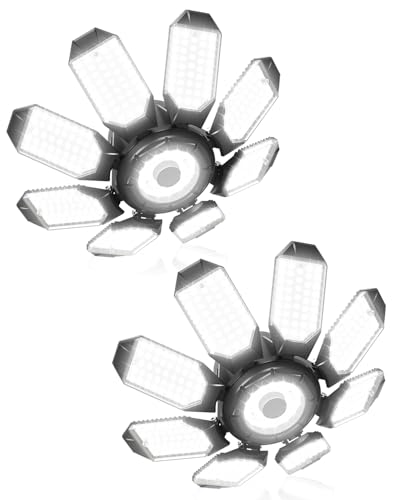
One large open basement asks a different question than a partitioned one: how do you flood the whole room without filling it with fixtures? This single-pack Adiding answers that with eight deformable LED panels (flat, hinged panels that tilt to aim light in different directions from a single base) arranged around a central core, each independently adjustable from flat to roughly 90°. The 6500K daylight tone matches the Adiding 2-Pack earlier, so the two can be mixed across rooms without color drift.
Compared with the SYDHTF six-plus-one panel design coming later, this unit trades a center spotlight for eight directional wings, so coverage pattern leans toward wall-flooding rather than floor-center brightness. Where it shines is a single-fixture solution for a finished basement where running multiple circuits would mean breaking open drywall.
Useful Touches
- Eight panels cover a wide area from a single socket, reducing install points
- Independent panel aiming lets you balance workbench and storage zones
- High total output supports detail-heavy tasks like mechanical repair
- Screw-in base keeps retrofit work to a simple swap
Honest Caveats
- Eight-panel units run heavier; older ceiling boxes with weak cross-bracing may need reinforcement
- Color temperature skews cool, which can feel harsh in living spaces
- Single-pack leaves partitioned basements under-lit
Feature Snapshot
Made For
One large open basement where a single ceiling socket is the realistic install point and broad coverage matters most.
A Better Fit Elsewhere
The LZHOME Hexagon 25-Pack suits homeowners who want a deliberate, styled lighting layout rather than a single fixture in the center.
Most LED basement ceiling lights treat the ceiling as a utility. The LZHOME hexagon kit treats it as a statement. Twenty-five hexagonal panels link into a snap-together grid that mounts directly to a finished or exposed ceiling, casting a 5000K neutral wash that flatters car paint, gym mirrors, and workshop benches alike. CRI (Color Rendering Index, a 0–100 scale measuring how accurately a light reveals true colors; 80+ is considered good, 90+ excellent) lands above 85, which makes color-critical detailing genuinely readable rather than guesswork.
The honest trade is installation effort. Each hex connects to its neighbor, so plan time for layout planning, ceiling mapping, and tidy wiring before the first panel goes up. Once it’s locked in, the result looks closer to a custom lighting install than a DIY retrofit, and it complements the G GJIA high bay kit for tall ceilings where one or two hex panels act as accent lighting.
Bright Spots
- High CRI value supports color-accurate work like auto detailing or paint matching
- Modular grid scales from a small gym corner to a full basement ceiling
- 5000K tone sits in a comfortable middle between warm and cool
- Honeycomb pattern doubles as a visual feature in finished basements
Worth Bearing In Mind
- Layout planning and ceiling mapping add hours to install time
- Higher panel count means more connection points to inspect over time
- Bulk pack suits larger rooms; smaller basements will leave unused panels
Who Should Grab It
Homeowners turning a basement into a car-detailing bay, content studio, or styled gym who want the lighting itself to be part of the room.
Look Elsewhere When
The Adiding 2-Pack fits better for a quick, single-socket retrofit where install time needs to stay under an hour.
A full basement at 10–35 ft ceilings needs serious throw. This ELEKICO 12-pack steps up to 250W per fixture with a 5000K daylight output aimed at replacing older metal-halide or HPS high bays (traditional industrial lamps known for warm-up delays and heavy energy use). Each unit runs on a wide 110–277V range, so it adapts to standard household circuits and light commercial wiring without a transformer.
The honest read: twelve fixtures is a serious commitment, and most residential basements won’t need more than four to six from this line. Think of this pack as a fit for split basements, basement-level shops plus home gyms, or homeowners converting a walkout lower level into a serious hobby space. Where the G GJIA four-pack handles one room well, this pack handles three or four.
Useful Highlights
- High per-fixture output suits ceilings above 12 ft
- Wide voltage range removes guesswork during electrical planning
- 5000K neutral tone balances task and ambient needs
- Bulk pack lowers per-fixture cost for whole-basement retrofits
Potential Drawbacks
- Twelve units is overkill for a single 400 sq ft basement
- Pendants need chains or hooks; ceiling structure must support the weight
- Total wattage adds up; check panel capacity before filling a circuit
Spec Overview
Whose Shelf It Belongs On
Homeowners finishing large or split basements where multiple pendants across zones make more sense than one central fixture.
Reach For A Different Pick When
The G GJIA 240W 4-Pack is the right match for a single-room basement ceiling between 9 and 12 ft, without surplus fixtures going unused.
Some basements need general brightness, but most need brightness exactly where the work happens. The SYDHTF 2-Pack splits the difference with a six-plus-one panel layout: six adjustable side wings aimed at walls and storage, plus one center panel aimed straight down at the floor. The 6500K tone matches the Adiding units earlier, so they coexist in the same basement without color shift between rooms.
For budget-conscious shoppers, the appeal is straightforward: a two-pack with serious output at a lower entry cost than the Adiding 8-Panel single unit, with comparable panel count when both packs are combined. The honest read is that CRI (Color Rendering Index) lands in a usable range for general tasks, though detail-critical work like paint matching benefits from the LZHOME hex kit’s higher rating.
Standout Benefits
- Six side wings plus a center panel aim light at floor and walls simultaneously
- Two-pack gives wide coverage without the bulk-pack commitment
- Daylight tone suits workshops, storage zones, and home gyms
- E26 base keeps install to a simple bulb swap
Practical Considerations
- CRI is acceptable for general use but not optimized for paint or auto detailing
- Panels lock with friction hinges; expect to readjust after a few months of use
- Cool color temperature can read sterile in finished living areas
Who It Suits Best
Budget-first shoppers covering a typical two-zone basement with existing ceiling sockets and no plans for hardwired pendants.
Where Another Pick Suits Better
The LZHOME Hexagon 25-Pack suits homeowners whose priority is color accuracy, whether for content creation or car detailing.
The 20000LM Adiding pair lands between the lower-output 12000LM and the bigger 8-panel unit earlier, giving two-fixture coverage for a standard basement at a middle output tier. Each unit still uses the same E26 screw-in base, so the install story matches the rest of the Adiding family. Wings tilt to aim throw at the workbench, the laundry zone, or a craft corner.
For households splitting a basement into two distinct rooms with one ceiling socket each, this pair handles both sides cleanly. It’s the most predictable Adiding profile in this list: medium output, daylight tone, two-pack convenience. Where it falls short is partitioned basements that need more than two fixtures, and that’s where the SYDHTF 6+1 panels or the ELEKICO 12-Pack pick up the slack.
The Upside
- Middle-tier output handles a typical two-room basement from two sockets
- Same E26 install as other Adiding units keeps the retrofit path simple
- Daylight tone suits general storage and utility work
- Two-pack covers most standard basements without a second order
Trade Offs To Consider
- Output sits between extremes; very large basements may need supplemental lighting
- Cool tone can read clinical in finished living spaces
- Not dimmable, so additional lamps handle mood lighting
The Right Fit
Homeowners with a two-room basement layout who want one predictable LED basement ceiling light per room without overbuying output.
Skip It When
The SYDHTF 6+1 Panel 2-Pack fits better when you want adjustable throw aimed at walls and floors from a single fixture per room.
What To Weigh Before Picking Led Lights For Basement
Ceiling height sets the rulebook. Basements under 8 ft favor screw-in deformable panels because pendants steal vertical headroom and feel like they’re falling on you. Ceilings between 9 and 12 ft open the door to high bay pendants, and ceilings above 12 ft practically require UFO-style fixtures with serious throw.
Color temperature (the Kelvin rating that describes how warm or cool a light appears; lower numbers read yellow, higher numbers read blue) shapes how the room feels. 5000K sits close to mid-morning sun and flatters most activities, while 6500K leans bluer and crisper, which is great for task work but can feel clinical in a finished living room.
CRI (Color Rendering Index) matters more than most shoppers expect. A CRI of 80+ handles general tasks, but anything color-critical like paint touch-ups, fabric matching, or auto detailing wants CRI of 85 or higher.
Lumens tell you how much light, not how bright the room feels. Distribution matters just as much. A 14,000-lumen fixture aimed at one wall wastes half its output, while a multi-panel design aimed at the floor and walls uses it efficiently.
Existing wiring decides what you can actually install. E26 screw-in sockets keep the project DIY-friendly, while pendant installations need ceiling hooks or chains and sometimes a new circuit.
Key Considerations Across These Picks
Pitfalls Shoppers Hit
Buying by lumen count alone often backfires. A single 40,000-lumen fixture in a low ceiling produces glare and hot spots, while the same output spread across multiple pendants feels even. Skipping CRI is another common miss: basement gyms and craft rooms look fine at CRI 80, but a content studio or auto bay looks washed out at the same rating.
Where The Extra Money Goes
Higher-tier kits like the LZHOME hex grid and ELEKICO 12-Pack add cost through better components, longer LED lifespans, and broader voltage compatibility. The honest read: most basements don’t need those specs, but tall ceilings, color-critical work, or whole-basement retrofits justify the jump.
Frequently Asked Questions
How many lumens do I need for a basement?
For a typical 400–600 sq ft basement used as a multi-purpose space, plan for around 8,000–14,000 lumens total, depending on ceiling height and whether the room is partitioned. Taller ceilings need more throw per square foot.
What color temperature works best in basements?
5000K suits most basements because it flatters wood, fabric, and skin while staying bright enough for task work. 6500K works in workshops or gyms where crisp task visibility matters more than warmth.
Are screw-in LED panels better than high bay pendants?
Screw-in panels win on install simplicity and cost for ceilings under 8 ft. Pendant high bays win on light distribution and dimming options for ceilings 9 ft and above.
Do basement LED lights need to be dimmable?
Not strictly, but dimmability adds real comfort in finished basements used for movies, hobbies, or entertaining. Task-only spaces like gyms and storage rooms do fine without it.
How long do LED basement lights typically last?
Quality LED panels and high bays commonly rate for 30,000–50,000 hours of use. For a basement used a few hours per day, that translates to many years before output drops noticeably.
Wrap Up
The right LED basement ceiling lights turn a forgotten lower level into a space that earns its square footage. Match the fixture type to your ceiling height, pick color temperature for the room’s purpose, and don’t skip CRI if detail work is on the agenda. Start with one room and let the rest follow.