

Most greenhouses struggle in winter, and supplemental lighting fills the gap when daylight drops. I put together this list for hobbyists, urban gardeners, and small-scale growers who want reliable LED fixtures that support healthy plant growth across every stage. Each pick here fits a different setup, from a small backyard greenhouse to a serious propagation space.
A Closer Look At The Lineup

GLOWRIUM 48W Grow Light with Stand

HLG 600 Rspec FR Quantum Board
VIVOSUN AeroLight 240W with Fan

DOMMIA Under Shelf Grow Light
VIVOSUN LumaLight 100W

VIVOSUN LumaLight 320W
Soltech Aspect Gen 2 Pendant
More On The Choices That Made The List
I think of this GLOWRIUM unit as a starter-friendly floor lamp for plants. The four-section telescoping pole extends up to 79 inches, so a tall tomato transplant or a leggy herb can sit underneath without getting scorched. The enlarged lamp head distributes light across a wider footprint than older narrow designs, which helps when you have a cluster of seed trays rather than a single pot.
Compared to the high-output HLG fixture coming up next, this one trades raw power for plug-and-play simplicity. You won’t need a separate timer or external controller for most setups. The stepless dimmer and three-mode switch make it approachable for someone just getting into indoor growing and who wants to learn how different plants respond to different intensities.
Advantages To Know
- Telescoping pole reaches up to 79 inches, giving tall seedlings room to grow without repositioning.
- Stepless dimming lets you dial intensity for delicate starts or hungrier vegetative plants.
- Wider lamp head spreads light more evenly across a tray of seedlings than narrow single-tube fixtures.
- Stand-mounted design requires no installation hardware or hanging hardware in your greenhouse.
Things To Consider
- At 48 watts, coverage shrinks fast once plants spread beyond a small tray, so large canopies will outgrow it.
- The plastic connectors on the pole can loosen over time, especially if the unit gets bumped during watering routines.
Who It Suits Best
First-time growers, apartment gardeners, and anyone starting a tray of herbs or leafy greens under a modest footprint will find this approachable and forgiving.
Consider Something Else When
Growers running a dedicated 4×4 tent with high-light crops should look at the HLG 600 Rspec FR instead, since it delivers the wattage needed for that canopy size.
The HLG 600 Rspec FR sits at a different altitude than the GLOWRIUM stand I covered first. This is a 600-watt quantum board, meaning a flat panel densely packed with mid-power white diodes and supplemented with far-red wavelengths. The far-red addition (the “FR” in the name) is the real story here: that wavelength influences how plants stretch and how they transition into flowering, which is why serious growers pay attention to it.
For a backyard greenhouse with a defined 4×4 footprint, this fixture simply delivers more usable photons per watt than smaller household units. The dimming driver means you can throttle it back for seedlings and then push it hard during bloom. You will need to hang it properly, since at this wattage a flimply setup will sag, but that’s a one-time install.
Strengths Worth Knowing
- 1529 PPF output with 2.60 micromoles per joule efficiency (the ratio of plant-usable light to electricity consumed) means serious light without wasted energy.
- Far-red supplementation supports the Emerson effect (a photosynthesis boost when far-red and red light overlap), helping drive stronger flowering responses.
- Dimming driver lets one fixture serve propagation, vegetative, and bloom stages at different intensities.
- Third-party lab-verified performance data gives growers confidence the output matches what the brand claims.
Honest Caveats
- The 600-watt draw means a dedicated circuit and likely an electrician’s check on older greenhouse wiring.
- Heat output, while moderate for the wattage, still needs some clearance above the canopy.
- Requires hanging hardware and ratchet hangers, neither of which ship in the box.
Right Fit For
Growers running a 4×4 tent or a comparable greenhouse zone who want a single fixture to carry seedlings through harvest will appreciate the headroom this provides.
Reach For A Different Pick When
Someone growing a few herb pots on a kitchen shelf would be happier with the GLOWRIUM stand, since this fixture is overkill for that scale.
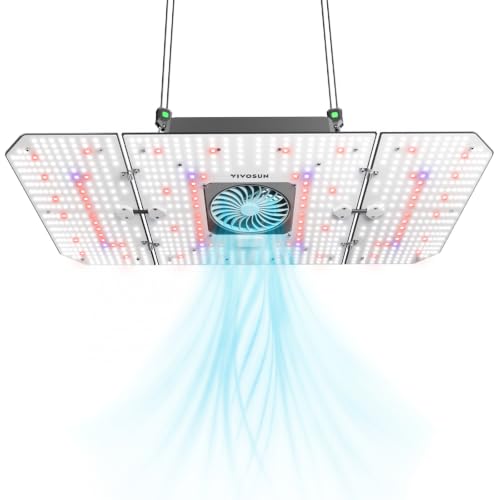
The VIVOSUN AeroLight 240W is the only fixture in this roundup with a built-in circulation fan, which solves a problem most growers don’t realize they have. Stagnant air inside a grow tent leads to humidity pockets, weak CO₂ exchange at the leaf surface, and patchy growth. By spinning air directly through the canopy, this light addresses airflow as well as illumination in one package.
The 240-watt output lands between the beginner-friendly GLOWRIUM and the high-output HLG, making it a sensible middle ground. Full-cycle tunable spectrum means you can adjust the light recipe (the specific mix of wavelengths) for seedlings, vegetative growth, and flowering without swapping fixtures. For an enclosed tent setup, this combination is hard to beat.
Notable Gains
- Integrated fan circulates air through the canopy, reducing stagnant zones that invite mold.
- Full-cycle tunable spectrum adjusts wavelengths for each growth stage from one fixture.
- 240W output suits a 2×4 or small 3×3 footprint without overpowering.
- Central fan placement distributes airflow evenly rather than from one corner.
Points To Keep In Mind
- Built-in fan adds a mechanical component that can fail over years of constant use.
- Heavier than fan-less fixtures at similar wattage, so check your hanging hardware rating.
- Image listings may not always show the exact color variant in stock.
Made For
Growers running enclosed tents who want airflow and lighting handled in one unit, especially anyone who has fought humidity issues in a sealed environment.
Swap It Out When
Someone with a wide-open greenhouse rather than a tent should consider the VIVOSUN LumaLight 320W, since the AeroLight’s fan advantage disappears in spaces with natural ventilation.
Where the HLG board handles a full tent and the AeroLight tackles airflow, the DOMMIA panel solves a very different problem: shelf propagation in a tight space. The unit is only 0.28 inches thick and roughly 4×4 inches, so it slides under a wire shelf, mounts to the underside of a greenhouse bench, or hangs above a single seed tray without dominating the area.
The built-in timer offers 6, 12, and 16-hour auto cycles, and the four-level dimmer gives you brightness control from 25% to 100%. Power-loss memory means your schedule resumes after an outage. For a hobbyist starting lettuces or microgreens on a kitchen counter greenhouse, that set-and-forget simplicity is the real appeal.
Key Advantages
- Ultra-slim 0.28-inch profile fits under shelves or tucks into narrow greenhouse corners.
- Built-in timer eliminates the need to buy and configure a separate outlet timer.
- Power-loss memory restores the last setting after outages, no reprogramming.
- USB-powered design keeps wiring simple and adapter swaps easy.
Trade-Offs
- Single panel covers only a small footprint, so scaling up means buying multiple units.
- Daylight white spectrum lacks the far-red wavelengths that serious growers look for.
- Some color options show image-unavailable placeholder listings, so verify the variant before ordering.
Best Suited To
Seed starters, propagation setups, and anyone with a small greenhouse shelf who wants automated daily lighting without buying a separate timer.
A Better Fit Elsewhere
Growers needing full-coverage lighting across a multi-tray bench should look at the VIVOSUN LumaLight 100W instead, since it covers a wider footprint from a single fixture.
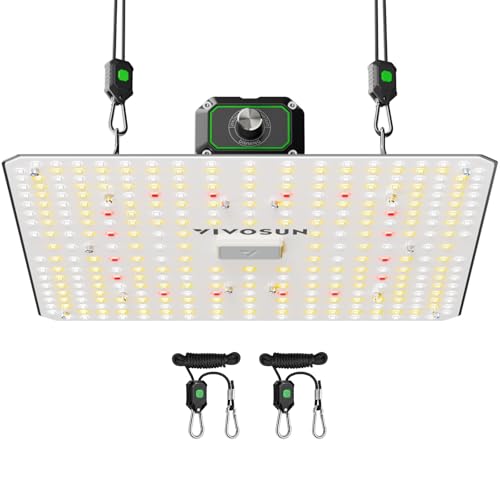
The LumaLight 100W is the kind of workhorse fixture that quietly handles most home greenhouse tasks. It uses a blend of white, blue, red, and far-red LEDs across 3000K, 5000K, 660nm, and 730nm wavelengths, covering everything from leafy greens to flowering crops. The 100-watt draw keeps it manageable on a standard circuit while still pushing meaningful intensity.
Compared to the DOMMIA shelf panel, this one is built to cover a real bench rather than a single tray. The diode layout is tuned for uniform PPFD (photosynthetic photon flux density, which measures how much plant-usable light actually reaches the leaves), which means fewer hot spots and more even growth across the canopy. For a small greenhouse or a 2×4 tent, it strikes a thoughtful balance.
What Pays Off
- Multi-wavelength blend supports photosynthesis from seedling through harvest in one fixture.
- Uniform PPFD distribution reduces hot spots that stress top-canopy plants.
- 100W draw stays friendly to standard household wiring without dedicated circuits.
- Compact form factor fits smaller greenhouses where big boards feel intrusive.
Small Caveats
- Lower wattage means slower growth for high-demand crops like dense-flowering tomatoes.
- No built-in fan, so growers in humid climates may need supplemental circulation.
Whose Shelf It Belongs On
Home greenhouse growers running a 2×4 or small 3×3 space, or anyone cultivating herbs and leafy greens through the colder months, will get the most out of this fixture.
Look Elsewhere When
Those running a large flowering operation should consider the VIVOSUN LumaLight 320W, since the 100W version won’t push a full bloom canopy hard enough.
The LumaLight 320W is the bigger sibling of the 100W I just covered, and the upgrade shows up in two places: output and uniformity. The light-bar matrix layout delivers up to 0.89 uniformity, which is a technical way of saying every plant from the center to the edge receives nearly identical light. For high-yield growers who hate seeing their corner plants lag behind, that evenness matters more than raw peak intensity.
The Micro-Lens Optic System uses curved, wave-shaped lenses to redirect photons deeper into the canopy rather than letting them scatter sideways. In practice, that means lower flowers and interior branches get more usable light. For a 4×4 or larger greenhouse zone, this is where the extra spend starts to make sense.
The Value In It
- 0.89 uniformity rating means edge plants grow nearly as fast as center plants.
- Micro-lens optics push light deeper into the canopy for fuller lower-branch development.
- 320W output covers a 4×4 footprint comfortably without overdriving smaller tents.
- Light-bar matrix reduces dead zones that bar-style fixtures sometimes leave between LEDs.
Where It Is Less Suited
- Higher wattage demands a more robust hanging system than lighter fixtures need.
- Lens system adds weight and cost that smaller greenhouse setups don’t always justify.
- Overkill for herb-only or propagation-only spaces.
Who Should Grab It
Serious greenhouse growers running a 4×4 or larger space, especially those growing flowering or fruiting crops where lower-canopy light penetration drives final yield.
Where Another Pick Suits Better
Decor-minded growers who want a fixture that blends into a living space should consider the Soltech Aspect Gen 2 pendant, since this is a strictly utilitarian look.
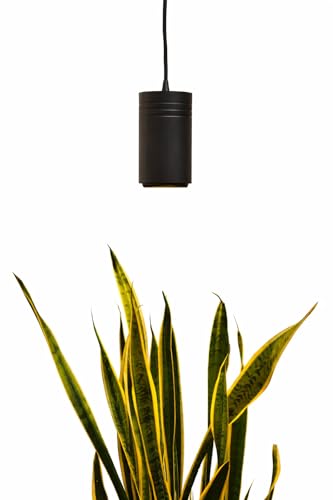
The Soltech Aspect Gen 2 is the odd one out in this roundup, and intentionally so. Where every other fixture here looks like gear, this one looks like a pendant light you’d hang over a kitchen island. The warm-white natural light tone means it disappears into a sunroom, living room, or stylish greenhouse without screaming “grow tent.”
The Gen 2 version delivers 110% more plant-usable light than the original Small Aspect, so the decor-friendly design no longer costs you meaningful photosynthetic output. Dimmable operation lets you tune the brightness for ambient mood or plant needs. For a sunroom greenhouse or a living-space grow corner, the trade-off between raw intensity and visual integration is finally balanced.
The Practical Payoff
- Pendant design blends into home interiors rather than reading as utilitarian hardware.
- Warm-white spectrum avoids the harsh purple or blue glare typical of grow fixtures.
- 110% output boost over the original Aspect makes it a serious plant light, not just decor.
- Dimming control adjusts brightness for both plant needs and room ambiance.
Factors To Consider
- Lower total output than high-wattage boards, so large canopies need multiple pendants.
- Pendant mounting requires ceiling hardware and a power source, so installation is more involved than a clip-on panel.
Perfect Match For
Sunroom growers, urban gardeners who want plants to coexist with living-room aesthetics, and anyone who values how a fixture looks as much as what it does.
Not Your Match When
Productive greenhouse growers focused on yield should look at the HLG 600 Rspec FR instead, since that fixture delivers the wattage and uniformity serious cropping demands.
Factors Worth Weighing Before Choosing Led Grow Lights For Greenhouse
Match Wattage To Your Footprint
Wattage alone doesn’t tell the full story, but it gives you a starting point. A small propagation shelf runs fine on 50 to 100 watts, a 2×4 bench wants 100 to 200 watts, and a 4×4 tent typically needs 300 to 600 watts depending on what you’re growing. Underpower a space and plants stretch; overpower one and you waste energy and risk light burn on sensitive crops.
Spectrum Matters More Than Wattage
Full-spectrum white LEDs, supplemented with red and blue diodes, support photosynthesis from seedling through bloom. Far-red wavelengths (around 730nm) influence stretching and flowering transitions, which is why fixtures like the HLG 600 Rspec FR and the LumaLight series include them. If you grow only leafy greens, a daylight-white panel works, but flowering crops reward a broader spectrum.
Consider Heat, Humidity, And Airflow
High-wattage fixtures generate meaningful heat, and sealed tents trap humidity. The VIVOSUN AeroLight solves the airflow question with a built-in fan. In an open greenhouse, natural ventilation handles humidity, so a fan-less fixture is fine. In an enclosed space, think about air circulation before you commit to a fixture design.
Think About Installation And Mounting
Pendant lights need ceiling hardware. Boards need ratchet hangers. Stand-mounted units need floor space. Shelves need slim profiles. The mounting style influences how permanent your setup feels and how easy it is to adjust as plants grow. Choosing a fixture that matches your existing structure saves a lot of retrofitting frustration.
Key Considerations Across These Picks
Common Buying Traps To Sidestep
The most frequent mistake is chasing wattage numbers without checking actual output metrics like PPF (photosynthetic photon flux) or PPFD (photosynthetic photon flux density). A 600W fixture with poor diode efficiency delivers less plant-usable light than a 300W fixture with high micromoles-per-joule ratings. Another trap is buying a fixture designed for tents and dropping it into an open greenhouse, where its tight beam pattern wastes light on the floor instead of covering the canopy evenly.
Where The Extra Money Actually Goes
Spending up in this category buys three things: better diodes, more even light distribution, and longer lifespans. Premium quantum boards and lens-equipped fixtures push more usable photons per watt, meaning lower electricity bills over years of daily use. They also tend to run cooler and last longer, which matters when a fixture operates 12 to 18 hours a day. The upgrade pays off most for growers running large canopies or high-value crops, while smaller setups often do perfectly well with mid-tier options.
Frequently Asked Questions
How Many Watts Do I Need Per Square Foot Of Greenhouse?
A common guideline is 30 to 50 watts per square foot for high-light crops like tomatoes and fruiting plants. Leafy greens and herbs do fine at 20 to 30 watts per square foot. Coverage depends on fixture quality and mounting height, so use wattage as a starting estimate, not a hard rule.
Do Led Grow Lights Really Work In Greenhouses, Or Only Indoors?
LEDs work in both settings. In a greenhouse, they supplement natural sunlight during low-light months or extend the photoperiod (the number of hours a plant receives light each day) into the evening. The benefit shows up most in winter and early spring, when daylight hours and sun intensity both drop.
How Far Should I Hang The Light Above My Plants?
Most LED fixtures perform best 12 to 24 inches above the canopy, depending on wattage. High-output boards like 600W quantum boards need more clearance to prevent light burn, while slim shelf panels can sit much closer. Always check the manufacturer’s recommended hanging height for your specific fixture.
Can I Leave Grow Lights On All Night?
Plants need a dark period to complete their growth cycle, so running lights 24/7 usually stresses them rather than helping. Most growers run an 18-hour vegetative cycle and a 12-hour bloom cycle, using a timer like the one built into the DOMMIA shelf panel to automate the on-off schedule.
Do These Fixtures Generate Enough Heat To Damage Plants?
Quality LEDs run cooler than older HID (high-intensity density) lighting, but high-wattage boards still produce meaningful heat at the canopy level. Maintaining recommended hanging height and ensuring basic airflow prevents heat stress. In tight enclosed tents, a fan-equipped fixture like the VIVOSUN AeroLight adds a layer of safety.