

I picked these five for homeowners who want their walkways to actually glow after sunset, not just hint at light. The right pick depends on whether you want wired reliability or pure solar freedom, plus how much brightness and runtime you need through long winter nights.
A Quick View Of The Lineup

Gardencoin Low Voltage Pathway Lights (8.5″ Shade, 21.5″ Tall) 6 Pack
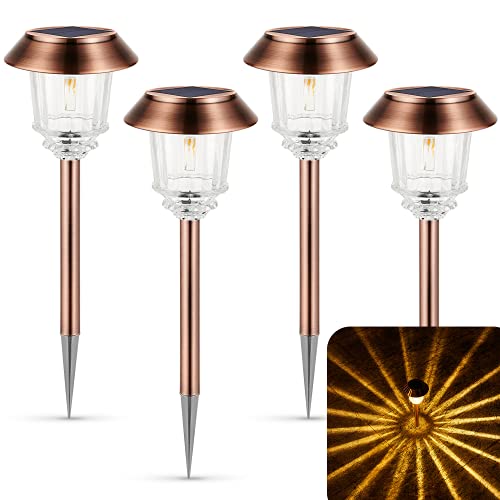
XMCOSY+ Solar Lights Outdoor Waterproof, 4 Pack

Amzarp 8 Pack Solar Garden Lights, Outdoor Bright LED

Solar Path Lights Outside 8 Pack, IP65 Waterproof Solar Garden Lights

XMCOSY+ Solar Pathway Lights Outdoor, 6 Pack
A Breakdown Of The Leading Choices
If you already run a low-voltage landscape system or plan to wire one in, the Gardencoin set gives you what solar can’t: predictable brightness every night, rain or shine. The aluminum body stands 21.5 inches tall with an 8.5-inch shade, and the 3W LED puts out 350 lumens per fixture in a soft 2700K glow (warm white, the kind that flatters stonework and plants rather than turning your yard into a parking lot).
Homeowners tired of dim solar output will appreciate that these run on a 12V transformer and use replaceable bulbs, so swapping a worn LED later costs pennies instead of replacing the whole fixture. For most suburban driveways, six units cover roughly 60 feet of walkway with even spacing.
The Helpful Details
- Wired 12V design delivers steady brightness, with no dependence on weather or panel angle
- Replaceable 3W LED bulb keeps long-term maintenance cheap and simple
- 21.5-inch height and wide 8.5-inch shade throw useful light sideways, not just down
- Aluminum construction handles rain and snow without the rust problems cheaper steel bodies show
Worth Bearing In Mind
- Requires a low-voltage transformer and basic wiring, which adds setup time versus true plug-and-go solar
- 350 lumens is solid for ambiance, but homeowners wanting security-grade brightness may want fewer, brighter units instead
Who It Suits Best
Homeowners already running (or ready to install) a low-voltage landscape lighting system who want a warm, steady path glow that doesn’t depend on sunny days.
Consider Something Else When
If you rent or want zero wiring, the XMCOSY+ 4 Pack offers a true solar setup that needs nothing more than a sunny spot.
Where the Gardencoin set prioritizes function, the XMCOSY+ 4 Pack leans hard into charm. The electroplated copper body and diamond-shaped glass shade give these a vintage lantern feel that suits cottage gardens and flower beds far better than utilitarian fixtures. Unlike the wired Gardencoin pick, these charge themselves, so installation is literally stick-in-the-ground.
The compact monocrystalline panel (2.4 x 2.4 inches) pairs with a 600 mAh battery to run the LEDs from dusk to dawn under normal conditions. For most flower-bed borders, four units spaced three feet apart create a soft guiding line without overwhelming smaller plantings.
The Upside
- Copper-and-glass design adds curb appeal even during daylight hours
- Monocrystalline solar panel charges efficiently in partial sun (this panel type converts more sunlight per square inch than cheaper amorphous panels)
- True zero-installation setup, no wiring, no transformer, no electrician
Honest Caveats
- Smaller battery capacity means shorter runtime on cloudy winter days compared to the 8-pack options below
- Glass shade can crack if hit by a lawnmower or thrown toy, so placement near play areas deserves some thought
Made For
Garden borders and flower beds where decorative style matters as much as light, and the path is short enough that four units cover the space.
A Better Fit Elsewhere
For longer driveways needing more coverage, the Amzarp 8 Pack gives you double the fixtures at a similar per-unit investment.
The headline here is simple: eight fixtures instead of four. For homeowners with long driveways, wide front walks, or winding garden paths, an 8-pack lets you light the whole route without buying two separate sets. The 3000K warm white output strikes a friendly middle ground, brighter and cooler than candle-warm 2700K but not the harsh blue of 5000K daylight LEDs.
Compared to the decorative XMCOSY+ 4 Pack, the Amzarp set trades vintage styling for sheer count and a more transparent light cover that pushes brightness further down the path. You may find these work better along functional walkways than among ornamental plantings.
Real-World Strengths
- Eight units in one box covers roughly 80+ feet of walkway with even six-foot spacing
- 3000K warm white stays easy on the eyes while still reading as “lit” from a distance
- Higher unit count lowers the effective per-fixture cost versus smaller packs
- Transparent cover maximizes downward light throw, useful for safety along uneven walkways
Trade-Offs To Consider
- Style is more functional than decorative, so these blend rather than stand out in ornamental beds
- Larger packs mean more individual units to position, clean, and occasionally reposition as plants grow
Best Suited To
Homeowners with longer driveways or multi-section paths who want full coverage from a single purchase and don’t need the vintage styling of the XMCOSY+ picks.
Look Elsewhere When
The Berrtinfn 8 Pack is a stronger choice in regions with weaker winter sun, where larger solar panels make the runtime difference meaningful.
If you live somewhere with long grey stretches, weak winter sun, or frequent storms, runtime matters more than raw style. The Berrtinfn 8 Pack leans into that reality with a high-performance monocrystalline panel and a larger onboard battery, designed to stretch a single charge across 12+ hours of warm white light. That’s a meaningful upgrade over smaller-panel sets like the XMCOSY+ 4 Pack, which can dim by midnight in December.
The IP65 rating (a weatherproofing standard that keeps out dust and rain jets from any direction) means the fixtures shrug off the kind of sideways rain that ends up in cheaper housings. Eight units cover the same ground as the Amzarp set, but with stronger endurance in low-light conditions.
A Strong Showing
- Larger monocrystalline panel charges faster and earlier in the day than smaller amorphous panels
- Extended 12+ hour runtime covers even the longest winter nights
- IP65 housing handles rain, snow, and sprinkler overspray without internal fogging
- Eight-unit count suits extended walkways and multi-zone yards
Some Limits To Know
- Heavier weatherproofing adds a bit of bulk to each fixture, which can look chunky next to delicate garden plantings
- Performance still depends on panel placement: shade from dense tree cover will cut charging even with a larger panel
Who Will Love This
Homeowners in cloudy climates, northern latitudes, or storm-prone regions who need solar path lights that survive grey weeks without fading by midnight.
Swap It Out When
For pure decoration in mild climates, the XMCOSY+ 6 Pack delivers similar styling with smaller batteries that still perform fine under reliable sun.
The 6-pack sibling to the XMCOSY+ 4 Pack, this set keeps the same electroplated copper body and diamond glass shade but doubles the count for longer path runs. Where the 4-pack suits a small front border, this version handles a full walkway edge or wraps around a patio perimeter without breaking the visual theme. It uses the same monocrystalline panel and 600 mAh battery as its smaller sibling, so runtime behavior is identical fixture-to-fixture.
For traditional homes, cottage-style landscaping, or anyone whose garden path is a design feature rather than a utility strip, the consistent copper finish across six fixtures creates a coherent look the 8-pack competitors can’t match.
Strengths Worth Knowing
- Six matching fixtures create a unified aesthetic that’s hard to replicate with mixed packs
- Same proven monocrystalline panel and battery chemistry as the smaller XMCOSY+ set
- Mid-size pack hits the sweet spot for typical suburban front walks
Points To Keep In Mind
- Battery capacity is the same as the 4-pack, so individual fixtures dim earlier on cloudy days than the Berrtinfn set’s larger cells
- Glass diamond shades need careful cleaning each season; pollen and mineral deposits dim output noticeably over a year
The Right Fit
Homeowners who want a traditional lantern aesthetic along a moderate-length path and have reliable sun exposure.
Reach For A Different Pick When
In regions with weak winter sun, the Berrtinfn 8 Pack trades decorative styling for stronger all-weather runtime.
What To Weigh Before Picking Path Lights
The first thing that actually matters is brightness versus ambiance. A lumen count above 200 per fixture reads as a clear guiding line, while anything below 100 leans more toward mood lighting than path safety. For most driveways, a middle ground in the 100-300 lumen range works best because it lights the way without shouting for attention.
Next, think honestly about your sun exposure. Solar panels need direct light for several hours to fill the battery, and shaded yards under tree canopies will see shorter runtimes regardless of marketing claims. If trees or buildings block midday sun, monocrystalline panels (a premium solar cell type that converts more sunlight per square inch than older amorphous panels) outperform cheaper alternatives noticeably.
Color temperature shapes how a path feels. 2700K reads candle-warm and soft, 3000K sits in a friendly middle, and anything above 4000K starts to feel clinical. For homes with stone or brick, warm tones flatter the materials and disappear into the landscape.
Finally, count your path length before you count your fixtures. A typical walkway needs a unit every four to six feet to read as continuous, which means most front walks take six to eight fixtures. Buying smaller packs and ending up short is a common mistake worth sidestepping.
Key Considerations Across These Picks
Where Shoppers Go Wrong
Chasing the highest lumen number often backfires, since blinding path lights wash out landscaping and create harsh glare. The bigger mistake is undercounting fixtures: buying a four-pack for an 80-foot walkway leaves long dark gaps that defeat the safety purpose. Always measure first, then size the pack to the path.
When Paying More Pays Off
The jump from budget to mid-tier path lights usually shows up in three places: panel efficiency, battery capacity, and housing material. Monocrystalline panels and larger batteries cost more but charge faster and run longer, which matters most in winter. Aluminum or copper bodies outlast plastic by years in full-sun exposure, so spending slightly more up front typically beats replacing cheap units every two seasons.
Frequently Asked Questions
How many lumens do I need per path light?
For a guiding walkway glow, 100 to 300 lumens per fixture is the practical sweet spot. Anything brighter works for security but tends to feel harsh along garden paths.
How long do solar path lights stay on at night?
Most quality sets run 8 to 12 hours on a full summer day charge. Winter runtime drops, especially with smaller batteries and weaker midday sun.
Can solar path lights handle snow and freezing temperatures?
Yes, most modern sets are rated for sub-freezing conditions, though lithium battery performance drops in extreme cold. Look for IP65 or higher weatherproofing for wet snow regions.
Do solar path lights need direct sunlight to charge?
They charge best in direct sun, but monocrystalline panels still pull meaningful charge from bright overcast skies. Deep shade under tree canopies will noticeably cut runtime.
How far apart should I space path lights?
Spacing between four and six feet reads as a continuous guide line for most walkways. Wider spacing works for ambient lighting, tighter spacing improves safety on uneven ground.
The Takeaway
The best pick comes down to your climate, your path length, and whether decoration or pure function matters more. Sun-rich yards with shorter walks get away with smaller packs, while cloudy regions and longer driveways need the larger panels and batteries the higher-count sets offer. Match the fixture to your path, not the other way around, and the lights will quietly do their job for years.