

I’ve started more seeds under shop lights than I’d care to admit, and the truth is that seedlings stretch, yellow, and sulk when the light is wrong. A dedicated grow light changes that overnight, keeping trays compact and sturdy from germination through the first true leaves. The picks below cover everything from a single windowsill herb to a full nursery rack, so you can match wattage and footprint to your actual setup.
A Snapshot Of The Selections

Barrina TX-L84 4FT LED Grow Light 84W
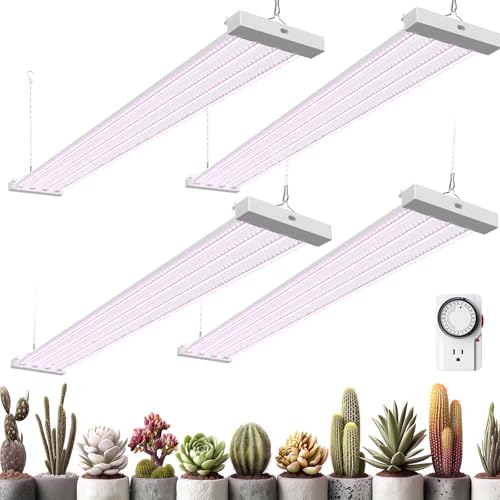
Barrina TX-L84 4FT LED Grow Light 336W

HLG 600 Rspec FR Quantum Board Grow Light

VIIVUU Clip-On Grow Light (White)

AC Infinity Humidity Dome Germination Kit

Kullsinss 3.5in Grow Light 48 LEDs
Why These Options Stand Out
The single-panel Barrina TX-L84 sits in that sweet spot for someone running one or two standard seed trays on a shelf. Its four-panel array spreads PPFD (photosynthetic photon flux density, the light intensity that actually drives leaf growth) evenly across roughly 47 by 20 inches when hung about a foot above the canopy, so seedlings at the edges don’t lag behind the middle.
For most home gardeners starting tomatoes, peppers, or a flat of lettuces indoors in late winter, this kind of coverage means no awkward rotation schedule. The fixture runs cool enough to drop fairly close to delicate cotyledons without scorching them, and the 4-foot body fits standard wire shelving cleanly.
What Earns Its Place
- Four-panel design spreads usable light across a typical 4-foot tray without harsh hot spots in the center.
- Cool-running output lets you lower the fixture close to leggy seedlings and tighten them up fast.
- 84W total draw keeps operating costs modest for the 14 to 16 hours most seedlings need daily.
- Form factor matches common wire racks, so no custom mounting or shelf modifications.
Things To Consider
- At 84W, output drops off at the panel edges, so growers running three or more trays side by side may notice uneven stretch on the outer rows.
- Owners commonly report the included hanging hardware is basic; chain or rope-ratchet hangers are worth adding for easy height adjustment.
Feature Snapshot
Right Fit For
First-time seed starters and casual gardeners running a single 4-foot shelf of trays through spring.
Where Another Pick Suits Better
Anyone filling a full rack of four or more trays should step up to the Barrina TX-L84 336W for headroom.
If the 84W unit above feels modest next to your seed ambitions, this four-pack configuration cranks out 336W across the same four-panel layout. That’s serious photon delivery for a home setup, enough to push peppers and basil through their slow early stretch without leaning toward the center.
Where the single 84W fixture struggles past two trays, this version keeps PPFD consistent across a full 4-foot shelf. The trade-off shows up on the power bill and the heat signature, both of which you’ll want to think about for a spare bedroom or a closed basement grow.
Benefits That Matter
- 336W total output sustains even growth across a full rack of trays, not just the middle row.
- Same wide-panel geometry as the smaller Barrina, so swapping between the two keeps your mounting setup familiar.
- High output shortens the daily “on” hours needed for stocky seedlings, which helps during long, sunny summer days.
- Scales easily for gardeners who plan to transition seedlings into larger vegetative growth under the same fixture.
Trade Offs
- Heat builds up faster than the 84W version, so spacing above the canopy matters more for sensitive starts.
- Draws meaningfully more power; a dedicated circuit is worth considering if you run it alongside other gear.
- May be overkill for someone only starting a couple of tomato flats.
Made For
Mid-scale gardeners running a 4-foot rack with four or more trays or planning to veg plants past the seedling stage.
Swap It Out When
A windowsill herb gardener will find the VIIVUU clip-on easier to live with than this much output.
The HLG 600 Rspec plays a different game entirely: a quantum board (a flat panel of small, high-efficiency diodes spread across a large surface area) tuned for serious indoor cultivation, with a 600W draw and a dimmer that dials output down to seedling-friendly levels. For someone who starts seeds and then transitions the same space into flowering or fruiting plants, one fixture covers the whole journey.
That flexibility comes at a cost in both dollars and electrical capacity. The Rspec leans on its full-spectrum diode mix, including far-red wavelengths that drive canopy stretch and flowering responses, so the spectrum is broader than the Barrina panels above. Dimming means you can hang it high during germination and bring it down as plants harden off.
Practical Advantages
- Built-in dimmer lets a single fixture handle germination, vegetative growth, and bloom phases in sequence.
- Quantum board design spreads diodes over a wide area, which improves canopy penetration past the seedling stage.
- Full-spectrum output including far-red supports compact, stocky seedlings and transitions cleanly into later stages.
- Mounts over a standard 4 by 4-foot tent footprint, scaling up a small seed operation into a full garden room.
Worth Noting
- At 600W, this unit pulls serious current and runs hot; you need a dedicated circuit and active airflow in a tent.
- Heavy frame requires sturdy hanging hardware, and owners commonly upgrade to ratchet hangers.
- Massive overkill if the only goal is starting a flat of marigolds.
Quick Facts
Who It Suits Best
Experienced growers who want one fixture to span seed-starting through flowering under a 4×4 tent.
Consider Something Else When
Someone starting only a tray or two will get more value from the Barrina TX-L84 84W, or even the VIIVUU clip-on.
Not every seed-starting project deserves a 4-foot shop light, and the VIIVUU clip-on is built for the opposite end of the scale. It clamps onto a pot rim or desk edge, throws light across a small footprint, and disappears when not in use, which matters in a living space where a full rack would feel intrusive.
The trade-off is coverage: a single clip-on won’t sustain more than a few seedlings at once, so think of this as a windowsill herb helper or a starter for one or two precious varieties. In return, you get pinpoint placement and no shelf modifications.
What Pays Off
- Compact clamp head attaches to pots, shelves, or desk edges without tools or a dedicated rack.
- Goes anywhere a household outlet reaches, so it’s friendly to renters and small apartments.
- Lightweight hollow head keeps the clamp from drifting, even on thinner pot rims.
A Few Limitations
- Covers a very small footprint, so anything beyond two or three seedlings at once gets uneven light.
- Clip may need padding on delicate finishes; owners commonly add a thin cloth strip to protect wood.
Best Suited To
Apartment growers, renters, and anyone nurturing a small herb cluster on a kitchen shelf.
A Better Fit Elsewhere
The Kullsinss halo light gives a tidier desktop look, while the Barrina panels suit anyone running real tray volume.
This one isn’t a light at all, and that’s the point. The AC Infinity Humidity Dome is the missing piece many first-timers don’t realize they need: a 3mm thick clear dome that locks moisture around a seedling tray while adjustable vents let you bleed off humidity as the sprouts toughen up. Pair it with any of the lights above and germination rates climb dramatically.
The included 5×8-cell tray holds up to 40 seedlings, and the dome’s rigidity means it survives a season or two of handling without clouding. Beginners in particular benefit from the controlled environment, since home humidity swings wildly between winter heating and summer air conditioning.
Real Benefits
- 3mm thick clear dome resists cracking and yellowing far better than the thin plastic off-brand kits ship with.
- Adjustable vents let you taper humidity as seedlings mature, training them for ambient room air gradually.
- 5×8 seedling tray supports a meaningful batch of starts without dominating a shelf.
- Extension panels raise the dome height for taller varieties before transplant.
Softer Spots
- Dome alone won’t germinate seeds; you’ll still need a light source from the picks above.
- Condensation can drip back onto seedlings if vents stay fully closed; owners commonly crack a vent from day one.
Perfect Match For
First-time starters working through inconsistent indoor humidity who want a forgiving germination setup.
Reach For A Different Pick When
Anyone starting only a couple of seeds in a single pot may find the AC Infinity tray larger than needed.
The Kullsinss halo grow light is the smallest footprint on this list: a 3.5-inch ring that sits on a detachable base or stakes directly into soil. Forty-eight diodes spread across that ring cover wavelengths from roughly 380 to 760 nanometers, which is the visible band of light chlorophyll uses most efficiently.
That dual mounting option separates it from the VIIVUU clip-on above. Where a clamp needs an edge to grip, the Kullsinss base just needs a flat spot on a shelf, and the soil-stake option lets it ride along as a plant grows. It’s the right tool for a single specimen that needs a steady light bath without rewiring your living room.
Standout Benefits
- Detachable base plus soil-stake option lets the light move with the plant as it grows.
- 48-LED halo shape distributes light evenly around a single pot rather than from one side.
- Compact 3.5-inch footprint fits on desks, plant shelves, and tight windowsills without crowding the room.
- Full-spectrum diode range covers the wavelengths chlorophyll responds to most strongly.
Possible Compromises
- Single-pot scope means it can’t replace a panel light for tray-scale seed starting.
- Owners commonly find the soil stake a bit short for taller pots, so a small extension may be needed.
Whose Shelf It Belongs On
Houseplant parents tending one or two high-value specimens on a desk or shelf where a tray light would be overkill.
Skip It When
Anyone planning a vegetable seed-starting operation will want the Barrina TX-L84 84W instead.
What Matters Most Before Choosing Grow Lights For Starting Seeds
Match Wattage To Tray Volume
The single biggest mistake is under-sizing wattage for the number of trays you’re running. A single 84W panel handles one or two 10×20 trays comfortably, but stretch that across four trays and edge seedlings lean hard toward the brightest spot. Measure your shelf footprint, count your trays, then pick wattage that delivers roughly 25 to 40 watts per square foot for stocky, compact growth.
Watch The Spectrum, Not Just The Wattage
Full-spectrum LED output covers the wavelengths chlorophyll actually uses, including blues for compact vegetative growth and reds that drive flowering later. Seedlings don’t need a fancy spectrum to germinate, but a balanced full-spectrum diode mix keeps them from stretching during the early weeks when most legginess happens.
Plan For Heat And Hanging
Higher-wattage fixtures throw real heat, and seedlings burn faster than mature plants. Pick a light with a dimmer if you want one fixture to span seedling and later stages, and budget for ratchet hangers so you can adjust height as the canopy rises. A few extra dollars in hardware saves a flat of scorched tomatoes.
Consider A Humidity Dome For Germination
Light alone doesn’t get seeds out of the ground. A humidity dome, like the AC Infinity kit, holds moisture around the seed long enough to trigger reliable germination, then vents off gradually as seedlings toughen up. For beginners, the dome often does more for success rates than upgrading the light itself.
Key Considerations Across These Picks
Where Shoppers Go Wrong
The most common trap is buying a cheap full-spectrum panel without checking the actual diode count or coverage area. A fixture can claim full spectrum and still throw mostly yellow-green light that plants don’t use efficiently. Look at the manufacturer’s specified coverage at a given hanging height and assume the edge of that coverage is weaker than the middle.
Where The Extra Money Goes
Stepping from the 84W Barrina to the 336W version, or to the HLG quantum board, pays for higher diode density, better thermal management, and longer the lifespans. Quantum boards in particular spread diodes across a broad panel for better canopy penetration, which matters once seedlings push past the cotyledon stage into true leaves. For a casual spring seed start, the 84W Barrina is plenty. For year-round serious growing, the upgrade pays back in yield and consistency.
Frequently Asked Questions
How close should a grow light hang above seedlings?
Most LED panels work well hung about 8 to 12 inches above the canopy for the first week or two, then lowered to 4 to 6 inches as seedlings strengthen. Watch for bleaching or downward leaf curl, both signs the light is too close.
Do seedlings need a full-spectrum light to germinate?
Seeds germinate on moisture and warmth, not light, but they need strong, balanced light within a day or two of emerging to avoid stretching. Full-spectrum LED is the easiest way to cover both vegetative and eventual flowering needs with one fixture.
How many hours per day should seed-starting lights stay on?
Sixteen to eighteen hours is a common range for indoor seedlings, with a true dark period each night to let the plants rest. A simple outlet timer keeps the schedule consistent without manual effort.
Can I use a regular shop light for starting seeds?
Cool-white fluorescent shop lights work for germination and early growth, though they lack the red wavelengths that drive stocky, compact seedlings. Full-spectrum LED panels are a meaningful upgrade if you’re starting more than a single tray.
Is a humidity dome necessary for germination?
Not strictly, but a dome dramatically improves consistency by holding moisture around the seed coat, especially in dry indoor air. For beginners, a kit like the AC Infinity setup removes a lot of guesswork.
Wrap Up
The right grow light for starting seeds depends entirely on how many trays you run and where you put them. A 4-foot panel like the Barrina TX-L84 covers most home gardeners well, while a quantum board suits someone building toward a full indoor garden. Add a humidity dome for germination reliability, and you’ll spend less time replanting and more time hardening off sturdy, compact seedlings ready for the garden.