

There’s something quietly satisfying about walking up to a backyard that glows along the fence line. The right fence lights do double duty: they give you a safe path after dusk, and they make a plain yard feel finished. I put this list together for homeowners who want that “glow-on-a-timer” effect without running wire, trenching, or hiring an electrician. Most of these are solar, a couple are low-voltage wired, and every pick is weather-rated for real outdoor life.
The Picks In Brief
Nibuuecer Solar Fence Lights 8 Pack Motion Sensor

LEONLITE 6-Pack 3000K LED Deck Lights Bronze
Nibuuecer Solar Fence Lights 8 Pack RGB 11 Modes

JOFIOS Solar Fence Lights 12 Pack 50 Lumens RGB

Nibuuecer Solar Fence Lights 8 Pack RGB with Remote

Soiarllt Solar Fence Lights 4 Pack Warm White + RGB
Ellasay 360° Solar Fence Lights 4 Pack

UGDLUCK Solar Fence Lights 16 Pack 100 Lumens
JOFIOS Solar Fence Lights 12 Pack White Shell
What Each Pick Brings To The Table
I tend to think of motion-sensor fence lights as the practical cousin of pure decorative models, useful when the path matters more than the vibe. This nibuuecer set ships eight units and runs on 3000K warm white output (a soft yellowish tone that flatters skin tones and wood alike), with a wide flood-style beam and a dusk-to-dawn mode that automatically powers the lights on when ambient light drops.
Three selectable modes let the lights dim steadily all night, brighten on motion, or stay on a fixed glow. The IP65 rating (a standard that means resistance to dust and low-pressure water jets) covers most rain and sprinkler splash, and the casing is built for outdoor mounting on wood, vinyl, or masonry posts.
The Upside
- Motion mode acts as a gentle security cue at side gates and driveway entries
- Warm 3000K reads as a porch-style bulb, not a harsh security flood
- Eight lights cover a typical 40 to 60 foot fence run without skimping
- IP65 rating handles rain and seasonal sprinkler drift
Things To Consider
- Solar panels need direct midday sun to fully charge in winter, so north-facing fences may underperform
- Warm white only: no color-changing modes for holidays or parties
Who It Suits Best
Homeowners with a shaded-side driveway who want set-and-forget lighting that doubles as a subtle welcome cue.
Consider Something Else When
The Nibuuecer Solar Fence Lights 8 Pack RGB 11 Modes fits better if you want festive color cycles for backyard parties.
Most solar fence lights want to disappear into the background. The LEONLITE bronze deck lights do the opposite: they make a statement. Built from die-cast aluminum with an oil-rubbed bronze finish, each unit pushes a starburst-style ray of 3000K warm white light through a clear lens, the kind of pattern that turns a plain stair riser into a deliberate design choice.
These are hardwired low-voltage fixtures (typically 12V DC, meaning they run on a transformer rather than household mains), so they belong in projects where a transformer and wire run are already on the table: new deck builds, remodeled staircases, or landscape refreshes with a planned lighting circuit. Compared to the nibuuecer solar set above, this is the look-first option.
The Case For It
- Aluminum body with bronze finish reads as architectural, not plastic
- Distinctive ray-style lens turns each step into a design element
- Hardwired reliability means no cloudy-day dimming
Worth Noting
- Requires a low-voltage transformer and wiring, which raises install effort and total project scope
- Only six fixtures, so longer fences may need additional packs
- Bronze tone may clash with white or gray rail systems
Key Specs
Made For
Homeowners mid-renovation who are already planning a low-voltage landscape lighting circuit and want a finished, architectural look on stairs or rail posts.
A Better Fit Elsewhere
The Nibuuecer Solar Fence Lights 8 Pack Motion Sensor works better for anyone who wants to skip wiring entirely.
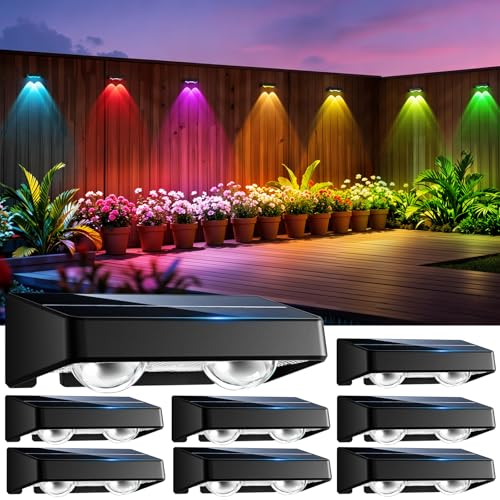
For most of the year, plain warm white fence lighting is exactly right. But then there’s a birthday, a graduation, a pool party, and suddenly you want the fence to match the moment. This nibuuecer 8-pack leans into that use case, offering nine solid colors and eleven total modes, including breathing and flashing RGB cycles.
The trade-off versus the motion-sensor nibuuecer set reviewed earlier is that mode changes happen via a small button on each fixture rather than a remote. That means a quick climb for color swaps. The IP65 rating matches the rest of the field, and the lights run on the same dusk-to-dawn logic.
Features That Help
- Nine solid color choices plus two animated RGB patterns cover most holidays and party themes
- Color-changing variety transforms a plain fence into event-ready decor without extra spend
- IP65 weather sealing matches the rest of the nibuuecer solar family
Trade Offs
- Mode changes require pressing a button on each light, so tall fences mean repeated ladder trips
- Color variety invites more visible wiring choices and placement decisions than a warm-white-only setup
Best Suited To
Hosts who host often, pool owners, and families who decorate seasonally and want a fence that follows the calendar.
Look Elsewhere When
The Nibuuecer Solar Fence Lights 8 Pack RGB with Remote makes more sense if climbing a ladder for every color change sounds tedious.
Twelve lights is the magic number for most backyard perimeters. The JOFIOS 12-pack splits the difference between the smaller nibuuecer sets and the giant UGDLUCK 16-pack reviewed later, giving you enough fixtures to wrap a typical suburban lot without leaving dark gaps. Each light outputs 50 lumens (a measure of visible light brightness), which is gentle rather than stadium-flood bright, and the upgraded dual-lens design focuses the beam for tighter, more defined posts of color.
Twelve lighting modes span warm white, cool white, and a broad RGB palette. Like the nibuuecer color set above, mode changes happen on the fixture itself, so the trade-off is the same: no remote.
Everyday Advantages
- Twelve lights cover most fence runs without leaving noticeable gaps
- Dual-lens design concentrates brightness into a tighter, more defined beam
- 12-mode flexibility covers both everyday white and themed color nights
Honest Caveats
- 50 lumens is gentle, not bright: not the right pick for security-style flood lighting
- Mode cycling requires manual button presses on each unit
- Solar charging relies on full-sun mounting positions for the included panels
Who Will Love This
First-time fence-light shoppers who want enough fixtures to do the whole yard in one order without going premium.
Not Your Match When
The UGDLUCK Solar Fence Lights 16 Pack 100 Lumens fits better if you want more lights and roughly double the brightness per fixture.
The single biggest complaint I hear about RGB solar fence lights is the climb. You finally hang them at the top of a six-foot privacy fence, and then changing from “soft purple” to “warm white” means hauling a ladder out from the garage. This nibuuecer set solves that pain point with a handheld remote that handles colors and modes from the ground.
Otherwise, the spec sheet mirrors the nibuuecer 8-pack RGB reviewed earlier: nine solid colors, eleven total modes, IP65 weather sealing, and dusk-to-dawn automatic activation. For tall fences, second-story mounting, or anyone who simply values convenience, the remote is the upgrade that earns its keep.
Well-Handled Touches
- Remote control turns color and mode changes into a 10-second task from the patio
- Eleven total modes cover holidays, parties, and everyday warm-white use
- Same 9-color palette and IP65 build as the rest of the nibuuecer solar family
Small Caveats
- Remote is small and easy to misplace near garden beds or pool decks
- Solar panels still need decent daytime sun, just like the no-remote nibuuecer set
Perfect Match For
Homeowners with tall fences, high posts, or any setup where a ladder trip would be a real hassle.
Swap It Out When
The Nibuuecer Solar Fence Lights 8 Pack Motion Sensor makes more sense for purely functional, warm-white-only setups where color changes don’t matter.
Not every fence needs sixteen lights. Apartment balconies, side-yard gates, short porch rails, and small patios usually need four fixtures, and that’s it. Soiarllt’s 4-pack is built for exactly that scope, with three LEDs per fixture that handle warm white plus a handful of RGB color modes.
The included mode count sits between the JOFIOS 12-mode range and simpler warm-white-only sets, so there’s enough variety for a holiday accent without overwhelming first-time users. The IP65 weather sealing matches the rest of the field, and the dusk-to-dawn sensor handles on/off without any programming.
The Helpful Details
- Right-sized four-pack for small patios and porch rails without overbuying
- Warm white default plus RGB accent keeps daily use simple
- Same IP65 and dusk-to-dawn fundamentals as the larger solar sets
Points To Note
- Only four fixtures, so longer fence lines will need additional packs
- Smaller per-fixture LED count than the larger JOFIOS or UGDLUCK sets
Who Should Grab It
Renters, apartment dwellers, and homeowners with a short fence section who want a small, neat solar install.
Reach For A Different Pick When
The JOFIOS Solar Fence Lights 12 Pack 50 Lumens RGB fits better if your fence run is longer than 30 feet.
Most fence lights throw a beam in one direction, usually down. The Ellasay set flips that idea on its head with a circular dual-beam design that washes light up and down at the same time, producing a soft 360° halo on the wall surface behind the fixture. The advertised 12-hour runtime suggests an efficient LED-and-solar pairing for full-night coverage.
Three selectable modes keep things simple, and the focused lens design directs the up and down beams into clean ovals rather than scattered splashes. For accent walls, pillars, and entryway columns, the up-and-down wash tends to read more “designed” than a single-direction spot.
Positive Points
- Up-and-down dual beam creates a soft halo effect on accent walls and pillars
- 360° wash style works on flat walls, columns, and posts alike
- Three-mode operation keeps daily use simple for non-tinkerers
Areas To Watch
- Up-and-down beam style may wash out on very textured stone or brick walls
- Only four fixtures, so large installations will require multiple packs
Feature Snapshot
Right Fit For
Design-minded homeowners with feature walls, columns, or entry pillars who want the fixture itself to be part of the look.
Where A Sibling Pick Shines
The Nibuuecer Solar Fence Lights 8 Pack Motion Sensor makes more sense for long fence runs where directional task lighting matters more than decorative halos.
There’s a moment when planning fence lighting where “more lights” stops being a luxury and starts being a necessity. Big yards, long perimeter walls, pool surrounds, and properties with detached structures all benefit from a 16-pack, and the UGDLUCK set delivers that scale with a 100-lumen-per-fixture output, the brightest single-fixture number on this list.
Modes include warm white plus three solid colors and a breathing RGB cycle. The up-and-down beam style works well on tall walls, where lighting the surface above the fence line adds a sense of height and depth. For most backyards, sixteen is generous; for large properties, it’s the right call.
Good Reasons To Consider
- Sixteen lights cover large perimeters in a single purchase
- 100 lumens per fixture is the brightest output in this roundup
- Up-and-down beam pattern reads well on tall privacy walls
Factors To Consider
- Sixteen fixtures mean more upfront installation time per mount
- Higher lumen count can read as too bright in small yards or close to bedrooms
- Solar panels on this many fixtures need real sun exposure across the whole run
Best Suited To
Owners of bigger properties, long driveways, and tall perimeter walls who want full coverage from a single order.
Skip It When
The Soiarllt Solar Fence Lights 4 Pack Warm White + RGB works better for compact spaces where 16 lights would feel like over-lighting.
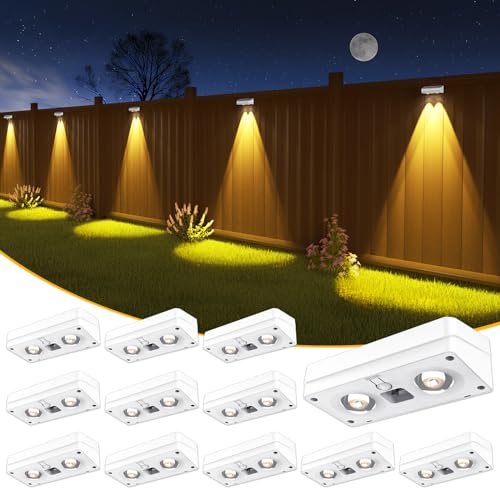
If the standard black solar fence light looks too heavy against white trim, vinyl rails, or modern coastal exteriors, a white-shell variant quietly fixes the problem. JOFIOS offers its 12-pack RGB color set in a white-housing version that disappears into pale siding and painted fences far better than black or bronze alternatives.
Spec-wise, it matches the earlier JOFIOS 12-pack: 50 lumens per fixture, twelve lighting modes, dual-lens focus design, and the same button-on-fixture mode cycling. The shell finish is the difference, and for the right home, that finish is everything.
The Good Stuff
- White housing blends cleanly with pale trim, vinyl, and coastal-style exteriors
- Twelve-mode flexibility matches the standard black JOFIOS set
- Twelve fixtures cover most mid-sized fence runs in one order
Possible Compromises
- White shells can show dust and pollen more visibly than black or bronze versions, so seasonal wipe-downs tend to matter
- Same 50-lumen gentle output, so not the choice for anyone needing bright flood-style lighting
Whose Shelf It Belongs On
Homeowners with white siding, painted fences, or modern coastal aesthetics who want the fixture body itself to disappear into the background.
Where Another Pick Suits Better
The LEONLITE 6-Pack 3000K LED Deck Lights Bronze suits projects where a real bronze architectural fixture is part of the plan.
Picking Fence Lights That Actually Fit Your Yard
Match Solar Or Wired To Your Project
Solar fence lights win on install speed: no transformer, no wire, no electrician. Wired low-voltage lights (like the LEONLITE deck set) win on consistency: same brightness at 6 PM and 2 AM, every night, regardless of cloud cover. For a rental, a weekend project, or any fence where running cable is impractical, solar is the right answer. For new construction, deck rebuilds, or projects with a transformer already in play, hardwired still has a real edge in output stability and finish quality.
Lumens And Beam Shape Decide The Vibe
Lumens (a unit that measures visible light output to the eye) tell you how bright a fixture is, but beam shape tells you what that brightness feels like. A 50-lumen spotlight reads as a soft accent; a 100-lumen floodlight reads as task lighting. Up-and-down beams (like the UGDLUCK or Ellasay sets) wash a wall; directional beams (like the JOFIOS dual-lens design) focus on a single post or panel. For ambient curb appeal, lower-lumen wider-beam fixtures usually feel more “designed.” For safety along paths, more lumens and a tighter beam work better.
Color Modes Only Matter If You’ll Use Them
RGB color-changing modes sound fun in the description, but many homeowners end up leaving the lights on warm white 90% of the time. RGB adds cost and complexity. If you genuinely host often, decorate for holidays, or want pool-party color, an RGB set pays off. If you want a quiet, classic glow at the end of each day, a warm-white-only setup is plenty.
Weather Rating And Sun Exposure Go Together
IP65 (the “Ingress Protection” standard rating dust-tight and resistant to water jets) covers most rain and sprinkler splash across this list, but solar charging still depends on real sun. North-facing fences, deep shade under trees, and fences shadowed by the house will all charge less reliably in winter. Run a quick mental check of where the solar panel actually sits before you commit to a pack size. A 16-pack with half the panels in shade is worse than a 12-pack with all panels in direct light.
What Most People Overlook Before Buying
Pitfalls Shoppers Hit
The biggest mistake I see is buying a 16-pack for a 20-foot fence and ending up with overlapping glows and washed-out color. Smaller yards benefit more from fewer, well-spaced fixtures. The opposite mistake, buying a 4-pack for a 100-foot perimeter, leaves long dark stretches between lights. Measure the fence run first, then size the pack. Most suburban lots land at eight to twelve fixtures, not four and not sixteen.
Where The Extra Money Goes
Stepping up from a basic warm-white solar set to a feature-rich RGB remote-controlled set typically pays for a color-changing LED array, a remote receiver, more solar panel surface area per fixture, and tighter weather sealing. The upgrade is worth it for hosts, holiday decorators, and anyone with tall fences where ladder climbs are real. For a quiet side yard that just needs a soft warm glow at dusk, the premium tier mostly adds features that sit unused.