

Candelabra sockets show up in the spots where ordinary A19 bulbs look out of place: dining chandeliers, vintage wall sconces, ceiling fans, and decorative lanterns. I put together this list because picking a smart bulb for those tiny bases is genuinely different from shopping for a lamp socket. The shape, heat dissipation, and dimming range all behave differently at E12, and the wrong choice can leave you with flicker, dim spots, or an app that simply refuses to pair. The ten options below cover the main use cases I hear about most: quiet white-only setups, full color-changing moods, Matter-ready gear, and budget packs for multi-socket fixtures.
A Side-By-Side Look
Philips Hue White B39 Candle E12 (2-Pack)

Linkind Smart Light Stick E26 (T19)
Philips Hue Color B39 Candle E12

HEKEE E12 RGB Candelabra (4-Pack)
Linkind Matter Smart Bulbs (Dual-Band)

Lightinginside E12 Smart Bulbs 4-Pack
Lightinginside E12 Smart 4-Pack

Lightinginside E12 Smart 3-Pack

Linkind Smart Bulbs (AiDot App)
Philips Smart B12 Candle Color (4-Pack)
The Details Behind The Selections
For a dining chandelier or a pair of bedside sconces where warm white is all I ever want, this Philips Hue White B39 candle shape keeps things beautifully simple. The flame-tip silhouette matches traditional candelabra glass, so it disappears into the fixture the way an incandescent used to. At roughly 450 lumens per bulb, it lands in the comfortable zone for accent lighting: enough to read by in a sconce, soft enough not to glare in a chandelier.
The Hue ecosystem is mature, which is the real reason I lean on this pick. Bluetooth pairing is instant for nearby control, and adding the Hue Bridge later unlocks automations, remote access, and Matter bridging to platforms the bulb wouldn’t otherwise talk to. For households already invested in Hue, this 2-pack slots in with zero friction. For everyone else, it costs a bit more than no-name alternatives, and you may find the white-only limitation frustrating once you start dreaming in color.
Benefits That Matter
- Soft warm white color temperature suited to dining rooms and entryways
- Candle-shape form factor fits traditional decorative fixtures without looking modern
- Smooth dimming through the Hue app, voice assistants, or Hue dimmer switches
- Bluetooth control works immediately without buying a hub, with Bridge as an upgrade path
Things To Consider
- White-only spectrum: no color scenes for holidays or movie nights
- Hue Bridge sold separately if you want remote control and automations
- Costs more per bulb than budget E12 packs on this list
Who It Suits Best
Homeowners decorating with traditional chandeliers who want clean warm white control and plan to expand into the Hue system.
Where Another Pick Suits Better
Color lovers should grab the Philips Hue Color B39 candle instead, since it shares the same ecosystem and adds a full RGB spectrum for about the same form factor.
Before I get into the review, a quick honest note: this Linkind stick runs on an E26 base, not E12, so it’s the odd one out in a candelabra roundup. I included it because some readers search “E12 smart bulbs” while actually needing an E26 stick form factor for a fixture where the bulb hangs exposed, like a pendant or a bare-socket wall lamp. At 850 lumens, this one is meaningfully brighter than the candle-shaped options, which matters when you want a single fixture to anchor a room rather than act as accent lighting.
The T19 tube shape, roughly 57 mm wide by 131 mm tall, gives it a modern silhouette that looks intentional in industrial pendants. It pairs over 2.4 GHz Wi-Fi only and stays clear of the 5 GHz band, which is fine on most home networks but worth knowing. Owners commonly report clean pairing through the AiDot app, and the bulb does both tunable color temperature and RGB color. The trade-off is compatibility: it’s not designed to play with Tuya or Smart Life, and pairing it with an existing in-wall dimmer can cause flicker or buzzing.
Strengths Worth Knowing
- 850 lumen output is significantly brighter than typical E12 candle bulbs
- Combined RGB color and tunable white in a single fixture-friendly stick
- Voice control through Alexa and Google once paired via AiDot
- Standard E26 base fits most common ceiling and pendant sockets
Worth Noting
- E26 base, not E12: verify your socket before buying
- 2.4 GHz Wi-Fi only; not compatible with 5 GHz routers set to separate bands
- Not compatible with Tuya or Smart Life ecosystems
- Traditional dimmer switches may cause flicker or buzzing
Made For
Anyone modernizing a pendant or exposed-socket fixture where the bulb shape itself is part of the look and a brighter output is needed.
Consider Something Else When
True candelabra fixtures call for the HEKEE 4-pack or the Lightinginside candelabra set, both of which match the small E12 sockets that this bulb won’t fit.
This is the bulb I reach for when a chandelier is doing double duty: dinner parties on Saturday, spooky lighting for the kids on Sunday. The Philips Hue White and Color Ambiance B39 candle delivers millions of color shades plus a tunable white range from warm to cool, all from the same E12 candelabra base. The 450 lumen output matches the white-only version I covered earlier, so swapping between the two across a single fixture keeps brightness consistent.
Pairing it is identical to the white-only candle, which means instant Bluetooth control and an optional Bridge upgrade for automations, remote access, and Matter bridging. The 9-watt draw sits cool enough for enclosed candle sleeves in most chandeliers, which extends bulb life in tight glass. You may find the price tag harder to swallow than a budget RGB pack, and the 1-pack count means a six-arm chandelier adds up fast.
The Practical Payoff
- Full color spectrum plus tunable warm-to-cool white in one bulb
- Same Hue ecosystem compatibility as the white-only version above
- Matter compatibility when paired through a Hue Bridge
- Smooth dimming down to very low levels for mood scenes
Trade Offs
- Single-bulb pack means multi-arm fixtures get expensive
- Hue Bridge required for remote control and advanced automations
- Costs meaningfully more than non-name RGB E12 alternatives
Best Suited To
Households already running Hue gear who want a candle-shaped bulb that can switch from soft dinner warm to full color on demand.
Look Elsewhere When
Budget-focused shoppers outfitting a ceiling fan with multiple bulbs should consider the Lightinginside E12 Smart 4-Pack, which trades the Hue polish for a much lower per-bulb cost.
Sometimes I just want a ceiling fan to switch from warm light to a slow color fade without dragging a phone out of my pocket. The HEKEE E12 RGB candelabra pack handles that case cleanly. It uses a handheld infrared remote rather than a smartphone app, which removes the Wi-Fi setup step entirely and keeps everything plug-and-play. The 270-degree beam angle spreads light evenly across a four-blade ceiling fan without leaving dark spots between arms.
Twelve RGB color options plus a 2700K warm white mode give this pack more versatility than its budget price suggests. Three brightness levels and a built-in timer round out the remote functions for everyday routines. At 450 lumens per bulb, the output sits in the accent range, so it works best where the fixture is meant to set mood rather than light a work surface. One practical note: owners commonly report that the included remote needs a clear line of sight to the bulb, so enclosed fixtures can limit control.
Positive Takeaways
- Remote-controlled color and brightness with zero hub or app needed
- 12 RGB colors plus a dedicated 2700K warm white for daily use
- 270-degree beam angle suits wide ceiling fan fixtures
- Built-in timer adds hands-off convenience for bedtime routines
Points To Keep In Mind
- Remote relies on infrared line of sight; enclosed shades can block the signal
- No smartphone app or voice assistant integration
- 450 lumen output is accent-grade, not primary room lighting
Perfect Match For
Renters and beginners who want a simple, app-free color option for a chandelier, ceiling fan, or plug-in wall sconce.
Skip It When
Voice control and automations matter to your routine, in which case the Lightinginside E12 Smart Bulbs pair more naturally with Alexa and Google Home.
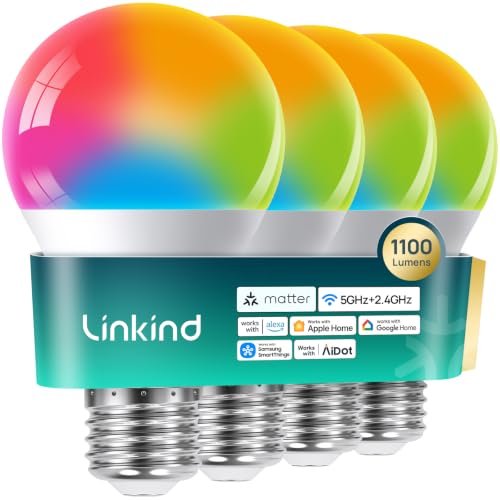
Most smart bulbs only speak 2.4 GHz Wi-Fi, and on a crowded network that translates to laggy responses when someone kicks off a gaming session or starts streaming 4K. The Linkind Matter Smart Bulbs support dual-band 2.4 GHz and 5 GHz Wi-Fi 6, which the brand positions for households with 50-plus connected devices where the 2.4 GHz band is starting to bottleneck. In real terms, the bulb responds faster to commands and stays connected more reliably during heavy network traffic.
The 1000 to 20000K color temperature range goes well past what most home users need, but it does mean the bulb covers everything from a candle-warm glow to a stark cool white. Matter compatibility is the bigger story: this bulb pairs with Apple Home, Alexa, and Google Home through a Matter controller without locking you into one app. The catch is that 5 GHz Wi-Fi 6 home networks are still rare, so most households will only benefit from the 2.4 GHz fallback.
The Upside
- Dual-band 2.4 GHz and 5 GHz Wi-Fi 6 for faster response on busy networks
- Matter support works across Apple Home, Alexa, and Google Home
- Extra-wide color temperature range from warm glow to cool daylight
- Strong fit for smart homes already running a Matter controller
Honest Caveats
- 5 GHz Wi-Fi 6 benefits require a compatible home router
- Matter controller hub is still needed for the full cross-platform experience
- Newer to market, with less long-term user feedback than Philips Hue
The Right Fit
Smart home enthusiasts with modern dual-band routers who are already running a Matter controller and want a future-proof bulb.
Reach For A Different Pick When
Simpler households just getting started should consider the Linkind Smart Bulbs AiDot version, which uses a friendlier app and skips the Matter learning curve.
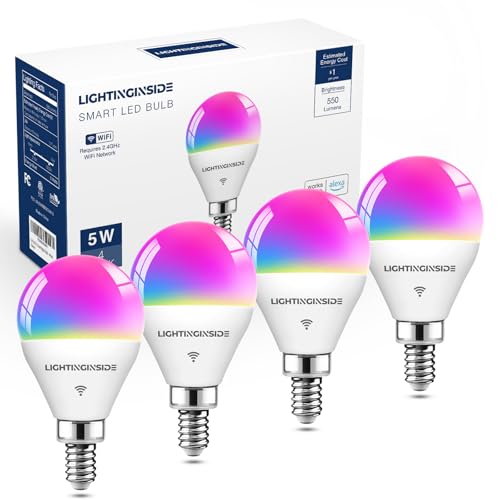
Wi-Fi outages used to mean smart bulbs became dead plastic cylinders, but the Lightinginside E12 Smart 4-Pack pairs Bluetooth Low Energy as a backup channel, so you can still flip the lights on and off locally even when the router goes down. The second-generation BLE and Wi-Fi dual-channel chip speeds up the initial pairing process, which makes a difference on a 4-pack where sitting through four slow setups gets old fast.
Each bulb is marketed as a 60-watt equivalent, which lands them firmly in room-filling territory rather than accent lighting. Once paired through the SmartLife app, they connect to Alexa and Google Assistant for hands-free control. The 4-pack count is the practical sweet spot for a dining chandelier or a ceiling fan with four arms. You may find the SmartLife app less polished than Hue, and grouping all four bulbs into a single room command sometimes takes a second attempt on first pairing.
Reasons It Performs
- BLE fallback keeps control working during Wi-Fi outages
- 60W equivalent output bright enough for primary room lighting
- Faster pairing thanks to the upgraded dual-channel chip
- Voice control through Alexa and Google Home via SmartLife
A Few Limitations
- SmartLife app is less refined than Hue or Apple Home
- Initial room grouping can take an extra attempt on first setup
- Color and white tuning details vary depending on firmware version
Who Should Grab It
Multi-socket room refreshes where reliable local control matters more than app polish and four bulbs cover the fixture.
Another Choice May Suit When
A smaller 3-pack is enough for a tighter fixture, in which case the Lightinginside E12 Smart 3-Pack covers the same feature set at a lower count.
The second-generation BLE plus Wi-Fi dual-channel chip is the headline feature here, because setup speed matters more than spec sheets admit. The brand markets pairing up to three times faster than the first generation, which on a 4-pack turns a 20-minute setup chore into something closer to a coffee break. Once paired, the bulbs support flexible configuration that switches between local BLE control and Wi-Fi control depending on whether you are home or away.
Voice control through Alexa and Google Assistant is straightforward through the SmartLife app, and the bulbs pair with the same SmartLife ecosystem as the 60W version above. The honest difference between the two Lightinginside 4-packs is mostly marketing and packaging rather than core features, so the choice comes down to which output wattage your fixtures call for. You may find SmartLife still lags behind dedicated Hue or LIFX apps for advanced scene programming, which matters more for users who tinker with custom automations.
A Few Strong Suits
- Noticeably faster pairing thanks to upgraded BLE plus Wi-Fi chip
- Local BLE control plus remote Wi-Fi control when away from home
- Compatible with Alexa and Google Home through SmartLife
- Four-bulb pack covers a standard dining chandelier
Where It May Fall Short
- SmartLife app scene programming is less deep than Hue or LIFX
- Hard to distinguish from the 60W version at a glance
- Full feature set relies on a 2.4 GHz Wi-Fi network
Whose Shelf It Belongs On
Anyone outfitting a frequently used chandelier who values quick setup and reliable voice control over advanced scene programming.
Swap It Out When
Color scenes and advanced automations matter more than setup speed, in which case the Philips Hue Color B39 candle is worth the premium for that one socket.
Not every decorative fixture has four arms, and buying a 4-pack to light a three-arm fixture leaves an orphaned bulb in the drawer. The Lightinginside E12 Smart 3-Pack solves that small but annoying mismatch. It carries the same BLE backup, dual-channel chip, and Alexa plus Google voice control as the 4-pack version covered earlier, just sized for tighter installations like a triple sconce or a three-arm ceiling fixture.
The 60W-equivalent output matches the other Lightinginside smart bulb here, so brightness stays consistent if you mix the two packs across connected rooms. SmartLife pairing, group control, and remote access through Wi-Fi all carry over without surprises. Owners commonly report that the three-bulb group responds well to scene commands once the initial pairing is complete, which depends on your router’s handling of multiple SmartLife devices. You may find the same SmartLife app caveats apply, but the smaller count makes setup feel less overwhelming.
Useful Strengths
- Right-sized 3-pack for three-arm fixtures and tight installations
- BLE fallback keeps control working when Wi-Fi drops
- Voice control through Alexa and Google Home via SmartLife
- 60W equivalent output for room-filling brightness
Some Limits To Know
- Same SmartLife app limitations as the 4-pack version
- Limited to 2.4 GHz Wi-Fi networks
- Final scene performance depends on router handling of multiple SmartLife devices
Built With In Mind
Shoppers with three-arm sconces or smaller ceiling fixtures who want the Lightinginside feature set without paying for an extra bulb.
A Better Fit Elsewhere
Larger fixtures with four or more arms are better served by the Lightinginside E12 Smart 4-Pack, which covers the full chandelier in one purchase.
The Linkind AiDot lineup is what I point people toward when they want app-driven color control without paying Hue prices or wrestling with Matter setup. Pairing happens through the AiDot app in three steps, which feels approachable for first-time smart bulb owners. Once paired, the bulbs integrate with Alexa and Google Home for hands-free voice commands, and the app itself covers routine scenes for cooking, baby care, or remote work scenarios.
No hub is required, which keeps the entry cost low and the setup tidy. The bulbs handle both RGB color and tunable white in a single unit, so most everyday needs are covered in one purchase. In my experience the AiDot app feels less mature than Hue, and grouping bulbs across rooms occasionally needs a manual refresh. For households that mostly want voice control and a few app scenes, those trade-offs rarely matter.
The Helpful Details
- No hub required, which keeps initial cost low
- Alexa and Google Home voice control after AiDot pairing
- Both RGB color and tunable white in a single bulb
- Three-step setup that feels approachable for first-timers
Where It Is Less Suited
- AiDot app is less polished than Hue or Apple Home
- Room grouping sometimes needs a manual refresh after first pairing
- Limited to 2.4 GHz Wi-Fi networks
Who Will Love This
First-time smart bulb owners who want voice control and basic app scenes without paying the Hue premium or learning Matter.
Not Your Match When
Crowded 5 GHz networks and Matter-first households should consider the Linkind Matter dual-band version covered earlier in this list.
The newest Philips candle on the market adds a feature I didn’t know I wanted: motion activation. With at least two Philips smart bulbs on the same Wi-Fi network, one bulb can trigger another when it senses movement, which is a quiet win for hallways and entry fixtures where fumbling for a switch in the dark gets old. The B12 candle shape is a touch slimmer than the older B39 form, so it tucks into narrower glass sleeves more cleanly.
Color spectrum coverage matches the older Hue Color candle covered earlier, with full warm-to-cool white plus RGB. Matter compatibility is now baked in rather than requiring a Bridge upgrade, which simplifies the setup for households already on Matter. The 4-pack count covers most standard chandeliers in one purchase. You may find motion activation more useful in hallways than dining rooms, and the feature needs a second compatible Philips bulb nearby to act as the trigger.
Advantages To Know
- Motion activation triggers another bulb when movement is detected
- Matter compatibility built in without requiring a separate Bridge
- Slimmer B12 shape fits narrower candelabra glass sleeves
- 4-pack count covers a standard chandelier in one purchase
Factors To Consider
- Motion activation needs a second compatible Philips bulb as the trigger
- Higher price point than budget RGB E12 packs
- Newer product with less long-term user feedback than the older Hue candle
Who It Suits Best
Homeowners outfitting a hallway chandelier or entry fixture who want hands-free motion lighting in addition to color scenes.
Where Another Pick Suits Better
Budget-first shoppers outfitting a ceiling fan should consider the Lightinginside E12 Smart 4-Pack, which delivers reliable voice control at a lower per-bulb cost.
What Matters When Choosing E12 Smart Bulbs
The candelabra base looks small but it carries real consequences for both fit and behavior. Three factors tend to decide whether a smart E12 bulb lives up to its promise: the physical shape of the bulb itself, the network protocol it uses to talk to your phone and voice assistants, and whether the bulb plays nicely with the rest of your smart home setup.
Shape, Size, and Heat
Candle-shaped bulbs (often labeled B11, B12, or B39) mimic the flame-tip silhouette of old incandescent chandelier bulbs and slip into most decorative glass sleeves. Stick-shaped smart bulbs, like the Linkind T19 I included earlier, sit taller and look more modern but won’t fit a narrow sleeve. Both form factors run much cooler than old incandescents, but enclosed fixtures can still trap heat, which shortens LED lifespan. For enclosed glass shades, look for bulbs that explicitly mention enclosed-fixture ratings.
Connectivity and Ecosystem
Most smart E12 bulbs pair over 2.4 GHz Wi-Fi, which works on virtually every router but can get crowded in homes with dozens of devices. A few newer options add 5 GHz Wi-Fi 6 support, which helps on busy networks. Bluetooth-only or Bluetooth-with-Wi-Fi bulbs can be controlled locally even when the internet drops, which is the unsung hero of any dependable smart home setup. Voice assistant support typically comes through a third-party app like SmartLife, Hue, or AiDot rather than directly from the bulb.
Color, White, and Dimming
Tunable white covers warm 2700K through cool 6500K shades, which handles most everyday needs. RGB color adds millions of shades for mood scenes and holiday lighting, usually at a modest cost premium. Smooth dimming matters more than people expect; cheap bulbs can flicker at low brightness or step rather than fade continuously. If you plan to use a traditional wall dimmer, confirm compatibility because mixing smart bulbs with in-wall dimmers commonly causes flicker or buzzing.
Pack Size and Long-Term Use
A 4-pack covers a standard dining chandelier, a 3-pack suits three-arm sconces or compact ceiling fans, and a 2-pack or single bulb makes sense for one-off fixtures. Buying a slightly larger pack than you need leaves a spare bulb on hand when one eventually fails, which matters more for installed fixtures where a dead bulb means a ladder. Plan replacement cycles in years rather than months, since LED smart bulbs typically last well past 15,000 hours under normal residential use.
Key Considerations Across These Picks
Where Shoppers Go Wrong
The most common slip is mixing smart bulbs with traditional in-wall dimmer switches. Smart bulbs contain their own dimming electronics, and pairing them with an old dimmer commonly causes flicker, buzzing, or shortened bulb life. The fix is usually a simple one: leave the wall switch on full and use the app or voice for dimming.
Another trap is buying on socket type alone. E12, E26, and B12 versus B39 look similar in photos, but an E26 stick won’t seat in an E12 candelabra socket, and a B39 candle can hang out of a narrow glass sleeve. Always measure the fixture depth and check the bulb dimensions before committing to a multi-pack. Forgetting to confirm Wi-Fi band support (2.4 GHz vs 5 GHz) is the third classic mistake, since some routers push devices onto a 5 GHz band that budget smart bulbs simply cannot see.
Why Top Tier Costs More
The price gap between a budget RGB E12 pack and a premium Philips Hue candle covers more than just the brand name. Premium bulbs tend to offer smoother dimming at the low end, more accurate color rendering, and longer firmware support lifecycles. Matter compatibility, when included, lets a bulb bridge Apple Home, Alexa, and Google Home without locking you into one app, which is a real long-term value if you switch platforms over the bulb’s lifespan.
The trade-off is whether those gains are worth it for your fixtures. A hallway sconce used 30 minutes a day may not justify the Hue premium, while a living-room chandelier you dim nightly for movie scenes feels the difference immediately. Higher-tier picks also tend to include longer warranty windows and more responsive customer support, which matters once a multi-pack has been installed for a few years.
Frequently Asked Questions
Do E12 smart bulbs work with regular dimmer switches?
Most E12 smart bulbs do not pair cleanly with traditional in-wall dimmer switches and can flicker, buzz, or fail prematurely when one is in the circuit. The dependable path is to leave the wall switch on full and dim through the app, voice assistant, or a compatible smart dimmer accessory.
Can I use E12 smart bulbs outdoors?
Indoor-rated E12 smart bulbs should stay indoors because moisture and temperature swings shorten their lifespan quickly. For outdoor fixtures like porch lanterns, look for bulbs explicitly rated for damp or wet locations, and confirm the fixture itself seals around the bulb base.
Do E12 smart bulbs need a hub?
Many do not, since they pair directly through Wi-Fi or Bluetooth to a phone app. Some, like Philips Hue bulbs, offer optional hub upgrades that unlock automations, remote access, and Matter bridging. Whether you need a hub depends on how complex your routines get over time.
Why does my smart bulb flicker at low brightness?
Flickering at low brightness usually points to a few common causes: a mismatched traditional dimmer on the wall circuit, weak Wi-Fi signal reaching the bulb, or a budget bulb with coarse dimming steps. Moving the bulb to a non-dimmer circuit, improving Wi-Fi coverage, or upgrading to a smoother-dimming brand typically resolves it.
How long do E12 smart bulbs typically last?
Under normal residential use, LED E12 smart bulbs commonly last well past 15,000 hours, which translates to many years of typical daily use. Heat trapped in enclosed fixtures shortens that lifespan, so enclosed-rated bulbs in sealed shades tend to outlast generic bulbs in the same spot.
The Takeaway
The right E12 smart bulb depends less on spec sheets and more on the fixture in front of me. For traditional chandeliers where warm white is enough, the Philips Hue White B39 candle is a dependable anchor. For full color in a sconce or fan, the HEKEE RGB pack or the Hue Color candle both earn their place. For Matter-first households, the Linkind dual-band bulb is the future-proof move. Match the bulb to the socket, the network, and the routine you actually run, and the rest tends to take care of itself.