

I built this roundup after weeks of reading grow-light forums and talking with hobbyists running everything from closet veg tents to multi-rack bloom rooms. Commercial LEDs aren’t cheap, so I focused on units that genuinely justify their footprint with real canopy coverage, useful spectrum control, and hardware that holds up to daily cycles. Here are eight options I’d feel confident pointing a serious grower toward.
The Main Contenders

HLG 600 Rspec FR 600W 120V LED Quantum Board Grow Light

VIPARSPECTRA XS1500 Pro LED Grow Light 150W
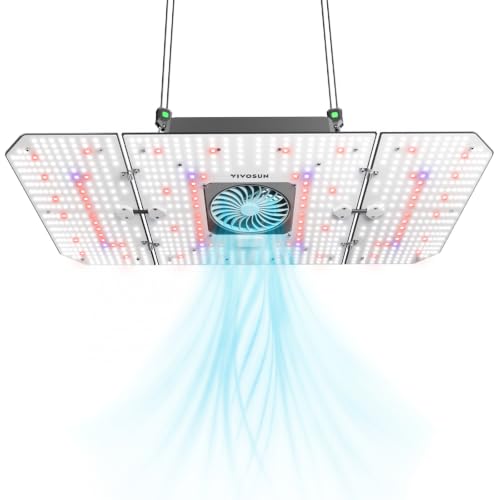
VIVOSUN AeroLight 240W LED Grow Light with Fan

Barrina T5 5000K LED Grow Light 2ft 8-Pack
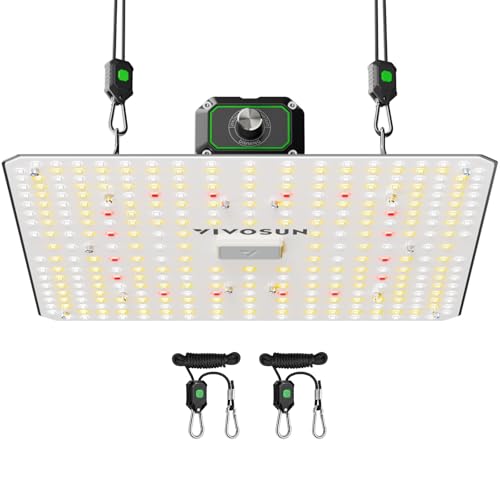
VIVOSUN LumaLight 100W LED Grow Light

Tmsluody 2-Panel Full Spectrum LED Grow Light

VIVOSUN LumaLight 320W LED Grow Light

VIPARSPECTRA 70W Dimmable LED Grow Light
The Picks, Examined More Closely
The HLG 600 Rspec is the workhorse I kept coming back to while researching this list. It uses a quantum board layout (a wide, flat panel populated with densely spaced mid-power diodes) that spreads light evenly across a 4×4 footprint, which makes it a natural fit for the most common tent size in the hobby. The added far-red channel helps steer photomorphogenesis (how plants shape themselves in response to light), nudging flowering behavior in the right direction during the stretch phase.
Where it pulls ahead of most competitors is efficiency, drawing 600W from a standard 120V outlet while producing strong output. For growers who care about the electric bill during long flower cycles, that balance matters. Compared with the panel-style AeroLight that follows, this unit skips active cooling and relies on a passive heatsink, which means quieter operation but slightly more thermal mass to manage in a sealed tent.
Useful Touches
- Full-spectrum output with dedicated 660nm red and far-red channels for canopy penetration
- Dimmable driver lets you dial intensity down during seedling and early veg stages
- Passive heatsink design means no fans to fail in a humid room
- Wide quantum board shape reduces hot spots in a 4×4 compared with bar-style fixtures
Things To Consider
- Larger physical footprint than bar lights, so check tent headroom before mounting
- No onboard fan, so room ventilation becomes more important in warm climates
Who It Suits Best
An intermediate-to-advanced grower who wants a single high-output fixture for a 4×4 flower tent without juggling multiple drivers.
Where Another Pick Suits Better
For growers running a multi-rack bloom room where daisy-chaining dozens of fixtures matters more than raw efficiency, the VIPARSPECTRA XS1500 Pro is a smarter match.
The XS1500 Pro earns its spot on a commercial shortlist because it was designed to be deployed in multiples. The optical lens design focuses each diode’s beam downward, which raises the usable PPFD (photosynthetic photon flux density, the measure of light energy actually reaching the canopy) at the edges of the tent rather than wasting photons on the walls. In practical terms, that translates to more even colas from corner to corner.
The standout feature for anyone scaling up is the dimming daisy chain. Up to 20 fixtures can be linked together for unified dimming, so a single controller sets the intensity for the whole room. Compared with the HLG 600’s single-fixture approach, this one trades top-end raw output for orchestration.
What Makes Sense
- Daisy chain supports up to 20 linked fixtures on one dimmer line
- Optical lenses concentrate light for higher usable PPFD at canopy level
- Lower wattage per unit makes electrical planning across a room simpler
- Full-spectrum output supports both veg and flower without swapping fixtures
Worth Noting
- At 150W, each unit covers a smaller footprint than the HLG 600, so more units are needed per room
- The lens design is precise but slightly raises the cost per watt versus a basic quantum board
Made For
Commercial growers running multi-light rooms who want centralized dimming and consistent canopy coverage across many fixtures.
Consider Something Else When
Solo growers with a single 4×4 tent get more output per dollar from the HLG 600 Rspec than scaling this platform to equivalent coverage.
The AeroLight stands out the moment you see the center-mounted fan. Instead of treating airflow as a separate system, VIVOSUN built circulation directly into the fixture, pulling air down through the canopy. That matters in late flower when dense buds create stagnant microclimates where humidity pockets and mildew love to start.
The light itself uses a tunable spectrum, meaning the recipe shifts between vegetative and flowering modes to match what the plant actually needs at that stage. For a 3×3 or 4×4 tent where one person is running the whole environment, having the fan integrated simplifies the layout. Compared with the HLG 600 Rspec, you trade some efficiency for active climate support.
The Helpful Details
- Built-in fan moves air through the canopy without needing a separate clip fan
- Tunable spectrum adjusts the diode mix for veg versus bloom stages
- 240W output lands in a sweet spot for medium tents
Trade Offs
- The integrated fan is another moving part that can wear out in humid environments
- Quieter than a clip fan but not silent, so noise-sensitive spaces should plan accordingly
Best Suited To
Growers running dense canopies in sealed tents who want to combine lighting and circulation in a single overhead unit.
Look Elsewhere When
Anyone optimizing purely for photosynthetic output per watt should look at the HLG 600 Rspec, which skips the fan for higher efficiency.
The Barrina T5 8-pack solves a different problem than the rest of this list. Instead of one heavy fixture for a flower tent, you get eight slim 2-foot strips that mount side by side across a shelving rack. For propagation, cloning, and early veg, that distributed light profile prevents the leggy stretching you get when seedlings reach sideways toward a single point source.
Each strip pulls about 10W from the wall, so the whole kit runs on standard household circuits. The 5000K white output leans toward the blue end of the spectrum, which keeps vegetative growth compact. Compared with the more intense VIPARSPECTRA XS1500 Pro, this kit trades raw power for layout flexibility across wide, flat trays.
Benefits That Matter
- Eight strips let you cover a full 4-foot shelf evenly with no dead zones
- Plug-and-play links chain multiple bars from a single outlet
- Low wattage per strip means cheap, continuous operation for long seedling cycles
- Slim aluminum housing fits into tight shelf gaps most panel lights cannot
Points To Note
- Not intense enough for flowering; these are a veg-stage tool, not a bloom solution
- Eight separate fixtures mean more cords to manage around a wet propagation area
Who Will Love This
Propagators and microgreens growers running multi-tier shelves where uniform low-intensity coverage matters more than per-strip power.
A Better Fit Elsewhere
For a dedicated bloom tent, the VIVOSUN LumaLight 320W brings far more intensity to the canopy than any T5 strip setup.
The LumaLight 100W is the kind of fixture that disappears into a small setup. Its diode mix uses 3000K warm white, 5000K cool white, 660nm red, and 730nm far-red, giving it the spectral building blocks for full-cycle growth without needing a separate veg and bloom light. For a 2×3 or 2×4 tent, that’s the right scale.
It uses the same general layout philosophy as the larger AeroLight that appears earlier, just scaled down. Compared with the Barrina T5 strips, this one unit replaces an entire multi-bar setup with simpler hanging hardware. You sacrifice the spread of distributed strips for the focused output of a single quantum-style panel.
The Good Stuff
- Full 4-band spectrum covers seedling through flower in one fixture
- Compact form factor suits 2×3 and 2×4 tents where larger panels overflow
- Single-driver design simplifies setup compared with linked multi-strip kits
Honest Caveats
- 100W limits coverage to smaller footprints; pushing it into a 4×4 leaves dim corners
- Passive cooling works fine at this wattage but the housing runs warm to the touch
Right Fit For
Home growers with a small tent or a dedicated veg chamber who want full-cycle spectrum without buying two separate lights.
Swap It Out When
Growers stepping up to a 4×4 flower tent will find the VIVOSUN LumaLight 320W a more honest match for that footprint.
This Tmsluody unit is built for the person who isn’t running a tent at all. The dual-panel design telescopes and rotates, so you can spread light across a wide shelf of houseplants or pinch both panels together over a single tall plant. The 6500K white, 3000K warm, 660nm red, and 450nm blue mix gives a sun-like blend suited to foliage plants rather than heavy bloom.
The housing feels closer to a consumer floor lamp than a grow fixture, which is part of the appeal for living-room setups. Compared with the VIVOSUN LumaLight 100W that came earlier, this one trades serious photosynthetic intensity for aesthetic placement flexibility. You won’t flower a pepper plant under this, but you’ll keep a fiddle-leaf fig happy through a dark winter.
A Strong Showing
- Adjustable dual panels cover wide shelves or narrow corners with the same unit
- Full 4-band spectrum keeps foliage plants vibrant through low-light months
- Living-room friendly design avoids the industrial look of most grow fixtures
Softer Spots
- Intensity is calibrated for houseplants, not heavy bloom loads
- The telescoping stand takes up floor space that a hanging fixture would not
Perfect Match For
Apartment growers and plant collectors who need supplemental light for decorative foliage without setting up a dedicated tent.
Reach For A Different Pick When
Growers running a real flower tent should pick up the VIVOSUN AeroLight 240W, which is built for that environment.
The LumaLight 320W is the bigger sibling of the 100W version, and the upgrade shows in the light-bar matrix. VIVOSUN designed the diode layout with a Micro-Lens Optic System, where curved lenses redirect each diode’s output downward into a tighter, more uniform beam. The result is reduced hot spotting across larger canopies, which is exactly what you want when colas in the corners get the same photon count as the colas in the middle.
For a 4×4 or even 5×5 flower tent, this unit covers the footprint that the HLG 600 also targets. The trade-off shows up in efficiency; the HLG still leads on output per watt. Where this fixture wins is in optics, specifically for growers who notice uneven tops and want to fix that with hardware rather than training.
Useful Highlights
- Micro-lens optics tighten beam angles for higher canopy uniformity across large tents
- 320W output supports flowering in 4×4 to 5×5 footprints
- Light-bar layout improves natural airflow around the diodes
Potential Drawbacks
- Heavier than smaller fixtures, so hanging hardware needs to be rated for the load
- The bar matrix takes up more vertical clearance than a flat quantum board
Built With In Mind
Growers running a single large bloom tent who care about edge-to-edge uniformity more than the last few percentage points of efficiency.
Another Choice May Suit
Growers chasing peak efficiency per watt on a single 4×4 should pick the HLG 600 Rspec instead, since it leads that category.
The 70W VIPARSPECTRA is the entry point on this list, and it leans into that role deliberately. It produces 11,000 lumens (a measure of total visible light output the lamp delivers) at full power, which is plenty for a small clone dome or a 2×2 veg shelf. The dimmer knob on the side lets you drop output for sensitive seedlings without moving the fixture up.
The diode mix uses 660nm red alongside 3000K and 5000K white, giving seedlings a balanced start. Compared with the Barrina T5 strips reviewed earlier, this single fixture delivers more intensity per square inch, so you don’t need to cover an entire shelf to keep young plants compact. The honest read is that this is a starter light, and once a grower moves to a real flower tent, they’ll outgrow it.
Good Reasons To Consider
- Built-in dimmer lets you adjust output without raising or lowering the fixture
- Compact housing fits inside small clone domes and 2×2 tents
- Full-spectrum 3-band output supports healthy vegetative growth from day one
A Few Limitations
- 70W is too low for serious flowering; this is a veg and seedling tool
- Heat dissipation is passive, so airflow around the housing should not be blocked
Who Should Grab It
First-time growers and propagators who need an affordable, dimmable light for starting seeds and running a small veg chamber.
Where A Sibling Pick Shines
Once a beginner graduates to flowering, the VIVOSUN LumaLight 100W offers more intensity in a similar footprint for that next step.
What Matters Most Before Choosing Commercial Led Grow Lights
Sizing the Fixture to Your Tent
The first real decision is matching wattage to footprint. A 4×4 flower tent typically wants somewhere in the 400 to 600W range to hit the 30 to 40 moles per day of light (the daily light integral, or DLI, that drives photosynthesis) that fruiting and flowering plants crave during the heavy stretch. Smaller veg chambers get by on 70 to 150W. Overspec’ing wastes electricity and runs heat, while underspec’ing leaves you with stretchy plants and airy buds.
Spectrum Quality Over Wattage
Full-spectrum LEDs blend white diodes with targeted reds and blues. Look for a fixture that lists specific wavelengths like 660nm red, 730nm far-red, and 450nm blue, since plants respond to specific bands rather than generic “white.” Far-red in particular helps trigger the Emerson effect (a boost in photosynthetic efficiency when red and far-red light alternate), which is why serious fixtures include it.
Cooling and Heat Management
Lights convert electricity into both photons and heat. Active cooling (fans) keeps diodes running cooler and extends their lifespan, while passive heatsinks run quieter but transfer more heat into the tent. In a sealed room, this distinction changes how hard your exhaust system has to work.
Dimming and Daisy Chaining
A dimmer on a small light lets you tune intensity for seedlings without raising the fixture. Daisy-chaining on larger commercial units lets you control dozens of lights from one knob. Either feature pays back quickly once you’re running more than one room.
Key Considerations Across These Picks
Common Shopping Slip Ups
The biggest mistake I see growers make is buying the cheapest high-wattage fixture they can find, then cramming it into a small tent. Without proper exhaust, the heat buildup stunts plants more than the extra photons help. Match your exhaust fan to the light’s BTU output before adding anything else.
The Case For Spending Up
Stepping up to a quantum board or lens-optimized fixture gets you higher efficiency per watt and more uniform coverage. Over a 12-week flower cycle, that translates to lower electric bills and tighter, denser colas. The upgrade pays off most clearly in tents bigger than 3×3, where cheaper fixtures start to show hot spots.
Frequently Asked Questions
How many watts do I need per square foot of grow space?
Most flowering plants want around 30 to 40 watts per square foot of actual LED draw, so a 4×4 tent benefits from roughly 500 to 600 watts total. Seedlings and leafy greens need far less, often 15 to 20 watts per square foot.
What does full-spectrum actually mean for plant growth?
Full-spectrum LEDs combine the wavelengths plants use for photosynthesis, including red around 660nm, blue around 450nm, and balanced white light. That blend supports both vegetative leafy growth and flowering in the same fixture.
Are quantum boards better than bar-style LED fixtures?
Quantum boards spread diodes across a wide flat panel, which gives even coverage at close hanging heights. Bar-style fixtures improve airflow and suit taller tents, so the right choice depends on your specific tent geometry.
How far should I hang my LED from the canopy?
Most full-power fixtures hang 18 to 24 inches above the canopy during flower, but always check the manufacturer’s recommendation. Seedlings want more distance until they harden off, then you can drop the light closer.
Can I run a commercial LED in a small apartment?
Yes, but plan for heat exhaust and a small circulation fan. Modern LEDs run cooler than older HPS (high-pressure sodium) fixtures, so a window-mounted duct and basic odor control usually cover a small setup.
Eight picks, each tuned to a slightly different grower profile, from the entry-level 70W clone light to the 600W quantum board. Pick the one that matches your tent size and ambitions, dim down during seedling days, and let the canopy tell you when it’s ready for more.