

I pulled together eight outdoor lighting options that genuinely hold up on a residential or community basketball court, and I sorted them by the kind of space each one handles best. Half-court driveways need different coverage than full-court park setups, and the wattage, beam spread, and mounting style all shift with the project.
A Fast Comparison Of The Options

YANYCN 200W LED Flood Light 3-Pack

Tomourd 360W LED Stadium Flood Light
Tomourd 240W LED Stadium Light
YANYCN 100W LED Flood Lights 3-Pack

KUKUPPO 320W LED Parking Lot Light 6-Pack

Tomourd 600W Dimmable LED Stadium Light

YANYCN 150W LED Flood Light 3-Pack
BBESTLED 400W LED Parking Lot Light
Inside Each Recommended Option
A three-pack of 200-watt floodlights gives a residential installer enough throw to wrap a full-size court without buying pieces separately. The IP66 rating (a measure of how well the housing keeps out dust and water jets) means rain and dust storms won’t end the season early, and the 5000K daylight tone keeps color recognition honest during fast breaks.
For a driveway hoop or a backyard slab, mounting two heads on opposite sides and one over the key area tends to balance shadows. The aluminum body with cooling fins on the back is what helps push the rated LED lifespan out, so I think of this as a set-and-forget setup rather than a project I’ll revisit next spring.
Useful Touches
- Three lights cover a full court from multiple angles, cutting down on harsh shadow zones
- 5000K daylight tone renders ball color and jersey detail cleanly during evening pickup games
- Plug-in lead simplifies wiring for homeowners running an outdoor GFCI outlet (a ground-fault outlet that safely cuts power if water is detected)
- IP66-rated housing shrugs off rain and dust for year-round outdoor mounting
Worth Noting
- The 200W draw per fixture means a standard 15-amp household circuit will only safely run a single unit at a time
- Owners commonly report the included bracket feels light for very tall pole mounts
Key Specs
Made For
Homeowners with a full-size residential court who want one purchase that covers the entire layout.
Look Elsewhere When
Shoppers with a small driveway hoop will get more usable light from the YANYCN 100W LED Flood Lights 3-Pack, which runs cooler and saves on energy.
Stepping up to stadium-class output, this 360W unit pushes a serious lumen count with a wide beam angle that fills open spaces without harsh hot spots. Where the YANYCN 200W 3-Pack spreads light across three heads, this Tomourd concentrates everything into one heavy-duty fixture.
It suits properties where a single high mast (a tall pole, typically 20 to 40 feet, that holds multiple fixtures overhead) does the work, like a community court or a church parking lot that doubles as a rec space. The wide beam helps eliminate dark pockets near the corners, which is where most pickup arguments about visibility seem to start.
What Earns Its Place
- One fixture replaces several smaller floodlights, simplifying pole and wiring work
- Wide beam angle spreads brightness evenly across larger courts
- High lumen output handles full-court play without dim zones
Trade Offs
- 360W continuous draw may require a dedicated circuit beyond a standard residential panel
- Single-point mounting means aiming must be precise; small errors create dark corners
- Heavy fixture body often needs a sturdier mounting bracket than what’s supplied
Right Fit For
Property managers running community courts or large driveways where one mast-mounted light replaces an array of smaller units.
Reach For A Different Pick When
A homeowner wiring off a standard garage circuit will find the Tomourd 240W LED Stadium Light easier to integrate while still delivering solid output.
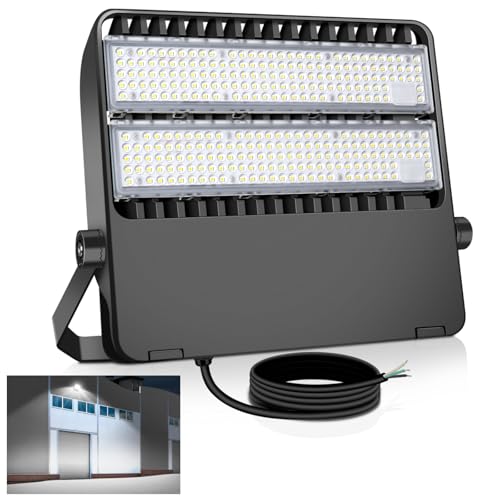
Sitting between the 360W powerhouse and smaller residential options, this 240W shoe-box-style fixture (a rectangular floodlight shape popular for area and pole lighting) hits the sweet spot for mid-size courts. The 120-degree beam keeps light flat and even, which matters when players are tracking passes at speed.
For most half-court residential setups paired with a second matching unit on the far side, the coverage holds up well. The focused beam also keeps light from spilling into neighboring yards, a common friction point when courts sit close to property lines.
Notable Gains
- Focused 120° beam aims light at the court rather than the neighbor’s window
- 240W output balances brightness with manageable electrical load
- Shoe-box form factor fits standard pole-mount brackets
Room For Improvement
- Two units are usually needed for full-court coverage, raising total install cost
- Beam aiming matters; misaligned mounts leave noticeable shadow lines under the rim
Who It Suits Best
Homeowners with a half-court or compact full-court who want stadium-grade output without the heaviest wattage class.
A Better Fit Elsewhere
Shoppers needing a single all-in-one solution should look at the Tomourd 360W LED Stadium Flood Light, which covers more ground from one mount.
At 100W per fixture, this three-pack leans into the smaller end of the residential basketball court lights range. The lower draw lets a homeowner run all three off a single outdoor GFCI circuit, which simplifies weekend installs without an electrician visit.
The wide 120-degree beam spreads brightness across a half-court or modest full-court setup, and the IP66 housing handles weather similarly to its 200W sibling. I think of this as the entry-level option for someone who plays a few evenings a week rather than hosting tournaments.
Points In Its Favor
- Three fixtures in one box covers a half-court from multiple angles
- Low 100W draw keeps electrical requirements simple
- Wide beam angle fills short-throw spaces efficiently
Minor Gripes
- Output may feel thin on full-size 94-by-50-foot courts
- Plug-in lead length limits how far from an outlet you can mount
Quick Facts
Best Suited To
Driveway hoops and small backyard courts where electrical capacity and budget both matter.
Swap It Out When
A full-size court needs more punch, and the YANYCN 200W LED Flood Light 3-Pack delivers triple the wattage per head.
The standout detail here is the wattage adjustability, letting installers dial output up or down depending on the project size. Six fixtures give a property owner enough inventory to light a multi-court complex or split a single large lot across several mounting points.
The shoebox-style housing fits standard arm mounts on existing poles, which makes it a renovation-friendly choice. The IP65 rating (slightly lower than IP66 but still solid for outdoor use) handles rain well, though I’d mount it where direct downpour hits least.
Everyday Advantages
- Adjustable wattage matches brightness to actual court size
- Six-pack quantity suits multi-court properties or large parking/recreation spaces
- Arm-mount design fits common existing pole hardware
Some Limits To Know
- 277-480V input requires commercial electrical service, not a standard household panel
- Larger upfront count than most residential shoppers actually need
Who Should Grab It
Contractors and facility managers handling multi-court properties or commercial athletic spaces.
Where Another Pick Suits Better
Residential installers should check the BBESTLED 400W LED Parking Lot Light, which runs on standard 100-277VAC home circuits.
For full-size competition courts, this 600W unit hits the top of the lumen range in this roundup. The flicker-free driver (an electronic component that prevents the LED from pulsing on and off rapidly) and high CRI (Color Rendering Index, a 0-100 score measuring how accurately a light reveals true colors) keep the output stable enough for HD broadcasts, which is the kind of spec language that signals this is built beyond casual play.
The dimmable function and adjustable bracket let a facility tune output for different events, from practice sessions to recorded games. It is overkill for most driveways, but for serious athletic venues, the optical efficiency pays off.
Why It Works Well
- Top-tier lumen output handles full competition courts with margin to spare
- Dimmable driver adapts brightness to practice versus game nights
- Flicker-free design suits slow-motion video and broadcast recording
Points To Keep In Mind
- 600W draw demands commercial-grade electrical infrastructure
- Higher unit cost makes it a tough sell for casual residential setups
Feature Card
Perfect Match For
Athletic facilities running competitive or televised events on full-size courts.
Skip It When
A residential installer would be overspending; the Tomourd 360W LED Stadium Flood Light delivers similar beam spread at lower wattage.
Slotting between the 100W and 200W YANYCN packs, the 150W trio gives a middle path for homeowners who need more brightness than the entry-level offers. The wide 120-degree beam and daylight color temperature stay consistent across the brand’s outdoor line.
Mounting flexibility is the quiet highlight, since the bracket design works on walls, eaves, or pole mounts depending on the property layout. For a garage-side hoop or a side-yard slab, this three-pack often covers the whole space without extra hardware.
Where It Delivers
- Mid-tier wattage balances brightness with reasonable energy draw
- Three-head setup minimizes shadow zones around the rim
- Plug-in design supports quick DIY installation
Honest Caveats
- Output sits between the brand’s other options, so value depends on matching the wattage to actual space
- IP66 housing is solid but periodic cleaning of the lens helps maintain brightness over time
Whose Shelf It Belongs On
Homeowners who have outgrown the 100W pack but don’t need the 200W’s full-court output.
Not Your Match When
Shoppers running a true full-size court benefit more from the YANYCN 200W LED Flood Light 3-Pack’s heavier throw.
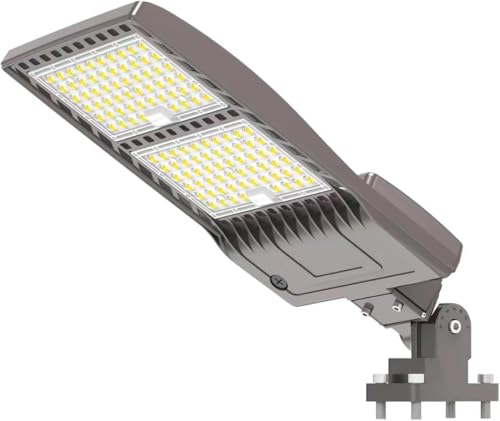
The 400W rating and arm-mount design target installers who already have poles in the ground. The 100-277VAC input range (a broad voltage compatibility window covering both standard household and light-commercial circuits) lets this fixture land on either residential or commercial service, which is rare in this wattage class.
The 5000K tone and high CRI keep color rendering honest, important for security cameras mounted nearby. Owners commonly position this as a retrofit (a swap-out replacement for an older fixture on an existing pole) for properties moving from older HID (high-intensity discharge, a legacy lamp technology using gas-filled bulbs) setups to modern LED.
A Favorable Mix
- Broad voltage input fits both home and light-commercial panels
- Strong lumen output suits pole-mounted retrofits on existing infrastructure
- CRI over 80 keeps camera footage and visual play honest
Less-Strong Areas
- Single-fixture purchase means most full courts still need two or more units
- Pole-mount only; no included hardware for wall or eave installation
Built With In Mind
Property owners retrofitting an existing pole with modern LED output in the 400W class.
Consider Something Else When
Homeowners starting from scratch with no existing pole should check the KUKUPPO 320W 6-Pack, which ships multi-unit.
What Matters Most Before Choosing Basketball Court Lights
Court Size And Beam Spread
Half-court driveways typically need 100W to 150W per fixture with a wide 120-degree beam, while full-size courts jump to 200W or higher per head. Beam angle matters as much as raw wattage, because a focused narrow beam on a wide court creates the dark corners that ruin visibility.
Mounting And Electrical Reality
Most residential basketball court lights run on 100-277VAC standard home circuits, but anything above 240W usually demands a dedicated circuit. Pole mounts suit properties with existing infrastructure, while plug-in floodlights with brackets work for wall, eave, or garage-side mounting.
Weather Resistance And Lifespan
An IP65 or IP66 rating is the practical floor for outdoor court lighting, since rain and dust shorten the life of anything less sealed. Aluminum housings with cooling fins tend to outlast plastic bodies in year-round outdoor exposure.
Smart Choices Around These Picks
Pitfalls Shoppers Hit
Underestimating electrical capacity is the most common slip up, where shoppers buy a 360W fixture assuming a standard 15-amp home circuit will handle it. A second frequent miss is mounting height; floodlights hung too low create glare that ruins the game for the player standing closest.
When Paying More Pays Off
Higher-tier stadium fixtures add dimmable drivers, higher CRI, and broadcast-grade flicker-free performance that budget options skip. For facilities hosting recorded games or competitive play, those specs translate to cleaner footage and more flexible event scheduling.
Frequently Asked Questions
How many lumens do I need to light a basketball court?
A residential half-court generally needs around 20,000 to 30,000 lumens total, while full-size courts typically require 50,000 lumens or more for safe, even play.
Can I install basketball court lights myself?
Plug-in floodlights with brackets are workable DIY projects for homeowners comfortable with outdoor GFCI outlets. Hardwired high-wattage units or pole-mount installations usually need a licensed electrician.
What color temperature is best for outdoor courts?
5000K daylight white is the standard choice for sports lighting because it renders colors accurately and keeps contrast high during fast movement.
How long do LED basketball court lights last?
Most LED fixtures in this category are rated for 30,000 to 50,000 hours of operation, which translates to many years of regular evening play before replacement.
Are floodlights or stadium lights better for residential courts?
Floodlights with brackets work well for wall, eave, or garage mounting, while stadium-style fixtures suit pole-mounted setups. The choice depends on existing infrastructure rather than performance.
The Takeaway
The right basketball court lights depend on court size, mounting situation, and electrical capacity more than brand loyalty. For driveway hoops, the YANYCN 100W or 150W packs handle the job without overloading home circuits. Full-size courts and competitive play benefit from Tomourd’s stadium-class options, while pole retrofits land naturally with BBESTLED or KUKUPPO fixtures. Match the wattage to the space and the mounting style to the property, and the rest falls into place.