

I built this roundup for anyone tired of lights burning through the night, fans left buzzing in empty rooms, or remembering to switch off holiday decorations. The right timer switch handles the forget-it-and-go part of home automation without needing a full smart-home overhaul. Each option below covers a different real-world routine, from set-and-forget lamp timers to wall-mounted controls and specialty exhaust fan switches.
The Choices Worth Comparing
Govee Dual Smart Plug 2 Pack, WiFi Bluetooth Outlet
DEWENWILS Indoor 24 Hour Digital Timer Outlet, 2-Pack

Intermatic 156T1978A Time Switch Tripper Kit, 2-Pack

Greencycle Remote Control Outlet with Timer, 3 Outlets

DEWENWILS Indoor 24 Hour Digital Timer Outlet, 1-Outlet 2-Pack

BN-LINK 7 Day In-Wall Digital Timer Switch

BN-LINK 60 Min Bathroom Fan Timer Switch, No Neutral
More On The Choices That Made The List
If you already live in a voice-controlled household or want to start one without rewiring the walls, this Govee bundle is the most flexible entry point on the list. Each unit houses two side-by-side outlets inside a single wall-plug body, so one duplex receptacle becomes four independently controllable smart sockets.
Setup runs through the Govee Home app over WiFi or Bluetooth, and it plays nicely with both Alexa and Google Assistant routines. I find the dual-outlet form factor especially handy behind the TV stand, where one plug handles the console and the other handles the bias lighting.
The Value In It
- Two independently scheduled outlets per plug, which doubles your automations without doubling the wall footprint.
- Hands-free voice control through Alexa or Google Assistant, so lamps and fans respond to a simple phrase.
- Bluetooth fallback keeps things responsive even when WiFi stutters in basements or far bedrooms.
- Compact horizontal layout leaves the lower wall socket free for an unscheduled device like a vacuum charger.
- App-based grouping means a “Goodnight” scene can shut off four devices from one tap.
Things To Consider
- Does not support 5 GHz WiFi networks, so you’ll need a 2.4 GHz band available on your router.
- Requires a fresh Govee Home App account; not a fit if you already standardized on a single smart-home ecosystem.
- Plugged-in device draws stay under 15 amps total, which rules out heavy space heaters on the same outlet.
Key Specs
Who It Suits Best
Renters and apartment dwellers who can’t cut into walls but want full voice and app control of lamps, fans, and seasonal lights.
Look Elsewhere When
You’d rather have a permanent in-wall solution with weekly scheduling, in which case the BN-LINK 7 Day In-Wall Digital Timer Switch is the better fit.
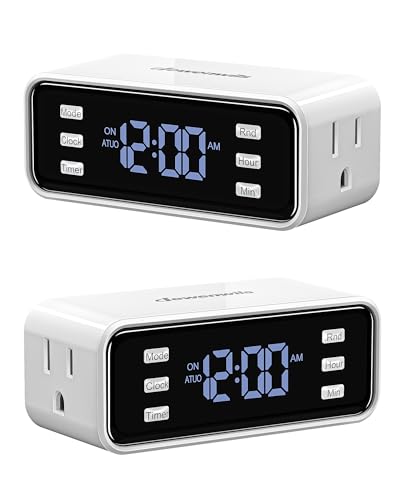
This DEWENWILS dual-outlet timer takes the no-app, no-voice approach, which is exactly the point. You press four buttons, program your on and off times, and the screen shows the next switch at a glance from across the room.
The wide-angle display is the standout detail here: most plug-in timers get a thin readout you have to crouch to read. With three daily repeat programs available, this pair handles routines like aquarium lights, holiday décor, and bedside lamps without any hub or subscription.
Noteworthy Benefits
- Two outlets run on the same programmed schedule, useful for matching lamps flanking a couch or bed.
- Up to three separate on/off programs per day cover sunrise, evening, and a late-night shutoff.
- High-visibility screen stays readable at standing height, which makes setup far less fiddly.
- Manual override button lets you skip the schedule when guests stay over.
Points To Note
- 24-hour-only cycle means no separate weekday-versus-weekend programs.
- Side-by-side outlets are wider than a standard plug, partially blocking the second wall socket.
Right Fit For
Anyone who wants a true set-and-forget timer without touching an app, especially for living-room lamps and decorative lighting.
Swap It Out When
You need two independent schedules on one outlet, where the Govee Dual Smart Plug 2 Pack offers per-outlet control.
The Intermatic tripper kit isn’t a finished timer; it’s the small mechanical heart inside one. If you already own an Intermatic T100, T7000, or WH40 wall timer and the on/off trippers have cracked or worn flat, this kit brings the unit back to life without replacing the housing.
Each pack ships eight trippers and eight set screws split across gold, silver, and turquoise pins, which corresponds to the different scheduling modes across the supported Intermatic families. Owners commonly keep a spare on hand because trippers take the most mechanical abuse on a daily-cycle timer.
Everyday Wins
- Genuine OEM replacement parts that match the original Intermatic fit.
- Two complete kits per order, enough to rebuild several timer cycles or stock a backup.
- Supports the most common mechanical wall-timer families still installed in homes and outbuildings.
- Restores a hardwired timer for the cost of small parts, far cheaper than a full switch swap.
Trade Offs
- Not a universal kit; using wrong-color trippers on the wrong series can produce unreliable switching.
- Requires opening the existing wall timer housing, so it isn’t a beginner-friendly repair.
Built With In Mind
Homeowners, electricians, and shop owners maintaining an existing Intermatic mechanical wall timer.
Not Your Match When
You want a brand-new programmable wall timer, in which case the BN-LINK 7 Day In-Wall Digital Timer Switch is the cleaner pick.
The Greencycle kit trades apps for a small handheld RF remote, which is refreshingly simple if you just want to turn a lamp off without getting up. The receiver block splits into three outlets so a single remote can manage a floor lamp, a reading light, and a holiday display at once.
Five preset countdown options (0.5H, 1H, 2H, 4H, 8H) cover the most common shut-off cases, like the kid’s bedroom lamp or a craft-room iron. Compared to the DEWENWILS digital timer above, this leans into manual control with light scheduling layered on top.
Positive Points
- Handheld remote removes the need to bend down behind furniture to toggle power.
- Three receiver outlets expand a single wall socket into a controllable hub.
- Five preset countdown windows handle most “leave it on while I shower” situations.
- Helpful for older family members who want one big button instead of a phone app.
Small Caveats
- RF remote works within a limited range and can be interfered with by other household remotes.
- Preset timer increments are coarse; not suited to minute-precise lighting design.
Perfect Match For
Living rooms and bedrooms where the comfort of a couch-side remote beats the precision of a digital schedule.
Reach For A Different Pick When
Voice control and per-outlet schedules are the priority, which pushes toward the Govee Dual Smart Plug 2 Pack instead.
Where the earlier DEWENWILS timer bulks up to fit two outlets, this single-outlet version shrinks into a slim frosted rectangle that leaves the second wall socket free. It’s the right call when you only need to schedule one fixture but want it to look clean behind a side table or media console.
Three daily on/off programs, a large screen, and a side switch for Always On, Auto, or Always Off give you the same scheduling muscle in a smaller footprint. I like keeping one of these for a window-unit AC in summer and another for a reading lamp year-round.
A Strong Showing
- Low-profile body fits behind tight furniture without crowding the second wall socket.
- Three daily programs handle multiple on/off transitions for shifting daylight hours.
- Side-mounted mode switch is easier to find than the tiny buttons on cheaper timers.
- Two-pack value lets you automate one lamp now and a second fixture later.
Worth Noting
- Single outlet means stacked appliances need a separate solution.
- Repeats daily only; no weekend-only or weekday-only program.
Whose Shelf It Belongs On
Small-space dwellers and minimalists who want scheduling without a bulky timer block.
Where Another Pick Suits Better
You run two lamps on the same schedule, in which case the DEWENWILS 2-Outlet Digital Timer covers both at once.
This BN-LINK wall switch installs in place of a standard toggle or rocker, replacing a single dumb switch with up to 18 on/off programs across a full week. A blue backlight makes the screen readable in a dark hallway, and individual days or preset day combinations make weekday-versus-weekend patterns painless.
It’s the most permanent option on the list, and the right one for outdoor lights, porch fixtures, and ceiling fans that benefit from a real weekly rhythm. Compared to plug-in timers above, this one trades portability for a clean wall-mounted look.
Where It Helps
- 18 on/off programs and 7-day scheduling handle complex household routines.
- Blue backlight improves visibility during late-night programming sessions.
- Individual day selection lets weekdays differ from weekends without separate timers.
- Replaces existing wall switches, removing a visible plug-in box from the wall.
Honest Caveats
- Requires basic electrical work, including a neutral wire in many homes.
- Not suited to renters who can’t modify the existing switch box.
Quick Facts
Best Suited To
Homeowners outfitting porch lights, hallway fixtures, or ceiling fans with a polished weekly schedule.
A Better Fit Elsewhere
Renters or anyone wanting no-install scheduling, where the DEWENWILS 1-Outlet Digital Timer Outlet is the right alternative.
The BN-LINK mechanical countdown switch is purpose-built for bathrooms and other rooms where you’d rather twist a knob than tap a screen. Turn the dial to anywhere between 2 and 60 minutes and the fan or light shuts off automatically when the time runs out.
The spring-wound design means no programming, no app, and no neutral wire required, which is a big deal in older homes that lack a neutral at the switch box. I see this working especially well for kids who forget to flip the bathroom fan off after their shower.
Key Advantages
- Adjustable 2 to 60 minute countdown replaces fixed 5, 10, or 20 minute presets.
- Spring-wound mechanical movement has no display to fail or software to update.
- No-neutral wiring fits older switch boxes lacking a neutral conductor.
- Saves energy by ensuring the exhaust fan actually stops after a shower.
Things To Weigh Up
- Single-function design isn’t suited to daily on/off schedules like the BN-LINK digital wall timer.
- Requires in-wall electrical installation and basic comfort with switch wiring.
Made For
Bathrooms, laundry rooms, and older homes where a simple twist-and-go fan timer solves the most common “left it running” complaint.
Skip It When
You want weekly programming rather than a one-shot countdown, in which case the BN-LINK 7 Day In-Wall Digital Timer Switch is the better match.
Picking The Right Automatic Timer Switches For Lights For Your Home
Match The Form To The Fixture
Plug-in timers like the DEWENWILS models and the Greencycle remote work without tools, which suits lamps and renters. In-wall switches like the BN-LINK digital and mechanical timers replace an existing wall control, which fits permanent fixtures and homeowners comfortable with basic wiring. A smart plug like the Govee bundle layers on app and voice control for routines that change often.
Decide Between Programming Styles
Countdown switches run a single shot, which fits the bathroom fan or window-unit AC scenario. Daily-repeat timers cycle the same schedule every 24 hours, which suits lamps and holiday décor. Seven-day timers let weekdays differ from weekends, which suits porch lights and family routines that shift around school or work schedules.
Consider The Wiring In Your Walls
Most digital wall timers need a neutral wire, which newer homes have but older ones may not. The BN-LINK 60 Min mechanical timer is one of the few wall timers that operates without a neutral, making it a strong pick for older switch boxes. Plug-in models sidestep the wiring question entirely.
Think About Daily Visibility
A wide-angle display and side mode switch, like the DEWENWILS timers offer, cuts down on the crouching and squinting that cheap timers usually demand. For dark hallways, a backlit in-wall display like the BN-LINK 7 Day switch is worth the upgrade.
Key Considerations Across These Picks
Common Buying Traps
Picking a digital wall timer for an older home without checking the neutral wire is the most common mistake I see; the switch simply will not power on until a neutral is added. Buying a smart plug and expecting 5 GHz WiFi to work is another frequent miss, since most budget smart plugs only join a 2.4 GHz network. Counting on minute-level precision from a remote-controlled outlet is also a trap, because the Greencycle presets jump in fixed increments.
Where The Extra Money Goes
Higher-tier timers tend to add weekly programming, blue backlit displays, and per-outlet scheduling rather than basic daily cycles. For most households the jump from a single-outlet daily timer to a 7-day in-wall switch is the upgrade that earns its keep, especially when porch and hallway lights can shift with the seasons. Smart features only justify the premium once a voice assistant or phone app is already part of the household routine.
Frequently Asked Questions
Do automatic timer switches save real energy?
Yes, by cutting off lights and fans that would otherwise run all night or while nobody is home. The savings compound across multiple fixtures and rooms.
Can I use a timer switch outdoors?
Only if the timer is rated for outdoor or damp locations, and most plug-in timers in this list are for indoor use. Outdoor setups often need a weatherproof cover or an in-wall switch inside a covered porch fixture.
What is a neutral wire and why does it matter?
A neutral wire returns current to the breaker panel and many digital timers need it to power their internal clock and display. Homes built before the mid-1980s sometimes lack a neutral at the switch box, which rules out many digital models in favor of mechanical options.
How long do plug-in timers usually last?
A well-made plug-in timer like the DEWENWILS models typically lasts several years of daily cycles, with the relay contacts being the most likely wear point. Mechanical wall timers can run even longer because they have fewer electronic components to fail.
Will a smart plug still work if WiFi goes out?
Most smart plugs, including the Govee bundle, fall back to Bluetooth for local control when WiFi drops. Schedules stored in the app may pause until the network reconnects, though the manual button on the plug itself still toggles power.
Wrap Up
The right timer switch is the one that quietly handles a routine you’ve been forgetting. Match the form factor to your wiring, the programming style to your weekly rhythm, and the visibility to where the timer lives, and you’ll find the right fit without overpaying for features you won’t use.