

African violets are famously fussy about light. They crave bright but indirect rays, and a dim apartment window rarely delivers enough consistency to keep them flowering through the colder months. A dedicated grow light solves that problem by giving each plant a steady, controllable light source right above its leaves, no matter what the weather does outside.
I’ve watched violets sulk through stretches of grey winter skies and perk up the moment a quality full-spectrum panel moved closer. The picks below cover everything from clip-on halo lights for a single windowsill to floor-standing fixtures for serious collectors. Each one suits a slightly different setup, so the right match depends on how many plants you keep and where they live.
The Choices Worth Comparing

GLOWRIUM Smart Grow Lights Full Spectrum LED Floor Light

GLOWRIUM Full Spectrum Plant Light with Stand

FECiDA Dimmable LED Grow Tent Light 1×2 ft

GLOWRIUM Puck Grow Light G7 Full Spectrum
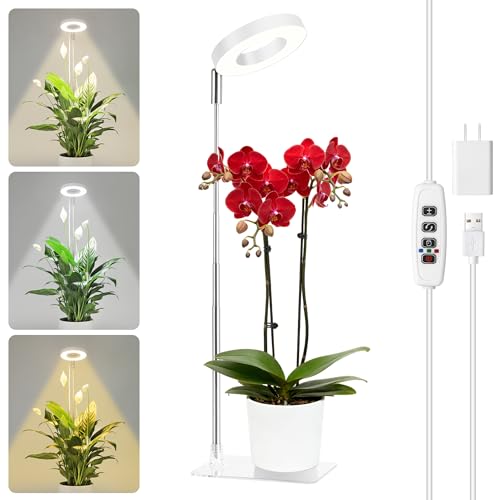
Hywyimlait 48 LED Halo Plant Light with Base

SGLEDs 12W Clip-On LED Grow Light Black

GLOWRIUM Smart Grow Lights Full Spectrum LED Plant Light

Hywyimlait Halo Ring Grow Lights 2 Pack

GLOWRIUM Smart Grow Lights with Bluetooth App
The Details Behind The Selections
A floor-standing light with a 3500K warm white tone feels surprisingly gentle for a panel rated at 189 μmol/m²/s at six inches, which is the kind of detail that matters for violets that scorch easily under harsh blue-heavy fixtures. CRI above 80 means foliage colors read naturally to the eye, so your plants stay attractive even when the room lights are off.
For a collector with a small cluster of African violets on a side table or plant stand, this light slips behind the pots and casts broad, even coverage without needing to be repositioned each week. The sunlike quality also flatters other flowering houseplants nearby, making it a friendly choice for mixed shelves where roses or orchids share space with violets.
What Helps Most
- Warm white output that mimics midday sun without harsh glare
- High PPFD (photosynthetic photon flux density, the measure of usable light reaching the leaves) at close range, ideal for compact violet foliage
- Slim floor base keeps walkways clear in tight apartments
- Wide beam covers a grouping of three to five standard 4-inch pots
Points To Note
- Floor placement may not suit shelf-only growers
- No app control, so dimming requires manual adjustment if available
- Warm tone can read slightly yellow in rooms with cool ambient lighting
Whose Shelf It Belongs On
A violet keeper with a few plants on a stand who wants a single light to cover a cluster without any app fuss.
Reach For A Different Pick When
Tall plant owners should look at the GLOWRIUM Bluetooth Floor Light (pick 9), which extends higher and adds app control.
Compared with the floor model above, this version trades the fixed warm-white panel for a height-adjustable stand with three detachable sections reaching 32, 47, or 63 inches. That flexibility makes a real difference for anyone moving seedlings up to mature violets on the same fixture over a few months.
The 360-degree rotating lamp head also helps when your plant shelf sits against a wall, since you can aim the beam straight down or angle it toward a side cluster. The full 380 to 780 nm spectrum covers seedling through bloom stages, so the same stand can carry a violet from propagation to flowering without swapping lights.
What Makes Sense
- Three height stops let the same fixture serve seedlings and mature plants
- Rotating head simplifies aiming at off-center pot groupings
- Broad spectrum supports every growth stage from leaf to bloom
- Detachable poles store flat, helpful in small closets
Trade Offs To Consider
- At full extension it can feel top-heavy on carpet
- No built-in timer mentioned, so an external outlet timer helps with consistent photoperiods (daily light cycles)
- Single head means wider shelves need more than one unit
Best Suited To
A propagation-minded grower who starts new violets from leaves and needs one fixture that adapts as plants grow.
Swap It Out When
Anyone with a wide multi-shelf rack should consider the FECiDA Tent Light (pick 3) for broader rectangular coverage.
This is the panel for someone running a small grow tent rather than an open shelf. The 1×2 ft form factor matches standard tent trays, and the 65W real draw at 600W-equivalent intensity means serious photon output without a heavy electricity bill.
Where the GLOWRIUM floor units aim for warm, decorative integration, the FECiDA leans into utility. The built-in aluminum heat sink with vent design keeps diodes cooler, and dimming lets you dial down intensity when delicate violet leaves show signs of bleaching. For a basement or closet setup dedicated to serious propagation, that control matters.
Advantages To Know
- High output per watt suits dense propagation trays
- Dimming knob lets you tune intensity as violets mature
- Cool-running heat sink extends diode life
- Full spectrum from 380 to 780 nm covers all stages
Things That May Matter
- Built for enclosed tents, so open-shelf placement can wash out neighbors
- Larger footprint than halo or puck options
- Cooler color temperature may read harsh in living areas
Key Specs
The Right Fit
A hobbyist with a small grow tent or closet nursery who wants serious output and dimming control for a dense violet tray.
Where Another Pick Suits Better
For a single windowsill, the SGLEDs Clip-On (pick 6) takes up far less space and requires no tent setup.
Puck lights suit shelves where a tall stand or panel would look out of place. The G7 adds Bluetooth app control alongside the inline controller, so brightness, timers, and on/off scheduling live on your phone rather than behind the shelf.
For a single African violet on a bookcase or office cubby, this puck tucks under the shelf edge and drops light straight onto the rosette. The full-spectrum LED chip array covers the wavelengths violets need for flowering, and app control means you can tweak photoperiods without crawling behind furniture.
What Works In Its Favor
- Bluetooth app and inline controller offer flexible scheduling
- Low-profile puck shape disappears under shelves
- Full-spectrum coverage supports blooming, not just foliage
- Compact form suits single-plant situations
Honest Caveats
- One puck covers a small footprint, so multi-plant shelves need multiples
- App dependency may frustrate those who prefer simple switches
Made For
A solo violet owner in a small space who values app-driven scheduling over bulk coverage.
Consider Something Else When
A collector with many violets will get more value from the GLOWRIUM Floor Light (pick 1), which covers a wider area.
What sets this halo apart from the puck and panel options above is its dual mounting. You can stake the telescopic rod directly into the soil of a large pot, or set the base beside a smaller arrangement and aim the ring downward. That flexibility is rare at this scale.
With 48 LEDs, three light spectrums, ten brightness levels, and a 3/9/12-hour timer built in, the halo offers more granular control than most clip-on rivals. Mixed pot groupings on a coffee table, where some violets sit in deeper soil than others, benefit most from the height-adjustable rod.
A Favorable Mix
- Stake or base mounting adapts to different pot sizes
- Ten brightness levels allow fine-tuned intensity
- Three spectrum modes cover vegetative and bloom needs
- Built-in timer automates daily photoperiods
Practical Considerations
- Stake mounting may disturb roots if repositioned often
- Halo size suits one or two plants, not a shelf full
Feature Snapshot
Perfect Match For
A violet keeper with one or two feature plants on a table who wants adjustable mounting and timer-driven scheduling.
A Better Fit Elsewhere
Shelf collectors with several plants should reach for the GLOWRIUM Puck G7 (pick 4) or Floor Light (pick 1) for broader coverage.
Small, simple, and inexpensive, this 12W clip-on is the light to grab when a single African violet needs a boost on a kitchen windowsill. The pot clip attaches to the rim and a flexible gooseneck aims the diode cluster at the rosette without taking up shelf space.
Inline controls set a 3, 6, or 12-hour timer and four brightness levels, which is enough automation for most casual violet keepers. Compared with the higher-end floor and panel picks above, this one trades coverage and spectrum finesse for affordability and a tiny footprint, a trade-off that suits many beginners.
Notable Upsides
- Pot clip design frees up shelf surface entirely
- Flexible gooseneck allows precise aiming
- Timer and dimmer built into the inline controller
- Modest wattage keeps electricity use low
Less Ideal Details
- 12W output suits only one or two small plants
- Clip grip may loosen on thick ceramic pot rims over time
Who Should Grab It
A beginner with a single violet on a windowsill who wants an affordable, low-effort introduction to grow lighting.
Skip It When
Anyone with a wider collection should pick the Hywyimlait Halo 2-Pack (pick 8) for double the coverage at a similar scale.
This GLOWRIUM model lands between the compact puck and the tall floor units. It extends to about 22.8 inches, which is the sweet spot for tabletop displays where plants sit on a console or buffet and need light from above rather than the side.
The enlarged lamp head casts a broader pool than the puck, while stepless dimming (smooth, continuous brightness adjustment rather than fixed steps) lets you back off intensity when a violet looks slightly washed out. The full spectrum covers seedling through flowering, so the same fixture follows a plant from propagation to bloom without swapping hardware.
Well-Handled Touches
- Stepless dimming allows precise intensity tuning
- Enlarged lamp head covers more pots per fixture
- Height range fits standard tabletop plant heights
- Full spectrum supports all growth stages
Small Caveats
- Floor footprint still requires some clearance behind furniture
- No app integration at this tier
At A Glance
Who It Suits Best
A violet hobbyist with a tabletop grouping who wants finer dimming control than the puck offers.
Not Your Match When
Tall-plant collectors should consider the GLOWRIUM Bluetooth Floor Light (pick 9), which reaches higher.
A 2-pack changes the math for collectors. Two halo rings let you flank a small grouping of violets with even light from both sides, eliminating the one-sided stretching you often see with single-source setups. The rings themselves read as decorative rather than utilitarian, which matters if your plants share space with a styled living room.
Red, blue, and yellow diodes combine for a full-spectrum blend, and the included 5V 2A adapter handles the power draw without a bulky brick. A 3/9/12-hour timer plus ten dimmable levels means each halo can run its own schedule, useful when one plant needs more bloom-phase light than its neighbor.
The Value In It
- Two halos cover a small grouping evenly
- Decorative ring shape blends with styled interiors
- Independent timers per halo allow customized photoperiods
- Low-voltage 5V operation is energy-efficient
Points To Keep In Mind
- Halo size suits small plants, not large specimens
- Adapter and cable management may need tidying in visible setups
Built With In Mind
A decorator-minded grower who wants grow lighting that doubles as a visual accent in a living area.
Look Elsewhere When
A propagator with many trays should pick the FECiDA Tent Light (pick 3) for serious cultivation output.
Reach matters most for tall specimens, and this floor model climbs to 70.9 inches. That makes it a strong match for fiddle leaf figs, monsteras, and any African violet perched on a tall plant stand where shorter fixtures simply cannot deliver useful light from above.
Bluetooth app and manual touch panel both control timers, brightness, and a sunrise-to-sunset sync effect that gently ramps intensity rather than slamming on at full power. Compared with the puck G7 above, this is the grown-up version of GLOWRIUM’s smart approach, sized for living rooms with high ceilings rather than desktops.
Why It Works Well
- 70.9-inch reach fits tall plant stands and floor specimens
- App and touch panel both control scheduling and brightness
- Sunrise and sunset sync eases plants into photoperiod shifts
- Slim pole profile keeps the footprint modest
Some Limits To Know
- Tall stance can feel intrusive in low-ceiling apartments
- Bluetooth range requires proximity, unlike Wi-Fi models
Quick Facts
Right Fit For
A violet keeper with tall plants or a high-ceiling room who wants app-driven scheduling and gentle sunrise or sunset transitions.
Another Choice May Suit
Tabletop collectors without tall specimens will find the GLOWRIUM Tabletop Light (pick 7) less imposing.
What Matters Most Before Choosing African Violet Grow Lights
Light intensity, measured as PPFD, is the first number to weigh. African violets thrive around 100 to 200 μmol/m²/s at the leaf surface, so a fixture that delivers too little leaves plants leggy, while too much scorches the rosette.
Match The Spectrum To The Growth Stage
Full-spectrum LEDs (diodes that emit across the wavelengths plants use for photosynthesis) cover both the blue wavelengths that drive leaf growth and the red wavelengths that trigger flowering. A panel rated from 380 to 780 nm handles seedlings through blooming violets without needing a separate bloom booster, simplifying any setup.
Height And Coverage Go Hand In Hand
A 6-inch clearance above the foliage is the standard for African violets, but the fixture’s beam width determines how many plants one unit covers. Clip-on halos suit single pots, while wider panels or pairs of pucks handle multi-plant shelves evenly.
Timer And Dimming Save Daily Effort
Aim for a built-in timer with at least 3, 6, and 12-hour presets, since consistent photoperiods prevent bud drop. Stepless or multi-level dimming lets you reduce intensity in summer when ambient light supplements the fixture, keeping leaves from bleaching.
Key Considerations Across These Picks
Common Shopping Slip Ups
Many shoppers buy the brightest panel they find, then watch violet leaves bleach within a week. African violets prefer moderate intensity at close range rather than raw power from a distance. Reading the PPFD at the actual mounting height, not just the headline wattage, prevents that mistake.
Another trap is choosing a fixture with no timer and then forgetting to switch it off for a day. Erratic photoperiods stress violets and stall bud development, so a built-in timer is a quiet feature that pays off every week.
Where The Extra Money Goes
Higher-tier models earn their price through stronger heat sinks, dimming circuitry, and app-based scheduling. For a casual one-plant setup, those features are optional. For a multi-shelf collection or a dedicated tent, the extra cost shows up as longer diode life, finer intensity control, and less daily fiddling, which justifies the upgrade.
Frequently Asked Questions
How close should an African violet grow light sit above the plant?
Most full-spectrum LEDs work well at roughly 6 to 12 inches above the foliage, depending on the panel’s intensity rating. Start at the manufacturer’s recommended distance and watch for leaf curl or fading, which signals the need to raise the light slightly.
How many hours per day should African violet grow lights stay on?
Twelve to fourteen hours of light per day supports steady blooming without overworking the plant. A timer keeps that schedule consistent, which matters more than the exact hour count.
Can LED grow lights burn African violet leaves?
Yes, especially high-output panels placed too close. Dimming controls or proper hanging height prevents bleaching, and a weekly leaf check helps catch any stress early.
Do African violets need red and blue light specifically?
A balanced full spectrum that includes red and blue wavelengths works better than red-blue only. The added green and warm-white diodes keep plants compact and flowering rather than stretched.
Is a clip-on grow light enough for a windowsill violet?
For a single small pot in a fairly bright room, a clip-on light can be enough. Shaded windows or multiple plants usually call for a wider panel or a second fixture to keep growth even.
The Takeaway
Match the fixture to the setup you actually have. A single windowsill violet thrives under a clip-on or halo, while a multi-shelf collection benefits from a panel or paired pucks. Reach, dimming, and timer features matter more than headline wattage once the basic spectrum is in place.