

Small projects call for small lights, and 5mm LEDs have quietly become the go-to choice for hobbyists, tinkerers, and anyone building a custom dashboard cluster or a wearable costume. The challenge is that the category is packed with near-identical diodes in plastic bags, with subtle differences in voltage, color variety, and whether they arrive pre-wired or as raw through-hole components. I put this list together to help DIYers, Arduino builders, and decorative-projection makers cut through the noise.
The Main Contenders

CHANZON 120pcs 12V 5mm LED Pre Wired Assorted Kit

Waycreat 165pcs 12V 5mm Pre Wired LED 11-Color Kit
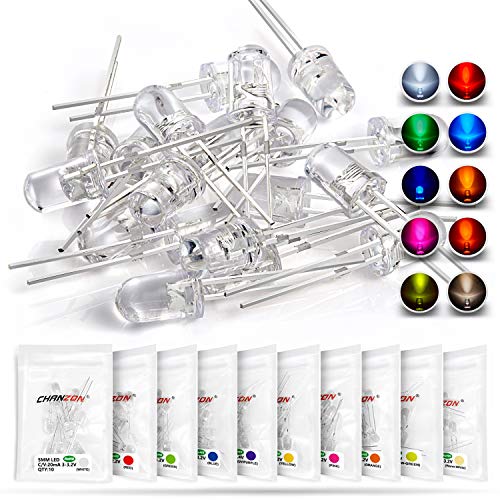
CHANZON 10 Colors 5mm LED Lamp Lights Assortment 100pcs

EDGELEC 100pcs 5mm Red Blinking LED Diodes 1.5Hz Flash + Resistors

DiCUNO 100pcs 5mm RGB Multicolor Fast Blinking LED Lights

BTF-LIGHTING WS2812B LED Strip RGB 5mm 12V 16.4FT

CHANZON 100pcs 5mm White LED Diode Lights Clear Round DC 3V

BTF-LIGHTING WS2812B LED Strip RGB 5mm 5V 16.4FT

BTF-LIGHTING WS2812B LED Strip RGB 2.7mm 12V 16.4FT
The Strengths Of Each Pick
Anyone replacing burnt-out dashboard bulbs in a 12V vehicle knows the pain of soldering resistors onto tiny leads. This CHANZON kit skips that step entirely: each diode ships with a resistor already in line on a roughly 7.9-inch pre-stripped lead. The bag splits 120 diodes into six color groups of 20, so there’s plenty of warm white, red, blue, and green to handle every switch and gauge in a typical instrument panel.
The colored-wire anode and black cathode convention means polarity mistakes happen less often at the bench. Compared with the raw CHANZON through-hole kit later in this list, this one trades flexibility for speed.
The Upside
- Resistor pre-installed, eliminating a frequent point of failure for first-timers
- Six color options cover the standard dashboard indicator palette
- Machine-soldered leads tend to stay attached under vehicle vibration
- Plenty of spares included for inevitable swap-outs later
Worth Noting
- The 12V rating makes it the wrong match for 3.3V or 5V microcontroller projects
- Bulk packaging can mix color counts unevenly when the bag is split mid-project
Quick Facts
Right Fit For
Vehicle owners retrofitting gauge illumination and hobbyists who want to skip resistor math.
Swap It Out When
The Waycreat 11-color kit suits mixed-color signal projects better when you want more than the basic six colors.
The CHANZON kit covers the basics, but sometimes a project calls for pink, orange, or a cycling RGB. Waycreat stuffs 11 color variants into a single bag, including both fast and slow RGB flash options. Each diode runs at 12V DC with a built-in 1/4W metal-film resistor, drawing roughly 20mA through a 30-degree viewing-angle lens.
The clear lens style (rather than diffused) gives these a sharper point-source look, which suits marker lights and edge-lighting more than soft panel glow. Pre-wired leads stretch about 7.87 inches, matching the CHANZON kit almost exactly.
The Good Stuff
- Eleven distinct color choices including pink, purple, and slow-flash RGB
- Pre-installed resistor saves bench time and limits soldering iron use
- Clear lens gives a crisp point-source appearance for marker work
Honest Caveats
- Clear lens variants can look harsh in enclosed cosmetic builds
- Flash modes are non-adjustable once soldered in place
Best Suited To
DIYers running multi-color automotive or themed indicator projects who want more hues than a basic six-color assortment.
Reach For A Different Pick When
The DiCUNO 7-color RGB kit offers faster color cycling when a constantly shifting output matters more than static colors.
Breadboard and PCB builders usually want raw through-hole LEDs they can drop into a circuit themselves. This CHANZON assortment ships 100 unpackaged diodes split across 10 colors (10 per color), with the standard 2-pin DIP layout that fits standard 2.54mm perfboard holes. The clear transparent round lens is a classic indicator look, and the 20mA forward current keeps them compatible with most Arduino and Raspberry Pi tutorials.
Unlike the pre-wired CHANZON 12V kit at the top of this list, this version runs at the diode’s native forward voltage, so the user picks the resistor. That’s the right trade-off for learning circuits but a hassle for quick swap-in jobs.
What Works In Its Favor
- Wide color variety for prototype boards and color-coded status panels
- Standard 2-pin DIP spacing, drop-in compatible with breadboards
- Bulk quantity keeps a small lab stocked for months
- Low cost-per-diode for classrooms and group workshops
Less Ideal Details
- No resistors included, so beginners must calculate or buy matching values separately
- Loose diodes can migrate across a workbench without organized storage
Built With In Mind
Electronics students, Arduino tinkerers, and anyone building indicator arrays on a custom PCB.
Where Another Pick Suits Better
The pre-wired CHANZON 12V kit saves significant bench time for car dashboard jobs where resistor selection is unwanted.
Sometimes a project needs an attention-grabbing pulse rather than a steady glow, and that’s exactly what these EDGELEC diodes deliver at a fixed 1.5Hz flash rate. The bag pairs 100 red blinking LEDs with 100 resistors rated for DC 6-12V, so the user has a complete circuit-ready bundle for status panels, warning beacons, and hobby signage. The diffused round lens softens the output, which is easier on the eyes than a clear lens in a dark room.
The 29mm lead length gives a little more routing flexibility than the shorter leads on the Waycreat kit, which can matter when the diode drops through a thick front panel.
Good Reasons To Consider
- Matched resistor pack eliminates a separate parts order
- Diffused lens keeps the flash gentle in low-light enclosures
- Long leads help reach through thicker mounting surfaces
Trade Offs To Consider
- Single-color only, no option for green or yellow alerts in the same bag
- Flash rate is fixed at 1.5Hz, with no adjustment range
Whose Shelf It Belongs On
Workshop builders who need ready-made flash indicators for safety panels, model railroads, or alarm enclosures.
Look Elsewhere When
The DiCUNO 7-color RGB fast-blinking kit fits better when a single-color flash feels too monotone for a display build.
Static-color LEDs get boring fast in decorative builds, which is where DiCUNO’s self-cycling RGB diodes come in. Each diode cycles through seven colors on its own without external logic, driven by an internal IC. Drop them on a 5V supply and they shift through the rainbow automatically, ideal for party props, costume accents, and any low-effort visual flair.
Unlike the addressable BTF-LIGHTING strips later in this list, these individual diodes run their cycle autonomously. There’s no microcontroller to program, which keeps the project scope minimal.
Noteworthy Benefits
- Self-contained color cycling removes the need for control code
- Diffused round lens softens the transition between hues
- Pack of 100 supports large-scale decorative installations
- Compact form fits wearable and small-housing projects
Some Limits To Know
- No way to pause or lock on a single color once powered
- Fast blink rate can feel busy in a small enclosed space
Who It Suits Best
Crafters, costume makers, and party-decoration builders who want animated color without any controller setup.
Not Your Match When
The CHANZON pure-white kit is a better fit for functional panel illumination where a single clean color matters.
Most LED strips are too wide to tuck behind a slim shelf edge, but BTF-LIGHTING’s 2020SMD strip measures just 5mm across. It runs on 12V DC and uses individually addressable WS2812B ICs at 160 LEDs per meter across a 16.4-foot reel. Each pixel can take its own color and brightness, which makes complex animated patterns possible along cabinet edges and inside display cases.
The 12V feed is friendlier for longer cable runs than the 5V variant lower on this list, since voltage drop matters less over distance. Cut points along the strip let the user trim to exact length.
Useful Touches
- Ultra-slim 5mm width fits gaps most strips cannot reach
- 160 LEDs per meter gives smooth, high-resolution animations
- 12V operation reduces voltage drop across long runs
Possible Compromises
- Requires a separate controller board to drive the pixel effects
- Heat dissipation is limited in fully enclosed channels
Made For
Makers fitting accent lighting into furniture, display cases, or model builds where every millimeter counts.
Skip It When
The BTF-LIGHTING 5V variant pairs more cleanly with Arduino and Raspberry Pi projects running off USB power.
Cool white output is the workhorse of indicator panels, and CHANZON’s bag of 100 5mm diodes delivers a 6000K-9000K color temperature with a clear round lens. The 30-degree viewing angle focuses the beam nicely for switch labels and panel backlighting. At 3V forward and 20mA, the diodes run cleanly off common microcontroller logic levels with a single current-limiting resistor.
Compared with the 10-color assortment earlier in this list, this kit is a single-purpose stock-up for white-only builds.
Real-World Strengths
- Cool white output reads cleanly in daylight and indoor panels
- Clear lens creates a defined point source for focused labels
- Compatible 3V forward voltage suits 3.3V logic boards
Where It Is Less Suited
- Cool color temperature feels clinical in warm home lighting
- Requires a separate resistor for each indicator chain
Feature Snapshot
Who Should Grab It
Custom panel builders and electronics hobbyists who want a large stock of clean white indicators for one project.
A Better Fit Elsewhere
The DiCUNO 7-color kit suits builds where variable color matters more than pure white clarity.
Microcontroller projects rarely have a 12V rail lying around, which is where the 5V sibling of the BTF-LIGHTING strip comes in. The same 5mm-wide 2020SMD strip carries WS2812B addressable pixels at 160 LEDs per meter across 16.4 feet, but it can be powered directly from an Arduino, ESP32, or even a beefy USB supply. Wiring stays simple since signal and power share the same low-voltage domain.
The shorter the strip segment, the cleaner the colors look, because 5V drops faster than 12V across long copper runs. Anything over a few meters starts to need a power injection point.
The Value In It
- 5V operation matches common microcontroller power rails
- Individually addressable pixels support custom animations
- Narrow 5mm profile fits compact project enclosures
- Cuttable design adapts to non-standard lengths
Factors To Consider
- Voltage drop shows up visibly past the first few meters
- External controller and power supply sold separately
Perfect Match For
Arduino and ESP32 builders running pixel art, status displays, or wearable projects that need slim, programmable lighting.
Consider Something Else When
The 12V BTF-LIGHTING strip handles longer cable runs better when voltage drop is a concern.
Some builds need a strip that nearly disappears, and the 0807SMD sibling to BTF-LIGHTING’s 2020SMD strip drops the width to just 2.7mm. It’s the thinnest addressable LED strip in this roundup, and at 12V DC it shares the long-run advantage of the wider 5mm version. Each of the 160 LEDs per meter still runs its own WS2812B pixel, so animation control is identical to the rest of the family.
The narrower PCB has less copper area for heat spreading, so fully enclosed aluminum channels become important for long-on-time installations.
Why It Works Well
- Thinnest 2.7mm width hides inside model and diorama builds
- Addressable pixel control matches wider BTF strips
- 12V input keeps long runs color-consistent
Practical Considerations
- Heat management matters more in tight enclosed channels
- Solder pads are smaller and tougher to work with for first-timers
Who Will Love This
Model railroaders, diorama builders, and prop makers who want the strip itself to vanish into the scenery.
Where A Sibling Pick Shines
The 5mm BTF-LIGHTING 12V strip handles everyday cabinet lighting better when the slightly wider profile is no concern.
What To Weigh Before Picking 5mm Led Lights
The first thing to sort out is the voltage. A 12V pre-wired kit is the right match for automotive and other 12V-supply projects, while a 3V raw diode needs an external resistor and runs cleanly on microcontroller logic levels. Mixing the two creates either dim output or burnt-out diodes, so the supply rail should drive the choice more than any other factor.
Pre-Wired Versus Raw Through-Hole
Pre-wired kits cut the soldering step and ship with a current-limiting resistor already installed, which matters when working in tight spots like a vehicle dashboard. Raw through-hole diodes cost less per piece and suit breadboard work, but the user picks and solders the resistors. Workshop veterans usually keep both styles on hand for different jobs.
Lens Style And Beam Angle
Clear lenses create a defined point source, while diffused lenses soften the glow for cosmetic builds. The 30-degree viewing angle on most 5mm diodes focuses the output, which works well for indicator labels but can look too narrow for ambient fill. Wider-angle versions exist but tend to be specialty parts.
Strip Versus Discrete Diode
Addressable LED strips handle long linear runs, while discrete diodes work for spot indicators and small clusters. Strips need a controller and power supply, which raises the project’s complexity but unlocks pixel-level effects. A simple status light rarely needs a strip, but a cabinet accent almost always benefits from one.
Picking The Right Strip Width
Common Shopping Slip Ups
The most frequent mistake is grabbing a 12V pre-wired diode for a 5V Arduino build, which immediately overheats the internal resistor. The opposite error happens with raw 3V diodes dropped into a 12V line without a properly rated current limiter, which can dim output or kill the diode quickly. Buyers also tend to underestimate how many spare diodes a project burns through, since one bad solder joint can ruin a part before it ever lights up.
Why Top Tier Costs More
Premium 5mm LED kits usually earn the extra cost through tighter forward-voltage binning, which means more consistent brightness across a batch. Higher-tier options also tend to ship with matched resistors and cleaner lead soldering, which reduces bench time. For hobby projects the difference is minor, but for production runs the consistency is worth paying for.
Frequently Asked Questions
What voltage do 5mm LEDs typically run at?
Raw 5mm through-hole diodes usually run at 2V-3V forward voltage, while pre-wired 12V kits include a built-in resistor for direct automotive use. Addressable strips come in both 5V and 12V versions. The supply voltage on the project should drive the choice.
Do I need a resistor with pre-wired LEDs?
Pre-wired 12V kits already include a current-limiting resistor in the lead, so adding another one is unnecessary and can reduce brightness. Raw through-hole diodes do need an external resistor matched to the supply voltage. The kit’s listing usually confirms which type it is.
Can I mix colors from different kits in one project?
Mixing colors is fine as long as the voltage rating and resistor configuration match across kits. Combining a 12V pre-wired kit with a 3V raw diode on the same circuit will cause one set to misbehave. Sticking with one kit or matching specs across kits avoids that problem.
What’s the difference between clear and diffused lenses?
A clear lens produces a sharper point of light with visible internal structure, which suits indicator labels. A diffused lens scatters the output for a softer glow that reads better in ambient cosmetic lighting. The choice comes down to whether the diode needs to focus attention or blend in.
How long do addressable LED strips last?
WS2812B strips from reputable brands tend to last through years of typical hobby use, though brightness slowly drops past 50,000 hours. Heat is the main lifespan killer, so enclosed channels need thermal management. Driving the strip below its rated current also extends service life noticeably.
Closing Thoughts
The right 5mm LED comes down to matching voltage, lens style, and assembly format to the project at hand. Car dashboards want pre-wired 12V kits, breadboard builds call for raw through-hole assortments, and slim accent lighting benefits from the narrow addressable strips. Start with the supply voltage and the rest tends to fall into place.