

A 2×2 grow space is one of the most popular footprints in indoor gardening because it tucks neatly into a closet, a corner of a spare room, or a small tent without demanding the square footage of a full closet garden. The right 2×2 grow lights make that footprint sing, pushing even light across seedlings, leafy greens, herbs, and compact flower cycles without bleaching the canopy or burning electricity. I’ve put together this roundup for anyone setting up a new indoor garden in 2026, from first-timers starting seeds on a shelf to experienced growers chasing tighter internodal spacing in a small tent.
The Main Contenders

VIPARSPECTRA 150W LED Grow Light (Full Spectrum)

OTeedo 3CCT LED Track Grow Lights 3x35W 39″ Black

OTeedo 3CCT LED Track Grow Lights 3x35W 39″ White

OTeedo 3CCT LED Track Grow Lights 4x35W 2 Rails Black

OTeedo 3CCT LED Track Grow Lights 4x35W 2 Rails White
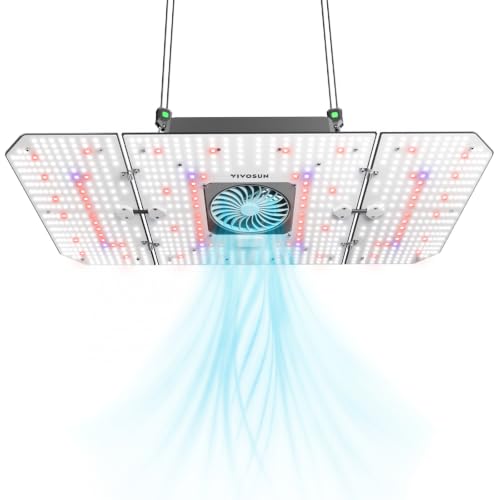
VIVOSUN AeroLight 240W LED Grow Light with Fan
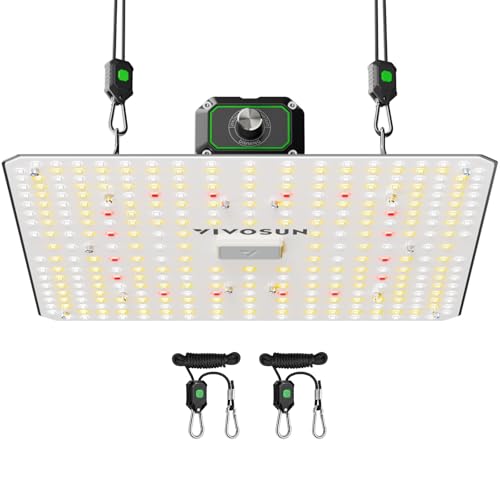
VIVOSUN LumaLight 100W LED Grow Light Full Spectrum

Spider Farmer SF1000 LED Grow Light for 2×2/3×3 Tents

VIVOSUN LumaLight 320W LED Grow Light Full Spectrum

VIPARSPECTRA 70W Dimmable LED Grow Light
Inside Each Recommended Option
Small tent growers chasing uniform canopy coverage should pay close attention to the VIPARSPECTRA 150W. Its optical lens design (curved lenses that focus and aim each diode) concentrates output with minimal scatter, which means a 2×2 footprint receives PPFD (photosynthetic photon flux density, the measure of usable light reaching the plant) more evenly across the corners rather than pooling brightness in the center. For anyone raising seedlings or running tight vegetative cycles in a small enclosed space, that even spread usually translates to more consistent growth and fewer stretched seedlings reaching toward a hot spot.
For the home gardener running leafy greens, herbs, or compact flower cycles, the full spectrum output supports plants from start to finish. In my view, this is the kind of light that disappears into your routine. Set the height, dial in the dimmer, and let the canopy do its thing.
The Practical Payoff
- Optical lenses aim light downward, which typically means less wasted spill on tent walls.
- Full spectrum output supports germination through flowering in the same fixture.
- Daisy-chain compatibility (linking multiple units to one controller) lets growers expand to a larger footprint later by adding identical units.
- Coverage uniformity in tight corners is the headline benefit for 2×2 tents.
Things To Consider
- Owners commonly report that the dimmer knob sits close to the housing, so cable management around the fixture takes a little planning.
- At 150W it runs warm, so ventilation in a sealed tent should be planned in advance.
Who It Suits Best
Intermediate growers running a sealed 2×2 tent who care about corner-to-corner canopy uniformity.
Where Another Pick Suits Better
For a quieter, more decorative setup in a living space, the OTeedo 3x35W Black rail style often blends into a room better.
This OTeedo rail takes a different approach than the enclosed tent fixtures on this list. Instead of a purple-tinged panel that screams “lab equipment,” it ships as a 39-inch black track with three rotatable 35W heads, each offering a switchable 3CCT (correlated color temperature, meaning three white color choices: 3000K warm, 4000K neutral, 5000K daylight). The visual language is closer to a designer track light than a horticultural panel, which is the whole point for renters and apartment dwellers.
Worth noting though: this is a 105W total fixture with three independently aimed lamps. For someone with a shelf of pothos, a fiddle-leaf fig, or a row of potted herbs near a window that doesn’t quite cut it, that targeting flexibility is genuinely useful. Compare that to the VIPARSPECTRA 150W above, which floods the entire tent at once. The OTeedo focuses on individual plants.
Practical Pluses
- Three switchable color temperatures on each head mean you can tune warmth to the room.
- Aimable heads let you spotlight a tall plant and a short seedling on the same rail.
- Clean white light output keeps the room livable rather than glowing purple at night.
Trade Offs
- Total output is lower than dedicated 2×2 panel lights, so dense flowering tents are not the right fit.
- The track format is fixed-length; repositioning between shelves requires mounting work.
Made For
Apartment growers who want a presentable plant light that doubles as room decor.
Swap It Out When
For a higher-output full-cycle flowering setup, the VIVOSUN AeroLight 240W is the more capable choice.
The white-finish sibling to the black OTeedo above is functionally identical, down to the three 35W aimable heads and the same 3CCT switch on each lamp. Where it diverges is the aesthetic: in a white-walled kitchen or a Scandinavian-style living room, the white housing reads as a piece of hardware you’d actually want visible. For most minimalist interiors, the difference between a black bar and a white bar is the difference between “blends in” and “stands out.”
You may find the white finish shows dust and water spots more readily than the black version, which is a small but real ownership factor when watering living plants indoors.
Features That Help
- Same switchable 3000K / 4000K / 5000K options as the black version, with three independent heads.
- White housing looks intentional against light walls and ceilings.
- Track format means one ceiling box powers all three heads.
Minor Gripes
- Total wattage is lower than panel lights; not built for heavy flowering loads.
- White finish tends to show mineral spots from hard-water misting over time.
The Right Fit
Design-conscious growers in bright, neutral-toned rooms who treat plant lights as part of the interior.
Reach For A Different Pick When
For a dedicated flowering tent, the Spider Farmer SF1000 puts out more usable light per square foot.
This 4x35W, two-rail configuration is essentially the wider, higher-output version of the OTeedo family. Two parallel rails give four independently aimable heads, with the same 3CCT switch per lamp, totaling 140W. For anyone with a longer shelf, a narrow plant wall, or a small room garden, the spread of light across a 2×4-ish area is markedly better than the single-rail version covered above.
Same story with the spectrum: clean white light rather than horticultural purple. Plants still get the wavelengths they need, but the room stays livable. Worth considering for living spaces where the grow area doubles as the relaxation zone.
Everyday Advantages
- Four aimable heads cover a wider, longer footprint than the 3-head version.
- Switchable color temperatures let you adjust warmth per head.
- Higher total output (140W) suits more demanding foliage than the 3x35W model.
Points To Note
- Two-rail installation is more involved than a single track and may not suit every ceiling box configuration.
- Still a lower-output system than dedicated flowering panels.
Best Suited To
Plant-wall collectors and longer-shelf indoor gardeners who want white-light coverage across a wider span.
Look Elsewhere When
For an actual 2×2 flowering tent, the VIVOSUN LumaLight 320W delivers much higher output per square foot.
The white-finish counterpart to the 4x35W two-rail black model brings the same 140W total output across four aimable heads, just in a softer visual package. For shared spaces where two people share a kitchen, a den, or a converted loft, the white finish tends to recede rather than dominate. It’s a small detail, but in a room where the grow light is on display, that visual integration matters.
Compared to the 3x35W White above, you’re gaining one extra head and a second rail for wider coverage. For most open-plan homes, that’s the right scale jump when the single rail feels too narrow.
A Favorable Mix
- Four switchable heads with 3CCT control per lamp.
- White housing blends with light walls and ceiling moldings.
- Wider coverage suits plant walls and longer shelving runs.
Honest Caveats
- Total output is moderate; this is foliage and herb territory, not heavy bloom cycles.
- Two-rail mounting may require an electrician for a clean install in older homes.
Whose Shelf It Belongs On
Shared-space households where plant lighting needs to coexist with everyday living and decor.
A Better Fit Elsewhere
For a sealed flowering tent where intensity matters more than aesthetics, the Spider Farmer SF1000 is the better tool.
The AeroLight 240W stands apart from every other option in this roundup because of one unusual feature: a built-in circulation fan in the center of the panel. In a sealed 2×2 tent, stagnant air pockets around the canopy are a real problem, and they encourage mold, slow transpiration, and weak stems. The integrated fan pushes air downward and outward, breaking up those pockets.
Beyond the airflow, this is a full-spectrum 240W panel designed for full-cycle use. Same story with the lighting profile: it’s tuned for both vegetative growth and flowering. For growers who already have a fan in their tent, the integrated fan is redundant. For everyone else, it’s a smart consolidation.
Standout Benefits
- Built-in fan reduces stagnant zones in sealed tents.
- Full-cycle spectrum handles veg and flower without swapping fixtures.
- 240W output provides strong PPFD for flowering in a 2×2 footprint.
Room For Improvement
- Adds audible fan noise, so it’s not ideal for bedroom-adjacent spaces.
- Higher power draw means tent ventilation and ducting should be planned accordingly.
Key Specs
Who Will Love This
Intermediate to advanced growers running sealed 2×2 tents who want airflow and light in one fixture.
Not Your Match When
For a quiet bedroom closet garden, the VIVOSUN LumaLight 100W is a calmer choice.
The LumaLight 100W is the entry-level VIVOSUN panel in this list, and it leans hard into simplicity. There’s no fan, no daisy-chain, no app; just a 100W full-spectrum panel with a balanced mix of white, blue, red, and far-red diodes (3000K, 5000K, 660nm, 730nm, the specific color wavelengths each diode emits). For first-time growers starting herbs, leafy greens, or a small flower run, that simplicity is the actual feature.
The honest read is that 100W is on the lighter side for dense flowering in a 2×2 tent, but it handles vegetative and early-flower stages well. Beginners usually aren’t pushing maximum intensity anyway, so the trade-off works out.
A Few Strong Suits
- No fan means silent operation for bedrooms and offices.
- Simple panel design is approachable for first-time growers.
- Far-red inclusion supports the flowering transition in some species.
Trade-Offs To Consider
- Lower total output caps heavy bloom performance compared to the 240W or 320W options below.
- Smaller thermal mass means the panel runs warmer at full power.
Perfect Match For
First-time growers starting a small herb or greens garden who value quiet, simple operation.
Skip It When
For aggressive bloom runs with high light demands, the VIVOSUN LumaLight 320W is the better stage.
The Spider Farmer SF1000 is one of those fixtures that has earned a long track record in the small-tent community. It’s specifically marketed for 2×2 and 3×3 grow tents, with a diode layout that aims to spread uniform PPFD across the footprint. The fanless, silent design uses a passive heatsink (a finned metal body that sheds heat without a fan) for cooling, which keeps noise down and removes a moving part that can fail.
For growers running full-cycle plants in a small tent, this is a reliable workhorse. Compare that to the VIPARSPECTRA 150W above: similar form factor, similar coverage goals, similar full-spectrum approach. The difference is in diode selection and lens design, and which one matches your tent depends on personal preference and existing equipment.
What It Does Well
- Silent fanless operation is ideal for bedroom closets or quiet homes.
- Diode layout aims light evenly across 2×2 and 3×3 footprints.
- Long-running track record in small-tent growing communities.
- Full-spectrum coverage supports veg through flower without swapping lights.
Where It May Fall Short
- Passive cooling means the body runs warm, so spacing from the canopy matters.
- Output may feel modest compared to the 240W and 320W panels below.
Feature Snapshot
Who Should Grab It
Full-cycle growers in 2×2 or 3×3 tents who want quiet, reliable operation.
Consider Something Else When
For a larger canopy or higher intensity needs, the VIVOSUN LumaLight 320W is the bigger stage.
The LumaLight 320W is the highest-output panel in this roundup, built around a light-bar matrix rather than a single dense board. That bar layout, combined with micro-lens optics (tiny lenses over each diode that shape and direct the beam), aims to push high uniformity across the entire canopy. For a grower pushing dense flowering cycles in a 2×2, that bar-matrix uniformity usually means fewer hot spots and more even bud development from edge to edge.
Worth noting though: 320W is a serious power draw for a small footprint. Depending on your electrical setup, you may want to confirm circuit capacity before running this alongside other equipment. In a typical 15-amp home circuit, this is usually fine on its own but can compete with heaters or window AC units.
What Earns Its Place
- Bar-matrix design spreads light more evenly than dense board layouts.
- Micro-lens optics aim each diode for deeper canopy penetration.
- 320W delivers high PPFD for aggressive flowering runs in small tents.
Some Limits To Know
- Higher power draw increases heat output, so ventilation becomes essential.
- Overkill for herb and foliage gardens that don’t demand intense light.
Built With In Mind
Experienced growers chasing maximum yield and uniform flower development in a 2×2 tent.
Where A Sibling Pick Shines
For a quieter, lower-heat operation, the Spider Farmer SF1000 is a more manageable option at lower intensity.
This 70W VIPARSPECTRA rounds out the list as a smaller, dimmable option aimed at seedlings, vegetative growth, and modest herb gardens. The diode layout balances 660nm red with 3000K and 5000K white, a combination commonly used for early-stage growth. For most growers starting seeds on a shelf or running a small herb garden, 70W covers the brief without overdriving the plants.
Compared to the 150W VIPARSPECTRA at the top of this list, this is the lower-wattage sibling. You trade canopy-penetrating power for a smaller electrical footprint and a tighter budget. In my view, that’s a fair exchange for the right use case.
What Helps Most
- Built-in dimmer allows output adjustment for seedlings versus mature plants.
- Compact size fits smaller shelves and tight grow spaces.
- Lower wattage keeps energy draw modest for continuous daily cycles.
Things To Weigh
- 70W is light for flowering-stage intensity in a 2×2 tent.
- Smaller thermal body means closer hanging distance is usually necessary.
Who Should Grab It
Shelf growers and beginners raising seedlings or running a small herb garden.
Reach For A Different Pick When
For full flowering in a 2×2, the VIVOSUN AeroLight 240W has the wattage headroom to push heavy blooms.
What Matters Most Before Choosing 2×2 Grow Lights
Matching Wattage To Your Footprint
For a true 2×2 grow space, total wattage is one of the strongest signals of capability. Light-hungry plants during flowering usually want around 30 to 50 watts per square foot of canopy, which lands a 2×2 tent in the 120W to 200W range as a comfortable starting point. Anything below that range is fine for seedlings, herbs, and leafy greens. Anything well above that range gives experienced growers headroom for heavy bloom cycles.
Spectrum and Color Temperature
Full-spectrum panels in the 3000K to 5000K range, often supplemented with 660nm red, cover the wavelengths most plants use across vegetative and flowering stages. The OTeedo track lights on this list lean on switchable 3CCT (3000K warm, 4000K neutral, 5000K daylight) white light, which keeps living spaces livable while still feeding plants useful wavelengths. The catch is that dedicated flowering panels usually push more red than a living-room-friendly fixture will.
Form Factor and Living Space Fit
The biggest decision most indoor growers face isn’t really about diode specs. It’s whether the fixture will live in a tent or in a visible room. Tent fixtures prioritize intensity and spectrum. Track-style fixtures prioritize visual integration. Both grow plants well, but they suit different setups.
Cooling, Noise, and Heat
Fan-cooled panels move heat out efficiently but add noise. Fanless panels are silent but run warmer and need more clearance from the canopy. Integrated-fan panels like the AeroLight 240W try to thread both needles by combining lighting with circulation, though the fan itself adds some sound.
Key Considerations Across These Picks
Common Shopping Slip Ups
The most common mistake I see is buying a panel sized for a 3×3 tent and squeezing it into a 2×2, or vice versa. A fixture that’s too small leaves dim corners that stretch plants toward the brighter center. A fixture that’s too large wastes light on tent walls and creates unnecessary heat. Match the recommended footprint in the source data to your actual space.
What Separates Premium From Basic
Higher-tier panels in this category usually invest in better diode selection, lens or optic systems that aim light more precisely, and passive cooling that extends diode life. The trade-off is mostly visible in canopy uniformity and long-term reliability. For a beginner running a few herbs, basic is genuinely fine. For someone pushing heavy bloom cycles, premium optics and diode quality usually pay back through more consistent yields over multiple harvests.
Frequently Asked Questions
How many watts do I need for a 2×2 grow space?
For seedlings and leafy greens, 70W to 100W is usually plenty. For flowering plants, most growers target 150W to 250W in a 2×2 footprint to reach useful PPFD levels across the canopy.
Can I use a regular LED panel as a grow light?
Standard household LEDs lack the red and far-red wavelengths most plants use during flowering. A dedicated full-spectrum grow light covers those wavelengths more reliably and is the safer choice for anything beyond low-light houseplants.
How far should a grow light hang above the plants?
Most panels on this list work well at 12 to 24 inches above the canopy during vegetative growth, with the light lowered during flowering if the plants tolerate it. Watch for leaf bleaching or curling, which signals the light is too close.
Do grow lights use a lot of electricity?
A 100W panel running 16 hours a day draws about 1.6 kWh (kilowatt-hours) daily, which lands in a modest range on most home electricity bills. Higher-wattage panels scale accordingly. LED efficiency on this list is generally strong across the board.
Should I choose a fan-cooled or fanless grow light?
Fan-cooled panels handle heat better and tolerate tighter hanging distances. Fanless panels are silent, which matters for bedroom-adjacent setups, but need more clearance and ventilation. The right answer depends on where your tent or shelf lives.
Closing Remarks
The right 2×2 grow lights come down to matching your space, your plant stage, and your tolerance for noise and heat. Tent growers chasing full-cycle harvests usually land on the VIPARSPECTRA 150W, the AeroLight 240W, or the Spider Farmer SF1000. Living-room gardeners tend to favor the OTeedo track fixtures for their clean white light. Whatever the choice, a small footprint rewards consistency more than raw power, so set a sensible schedule, watch the plants, and adjust from there.