

Choosing the right office bulb in 2026 is less about wattage than what a workspace actually needs. The best options now balance bright output, clean color, and low energy use, while avoiding glare and fatigue during long days. From compact A19 packs to high-lumen A21 models, the differences can be subtle but important. The real question is which bulbs hold up best once they are installed.



More Details on Our Top Picks
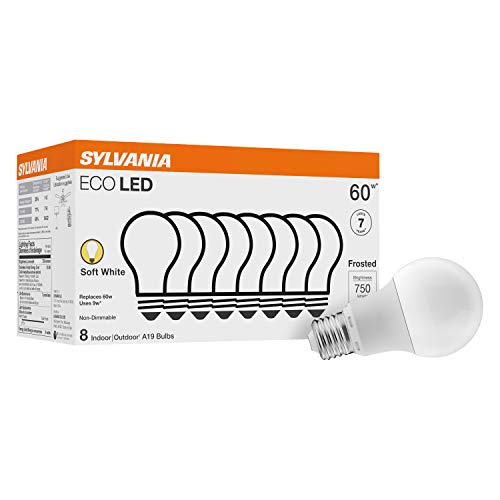
Sylvania ECO LED Light Bulb 8-Pack (40821)
If you want a simple, budget-friendly lighting upgrade for your office, the Sylvania ECO LED Light Bulb 8-Pack (40821) is a strong pick. You get A19 bulbs that replace 60W incandescents while using just 9W each, so you can cut energy use without changing your space’s feel. The 2700K soft white glow and 750 lumens create comfortable light, and the frosted finish helps soften glare. With an 80 CRI, colors still look natural. It’s non-dimmable, but its low $1.08 yearly energy cost and seven-year lifespan make upkeep easy.
- Bulb Type:A19 LED
- Base Type:E26 base
- Wattage:9W
- Brightness:750 lumens
- Color Temp:2700K soft white
- Dimmable:Non-dimmable
- Additional Feature:60W incandescent equivalent
- Additional Feature:750 lumens output
- Additional Feature:7-year lifespan
evelor A19 LED Light Bulbs 100W Equivalent Daylight
For offices, workspaces, and study rooms that need bright, daylight-like illumination, the evelor A19 LED Light Bulbs stand out as a practical pick. You get 1,500 lumens of 5000K white light, which helps you stay alert and see details clearly. Each 13W bulb replaces a 100W incandescent, so you can cut energy use by up to 90%. The non-flicker, instant-on output supports steady work, and the 80+ CRI keeps colors looking accurate. With a 15,000-hour life and six bulbs per pack, you won’t replace them often.
- Bulb Type:A19 LED
- Base Type:E26 base
- Wattage:13W
- Brightness:1500 lumens
- Color Temp:5000K daylight
- Dimmable:Non-dimmable
- Additional Feature:1500 lumens output
- Additional Feature:15,000+ hour life
- Additional Feature:ETL certified
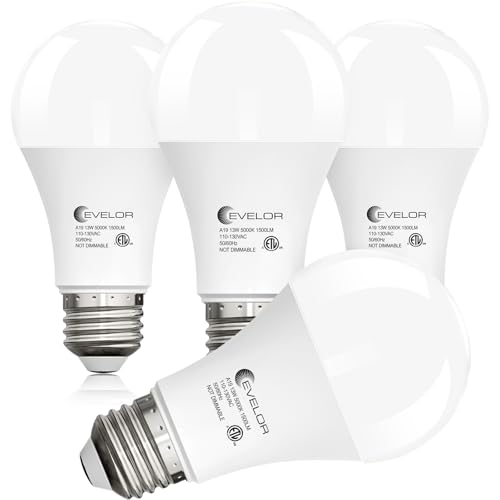
evelor A19 LED Light Bulbs 100W Equivalent 4-Pack
The evelor A19 LED Light Bulbs are a smart pick for offices and workspaces that need bright, steady light without high energy costs. You get 1500 lumens of 5000K daylight white light, so your desk stays clear and colors look accurate with CRI 85+. Each bulb uses just 13W to replace a 100W incandescent, cutting energy use by up to 90%. The non-flicker design helps reduce eye strain, and the standard E26 base makes installation easy. With 15,000+ hours of life, you won’t replace them often. The 4-pack suits offices, garages, and other indoor or commercial spaces.
- Bulb Type:A19 LED
- Base Type:E26 base
- Wattage:13W
- Brightness:1500 lumens
- Color Temp:5000K daylight
- Dimmable:Non-dimmable
- Additional Feature:CRI 85+ color accuracy
- Additional Feature:Non-flicker LED beads
- Additional Feature:E26 screw base
12 Pack LED Light Bulbs 100W Equivalent Daylight
A 12-pack of 100W equivalent daylight LED bulbs is a smart pick when you need bright, reliable office lighting at scale. You get 1,500 lumens per bulb, a crisp 5,000K daylight tone, and a 280° beam that helps desks, meeting rooms, and hallways feel clear and focused. Each A19 bulb uses just 15 watts, fits standard E26 sockets, and turns on instantly without flicker or buzz. With 15,000+ hours of life, lower heat, and up to 90% energy savings, you’ll cut costs while keeping your workspace consistently bright and professional.
- Bulb Type:A19 LED
- Base Type:E26 base
- Wattage:15W
- Brightness:1500 lumens
- Color Temp:5000K daylight
- Dimmable:Non-dimmable
- Additional Feature:280° beam angle
- Additional Feature:UL specification met
- Additional Feature:1-year warranty
TJOY 100W Equivalent A19 Daylight LED Bulbs (6-Pack)
TJOY’s A19 6-pack stands out if you want a bright, daylight-style office bulb that helps you stay focused without fuss. You get 1,500 lumens per bulb, a 5,000K daylight tone, and a 100W equivalent output while using just 15 watts. The non-dimmable bulbs turn on instantly, stay flicker-free, and deliver 85+ CRI for accurate color. You can use them in E26 fixtures across desks, lamps, and shared workspaces. With 15,000+ hours of life, UL, RoHS, and FCC listings, plus a 5-year after-sales service, they’re a practical, efficient pick.
- Bulb Type:A19 LED
- Base Type:E26 base
- Wattage:15W
- Brightness:1500 lumens
- Color Temp:5000K daylight
- Dimmable:Non-dimmable
- Additional Feature:UL listed
- Additional Feature:RoHS compliant
- Additional Feature:5-year after-sales support
BUBO A19 LED Light Bulbs 24 Pack
If you’re outfitting a home office, classroom, or any workspace that needs dependable everyday lighting, the BUBO A19 LED Light Bulbs, 24 Pack is a practical pick. Each A19 bulb uses just 8 watts to deliver 800 lumens, matching a 60W incandescent while fitting standard E26 fixtures. You can choose from 2700K to 5000K, including a balanced 3500K option. With CRI 80+ and steady, buzz-free, non-flickering light, they help reduce eye strain. You also get up to 15,000 hours of life, but they aren’t dimmable or sold in California.
- Bulb Type:A19 LED
- Base Type:E26 base
- Wattage:8W
- Brightness:800 lumens
- Color Temp:2700K-5000K options
- Dimmable:Non-dimmable
- Additional Feature:24-pack value bundle
- Additional Feature:5 color temperatures
- Additional Feature:California sale restriction
23W A21 LED Bulb 2500 Lumens 5000K Daylight
With 2500 lumens and a crisp 5000K daylight output, this W A21 LED bulb is a strong pick for offices that need bright, clear visibility without wasting energy. You get the punch of a 150–200W incandescent or halogen bulb while using just 23W, which can cut energy use by about 88%. Its 270° beam helps reduce shadows, and it turns on instantly with no warm-up. You’ll also avoid buzzing, flicker, lead, mercury, and UV. Just use it in an E26 socket, and don’t pair it with a dimmer switch.
- Bulb Type:A21 LED
- Base Type:E26 base
- Wattage:23W
- Brightness:2500 lumens
- Color Temp:5000K daylight
- Dimmable:Non-dimmable
- Additional Feature:2500 lumens output
- Additional Feature:270° beam angle
- Additional Feature:RoHS compliant
Factors to Consider When Choosing Light Bulbs For Office
When choosing office light bulbs, brightness levels, color temperature, and energy efficiency are primary factors that shape comfort and productivity. Flicker-free lighting also matters because it can reduce eye strain during long work hours. Color accuracy is equally important, especially in offices where visual tasks demand true-to-life rendering.
Brightness Levels
Brightness levels should be chosen by matching the office task to the required illuminance in lux, since general work areas usually need about 300–500 lux while detailed drafting or inspection zones may need 500–1,000 lux. Bulb selection should then be based on lumens, not watts, because lumen output indicates actual light delivered. For open-plan offices, total fixture output of roughly 3,000–6,000 lumens per 10 m² is often appropriate, depending on task demand. Large rooms and high ceilings benefit from higher-output bulbs, around 1,500–2,500 lumens, to reduce fixture count and keep lighting even. Desk lamps can remain in the 400–800 lumen range for focused work. Beam angle and layout also affect brightness distribution, while long-rated LEDs with low depreciation help preserve usable light over time.
Color Temperature
For office lighting, color temperature should usually fall between 4000K and 5000K, since this cool-white to daylight range supports alertness, contrast, and task performance. Within that band, 4000K often feels balanced for general workspaces, while 5000K can enhance perceived brightness and visual clarity for detailed tasks. Warmer options around 2700K to 3000K create a softer, more relaxing atmosphere, but they can reduce alertness and are less appropriate for sustained concentration. Consistency also matters: fixtures should match within a few hundred Kelvin to avoid distracting color shifts and discomfort. CCT should be considered alongside CRI, ideally 80 to 85 or higher, so colors remain accurate and the lighting stays comfortable for office use.
Energy Efficiency
Energy efficiency should be a primary filter when selecting office light bulbs, with high-efficacy LEDs offering the best balance of performance and operating cost. Office buyers should target at least 100 lumens per watt so task areas receive adequate light without unnecessary power draw. Color temperatures around 4000–5000K typically preserve strong efficacy while supporting a focused workplace atmosphere. Longer rated lifespans, ideally 10,000 to 25,000 hours or more, reduce replacement cycles, maintenance labor, and manufacturing-related energy costs. High CRI bulbs should be reserved for color-sensitive work because improved accuracy can come with a small efficiency tradeoff. Compatibility with occupancy sensors, daylight harvesting, and dimming controls can further lower consumption by trimming runtime and output when full brightness is not needed.
Flicker-Free Lighting
Beyond efficiency and output, office buyers should also evaluate flicker-free performance, since unstable light can undermine comfort even in otherwise high-quality LED bulbs. LEDs labeled flicker-free, or those with flicker below about 10%, are preferable because steadier emission reduces eye strain, headaches, and fatigue. Datasheets should be checked for flicker percent and flicker index; lower numbers generally indicate smoother output. Bulbs using high-frequency electronic drivers, especially above 1 kHz, or constant-current designs, are typically better than low-frequency systems. Fixtures with regulated power supplies and solid thermal management can maintain stability as components age, since heat and driver stress may worsen flicker over time. In spaces with sensitive users, candidate lamps should be examined under normal dimming and mains conditions, because some drivers flicker only when adjusted.
Color Accuracy
Color accuracy is a key office lighting factor because it affects how naturally colors appear and how easily details can be distinguished. A CRI of at least 80 suits general office work, while 90+ is preferable for color-critical tasks where printed materials, screens, and signage must look true. Color temperature also matters: around 3500K can create a warmer, calmer feel, while 4000K to 5000K usually improves contrast and visual clarity for detail-oriented work. Keeping CRI and color temperature consistent across fixtures, ideally within a few hundred kelvins, helps prevent distracting shifts when moving through the office. Accurate lighting can also reduce eye strain and mistakes. Manufacturer ratings should be verified, and in-situ samples are wise because published CRI does not always match real-world perception.
Base Compatibility
Before any office bulb is selected, the fixture’s base must be matched exactly, whether it is an E26, E27, GU10, G24, or another standard. The socket type should be confirmed first so the replacement fits the lamp or ceiling fixture without force. Retrofit work also requires checking whether the fitting accepts screw bases, bayonet, bi-pin, or twist-lock designs. Even with the correct base, physical clearance matters; some LED bulbs have larger housings or heat sinks that conflict with recessed cans or enclosed fixtures. Fixtures with integrated ballasts or electronic drivers may need compatible LED replacements, ballast bypasses, or driver changes. In pendant systems with multiple sockets, one base type should be standardized, and lamp holders must match the bulb’s voltage and wattage.
Lifespan Expectancy
Lifespan expectancy is a key office lighting metric, with rated life in hours offering a practical way to compare bulbs and plan replacements. A bulb rated at 15,000 hours will generally outlast one rated at 8,000 hours, but the figure should be translated into years using the office’s daily runtime. At three hours a day, 15,000 hours lasts about 13.7 years; at twelve hours a day, about 3.4 years. Longer-life options can lower maintenance frequency, reduce disruption, and improve total lifecycle cost even when purchase prices are higher. Buyers should also review L70 or L80 data, which shows how long usable brightness remains acceptable. Frequent switching and high heat can shorten real-world LED life versus ideal conditions.
Dimmability Needs
Dimmability should be assessed based on how often an office needs to shift from full illumination to lower levels for presentations, video calls, or focused work, since non-dimmable bulbs cannot adapt without replacement. Workspaces with variable tasks benefit from dimmable bulbs paired with LED-compatible dimmers rated for the specific lamp type. This helps prevent flicker, buzzing, and shortened service life. The dimming range should be checked to make certain both low-end and high-end output remain useful, while color rendering and color temperature stay stable across the curve for comfort and accuracy. In open-plan layouts, zoning controls for perimeter and task areas allow local adjustment without disrupting ambient light. Fixtures, drivers, and controls should also match electrical standards and expected duty cycles to reduce overheating and premature failure.
Frequently Asked Questions
Are Smart Bulbs Worth Using in Office Environments?
Yes, smart bulbs can be a good fit for offices. Research suggests lighting can affect productivity by as much as 20 percent. Features like scheduling, dimming, and energy savings can be useful, but higher upfront costs and compatibility issues may reduce their value.
Which Bulb Color Temperature Reduces Eye Strain Best?
Neutral white light, around 4000K to 5000K, often works best for reducing eye strain because it offers a good mix of brightness and comfort. Very cool or very warm light can increase fatigue, create glare, or make details harder to see during long periods.
Do Office Light Bulbs Affect Employee Productivity?
Office light bulbs can shape employee productivity in practical ways. Brightness and color temperature affect alertness and concentration, while weak or harsh lighting can lead to eye strain, fatigue, and lower performance.
How Often Should Office LED Bulbs Be Replaced?
Office LED bulbs usually last 5 to 10 years. Replace them sooner if they start to dim, flicker, or change color. Lifespan depends on how often they are used, how much heat they are exposed to, and the quality of the fixture.
Are Dimmable Bulbs Useful in Shared Office Spaces?
Yes. Dimmable bulbs help shared offices handle different tasks and preferences by lowering brightness for presentations, reducing glare during screen work, and making it easier to adjust the room without replacing fixtures.